Home » Divorce and Family law Blog » Choosing a High Net Worth Divorce Mediator in California: 5 Red Flags


Reach out to find the best solution for your divorce with trusted professionals.
Although both are called “divorce mediators,” they have very different roles. A high-net-worth divorce mediator is working with clients who have significant financial interests (including businesses), complex investments, privacy, tax, trust, and other financial considerations at each step of the mediation process.
High-net-worth divorce mediations do not just resolve conflicts; they also need to assist in structuring financially sound, tax-sensitive, and private resolutions to preserve value while addressing unique property/valuation issues associated with large marital estates.
Do you have any questions for our top-rated California HNWD mediators? We would be delighted to assist you during a confidential consultation.
Whether you wish to ask a specific question or simply assess whether we are the right fit for your case, please feel free to reach out. We look forward to speaking with you.
The following are the differences explained between a high net worth divorce mediator and a normal family law mediator.
|
Area
|
High-Net-Worth Divorce Mediator
|
Normal Divorce Mediator
|
||||||
|---|---|---|---|---|---|---|---|---|
|
Scope of assets
|
Businesses, trusts, global real estate, illiquid holdings, offshore assets, etc.
|
Home, vehicles, bank accounts, other easily valued assets, etc.
|
||||||
|
Property characterization
|
Handles commingling, tracing, business apportionment, etc.
|
Straightforward classification
|
||||||
|
Expertise
|
Strong understanding of valuation, taxation, financial statements, etc.
|
General family law and mediation knowledge
|
||||||
|
Team involvement
|
Coordinates with forensic accountants, valuation experts, CPAs, etc.
|
Work independently with limited involvement
|
||||||
|
Privacy concerns
|
Protects confidential information for executives, entrepreneurs, etc.
|
Standard mediation confidentiality is generally sufficient
|
||||||
|
Hidden asset risk
|
Greater emphasis on forensic tracing and complex financial disclosure
|
Lower likelihood of concealed assets
|
||||||
|
Settlement design
|
Creates tax-efficient, long-term settlement structures
|
Focuses on equitable division of readily distributable assets
|
||||||
|
Conflict level
|
Manages high financial stakes and sophisticated negotiations
|
Handles lower-value disputes with fewer financial complexities
|
||||||
|
Process
|
Multiple mediation sessions, extensive document review, expert participation
|
Shorter, simpler, and less expensive process
|
A high net worth couple in mediation will typically deal with a wide range of assets, including a private business, trust(s), equity (stock) in private companies, stock option plans, VC funds, domestic & international real property holdings, partnership interest(s), art/collectible items, and other illiquid investment opportunities that require expertise to evaluate.
The typical divorce mediation model is geared toward valuing and dividing ownership of the home, cars, bank accounts, and retirement plans.
As you add additional property types or move outside the traditional categories, your mediation process will become much more complex.
The process of identifying (characterizing) individual assets in a divorce is much more difficult for wealthier couples who have owned an asset for many years, as they continually reinvest in it and combine funds from both parties.
In California, determining whether an asset belongs to each spouse separately will likely involve applying tracing methods, along with either the Pereira or Van Camp factors, to determine which spouse’s income will benefit from a business’s growth.
The exact date on which spouses “separate” can also greatly influence the division of tens of millions of dollars in marital assets.
A high net worth divorce mediator must understand financial statements as comfortably as legal issues. Often, reading balance sheets, capitalization tables, Schedule K-1s, trust instruments, executive compensation packages & valuation reports is needed to negotiate productively.
Understanding of taxation & business valuations allows the mediator to recognize settlement risks before agreements are finalized.
In contrast, traditional divorce mediators rely primarily on family law principles & conflict resolution skills with much less emphasis on advanced financial analysis. Learn more about how much divorce mediation costs in California.
High-net-worth divorces often do not involve a single mediator. In fact, most high-net-worth mediators have a team of experts that includes forensic accountants, business valuators, tax planners, estate lawyers, pension experts, and other neutral third-party experts to ensure all financial aspects are correct.
They organize the input from these experts to keep the negotiation productive. Unlike standard divorces, which require very few additional professionals due to the ease of valuing and dividing assets and can be completed without much external support or specialized financial knowledge. Learn more about whether I need a lawyer for divorce mediation.
Privacy is a priority for many couples going through a high-net-worth divorce. The business owner, executive, physician, entertainer, etc., usually seeks to limit public access to their financial information and sensitive business documents.
Therefore, during this potentially high-net-worth divorce, a high-net-worth divorce mediator will emphasize private negotiation, secure document management, and discreet communication.
Confidentiality can be very important to each party in all mediations; however, it may not carry the same reputational or commercial risk as large sums of money in standard divorce mediation.
When substantial wealth exists, there are many more ways to hide money, including using layers of asset owners, an offshore account, a closely held business, deferred payment of compensation, or extremely sophisticated investments.
A high net worth divorce mediator must be aware of when forensic accounting, tracing, or complete analysis of one’s financial information will be required before reasonable negotiation can begin.
Most standard divorces contain less complexity within their marital estates (i.e., few if any complicated layers of ownership) and present much less opportunity for concealed marital property. Learn more about high net divorce, assets, taxes and strategy.
Dividing a couple’s assets in a high-net-worth divorce requires more than just assigning equal dollar amounts.
High net worth divorces often require a mediator to help both parties reach a settlement agreement that accounts for liquidity, tax implications, future appreciation, the continuation of businesses and trusts, and long-term estate planning.
A deferred payment plan, a buyout, or a plan to make equal payments over time can protect the value of the assets by avoiding the loss that comes from selling them immediately.
As for traditional divorce mediation, asset division is more direct since most property can be transferred without significant tax planning or long-term financial considerations.
Financial complexity often increases emotional complexity. In a high-net-worth divorce, spouses may have stronger incentives to protect their businesses, investment portfolios, executive compensation plans, and family legacies, which creates sensitive negotiations.
The mediator must manage both sides’ strong personalities while also preventing the use of financial leverage or information gaps as motivators for each party’s settlement decisions.
Standard mediation does involve emotionally charged conflict between parties; however, lower financial exposure generally relieves the pressure associated with negotiating life-changing business and investment interests worth millions of dollars.
High-net-worth mediation will normally require several pre-mediation sessions prior to negotiation; multiple negotiation sessions; extensive financial disclosure; business appraisals and consulting with various experts in other areas, such as tax or accounting; and/or reviewing proposed settlements.
The above processes are obviously longer and more costly due to the increased number of procedures. However, they provide an added level of protection for high-net-worth estates, which are extremely complex.
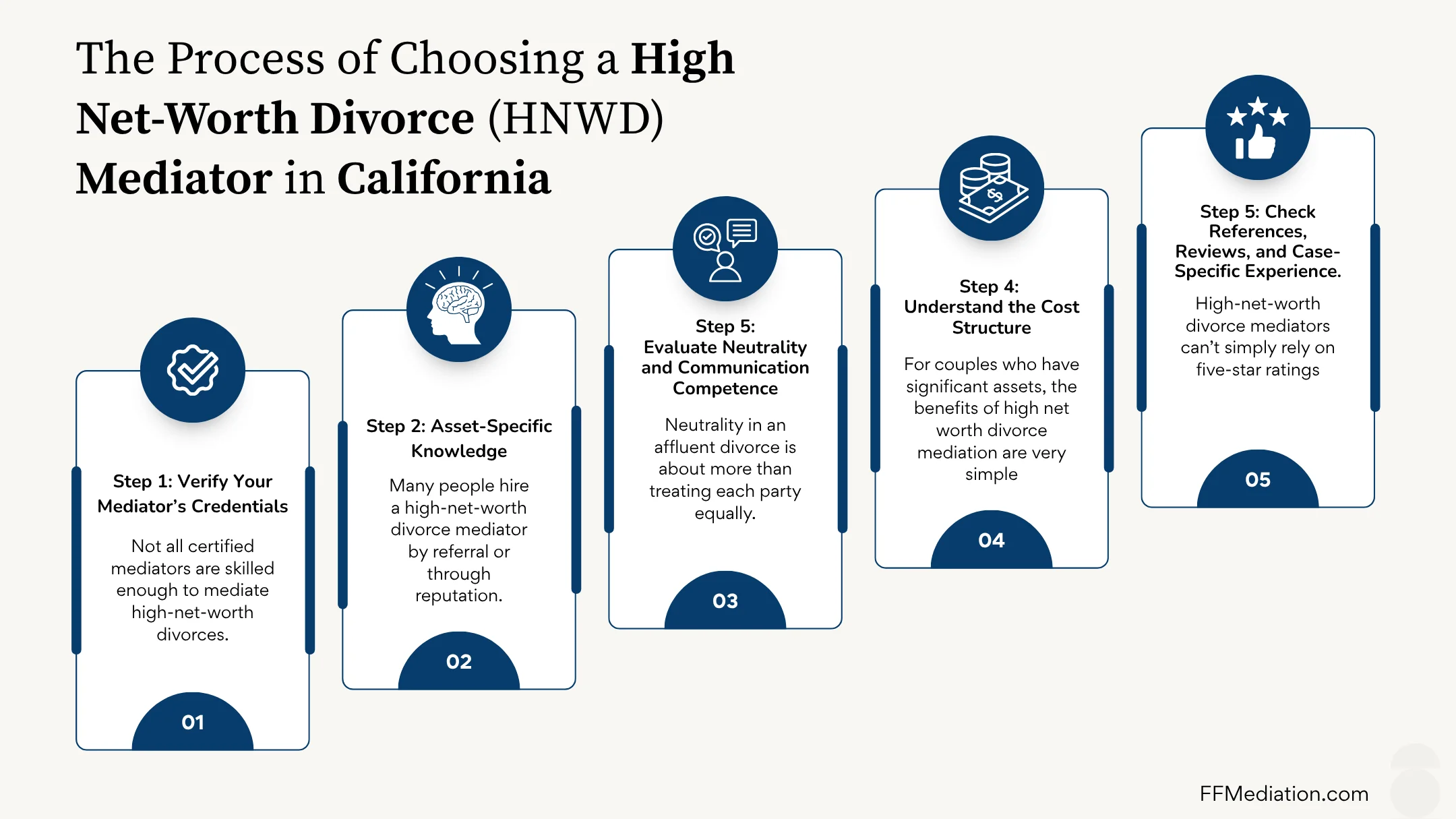
The complete and comprehensive process of choosing an asset or high net worth divorce mediation lawyer/mediator for California is explained below.
Not all certified mediators are skilled enough to mediate high-net-worth divorces. So before you choose your mediator, make sure that he/she has the proper credentials and/or experience. You need to confirm that your potential mediator has:
It makes sense to confirm this because while court-connected civil mediators must meet certain qualification requirements in California pursuant to California Rule of Court 10.781, private divorce mediators are not subject to those requirements. It is therefore up to you to determine if the mediator you intend to hire is qualified.
Your priority should be to find a mediator who has:
If you retain a non-attorney mediator, they will typically prepare a Memorandum of Understanding (MOU), which an attorney can convert into a legally enforceable Marital Settlement Agreement (MSA), and ultimately into a divorce judgment.
Lastly, verify their state bar status and inquire about the number of high-net-worth divorce cases they have previously mediated.
Many people hire a high-net-worth divorce mediator by referral or through reputation. The biggest problem with this is that it overlooks one very important test of their ability to mediate your divorce: Are they financially competent?
A successful mediator will have knowledge of California Family Law, specifically the unique assets involved in your divorce.
You can find out whether they are knowledgeable by asking them how they would handle some real-world examples of your divorce:
Monitor their response closely. If the mediator says, “We bring in experts,” ask, “Which expert? CDFA, forensic accountant, valuation professional, or DRO specialist? And in what area will they be needed?”
An experienced and reliable high-net-worth divorce mediator will confidently answer these questions without feeling pressured or insulted.
Neutrality in an affluent divorce is about more than treating each party equally. In most divorces, at least one spouse controls the finances, the record-keeping for businesses or investments, etc.
Therefore, to create a neutral environment, an effective Mediator will insist on full financial disclosure from all parties prior to meaningful negotiation. This allows for a fair process, but does not advocate for either party.
In California, the Preliminary Declaration of Disclosure cannot be waived. The preliminary declaration must be completed and signed under penalty of perjury.
It includes all tax returns for the past two years and other necessary financial information. Generally, it must also be completed before a divorce judgment can be finalized.
Ask prospective mediators questions such as:
Lastly, evaluate their communication skills. A good mediator should be able to explain business valuation results, forensic accounting findings, and issues related to Qualified Domestic Relations Orders (QDRO’s), Domestic Relations Orders (DRO’s), and other relevant financial impacts in simple English for both parties.
For couples who have significant assets, the benefits of high net worth divorce mediation are very simple: you will pay one neutral third party rather than two lawyers representing opposite sides, and your process will remain confidential.
Typically, experienced mediators who handle high-net-worth divorces in California charge an hourly rate of $400-$800. Generally, the cost of mediation in a complex case ranges from $10,000 to $25,000. However, in cases where multiple businesses and/or real estate are involved, those costs could be higher.
The overall cost of your mediation will depend on several factors, such as:
Litigation for a contested high net worth divorce can easily cost each spouse over $100,000 when including attorney fees, discovery, and expert witnesses. Forensic accountants will also charge by the hour, anywhere from $300 to $600. Business valuations can cost $5,000 to $25,000+, depending on the business’s complexity.
The most common costs associated with litigated high-net-worth divorces include: property characterization issues (Moore/Marsden, Pereira/van Camp, etc.), pension division issues involving QDROs/DROs, and contested spousal support issues.
Your quality mediator should provide you with a written engagement letter that includes their hourly rates and retainers/cancellation terms, the services included, and an estimate of how long they expect the mediation process to take.
Mediation will generally cost significantly less money than litigation and protect both parties’ privacy while reducing unnecessary conflict.
High-net-worth divorce mediators can’t simply rely on five-star ratings. While strong communication skills can lead to positive feedback, there’s no guarantee the mediator has the necessary experience in handling complex financial issues.
Look for reviews/testimonials referencing business valuations, executive compensation, Restricted Stock Units (RSUs), Stock Options, Partnership Interests, or the division of retirement assets from CalPERS, CalSTRS, etc. A Mediator may do well with standard divorces but be woefully inexperienced at mediating multi-million dollar estates.
Ask them during your consultation if they’ve ever mediated cases involving business owners, executives with equity compensation, significant retirement assets, or complex investment portfolios.
Due to the confidential nature of Mediation, they may not be allowed to name their previous Clients nor disclose specifics about prior Cases without the Client’s permission.
Still, though, an Experienced Mediator will be able to tell you what kinds of high asset disputes they commonly encounter, the Financial Issues involved, and how they usually collaborate with Valuation Experts, Certified Divorce Financial Analysts (CDFAS) & Forensic Accountants all while maintaining their Client’s Confidentiality.
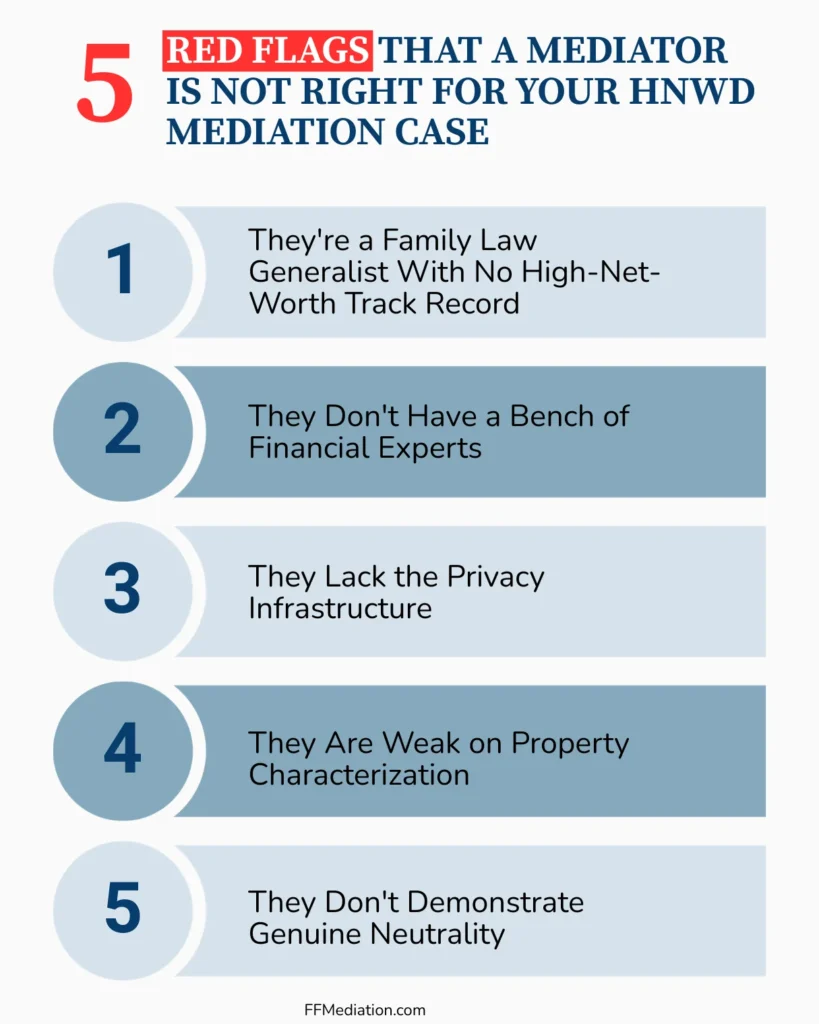
Handling hundreds of divorces doesn’t mean you have experience in mediating a High-Net-Worth Divorce.
Ask how many estates similar to yours they’ve mediated (especially those with private business ownership, equity compensation, trusts, or foreign assets).
Mediators who are used to splitting homes and 401(k)s may find it difficult to divide multimillion-dollar estates. It could be a red flag if they can’t provide examples of mediation of cases at or near your net worth.
High Net Worth Mediation requires much more than a single professional. High net worth mediation should be conducted by an experienced high net worth mediator who has built strong professional relationships with other professionals, including forensic accountants, business valuation experts, QDRO/DRO specialists, tax professionals, and Certified Divorce Financial Analysts (CDFAs).
If your mediator does not know who their “go to” experts are or insists that he/she can adequately value business and/or identify/trace commingled assets without seeking the assistance of these experts, you should be wary.
The mediator should understand at what point each expert will become involved in the process.
They should also know how to ensure that all experts reviewing financial data are reading from the same page, rather than providing conflicting analyses that may prevent the parties from negotiating.
The most common reason affluent couples choose to mediate their divorces is privacy. While Communications made in Mediation are protected by California Evidence Code Section 1119 (from being disclosed), that protection alone does not provide adequate safeguards.
A well-seasoned mediator will likely have protocols for drafting Nondisclosure Agreements where applicable, secure means of sharing documents, communicating with discretion, and protecting sensitive financial data from publicly filed documents.
If the mediator has not developed strategies to maintain confidentiality over settlement details and/or the financial aspects of your case, they are probably treating your case as if it were a run-of-the-mill divorce rather than an issue of great concern regarding reputation and potential business consequences.
In many high-net-worth divorces, one of the biggest fights is over whether an asset is community or separately owned.
An experienced mediator can help by addressing tracing, commingling bank accounts, the time of separation, and dividing business income under Pereira or Van Camp, if applicable.
Additionally, the mediator should understand how to calculate the value of separate properties (e.g., using a Moore/Marsden calculation) and how to handle retirement plans or equity compensation received during the marriage.
If none of this arises in mediation, it’s likely there are other critical issues that could make a big difference in how things ultimately settle.
Neutrality is a lot more than just being impartial. Also, ask about potential conflicts of interest. What kind of past professional relationships does the mediator have with either of you or your companies?
How will they disclose potential conflicts of interest to you before they begin mediating? Are there red flags that indicate a potential conflict of interest?
For example, are they always accepting one spouse’s number (valuation) as the number; do they never allow you to hire a third-party neutral financial expert to help evaluate the financials; or do they consistently resist co-mediation, which could provide multiple perspectives and potentially make it easier for both spouses to negotiate?
A good high-net-worth divorce mediator can protect the integrity of the mediation process by maintaining independence, providing both spouses with opportunities to receive input from multiple sources (including both parties’ experts), and creating a level playing field where each spouse feels confident in what they are negotiating.
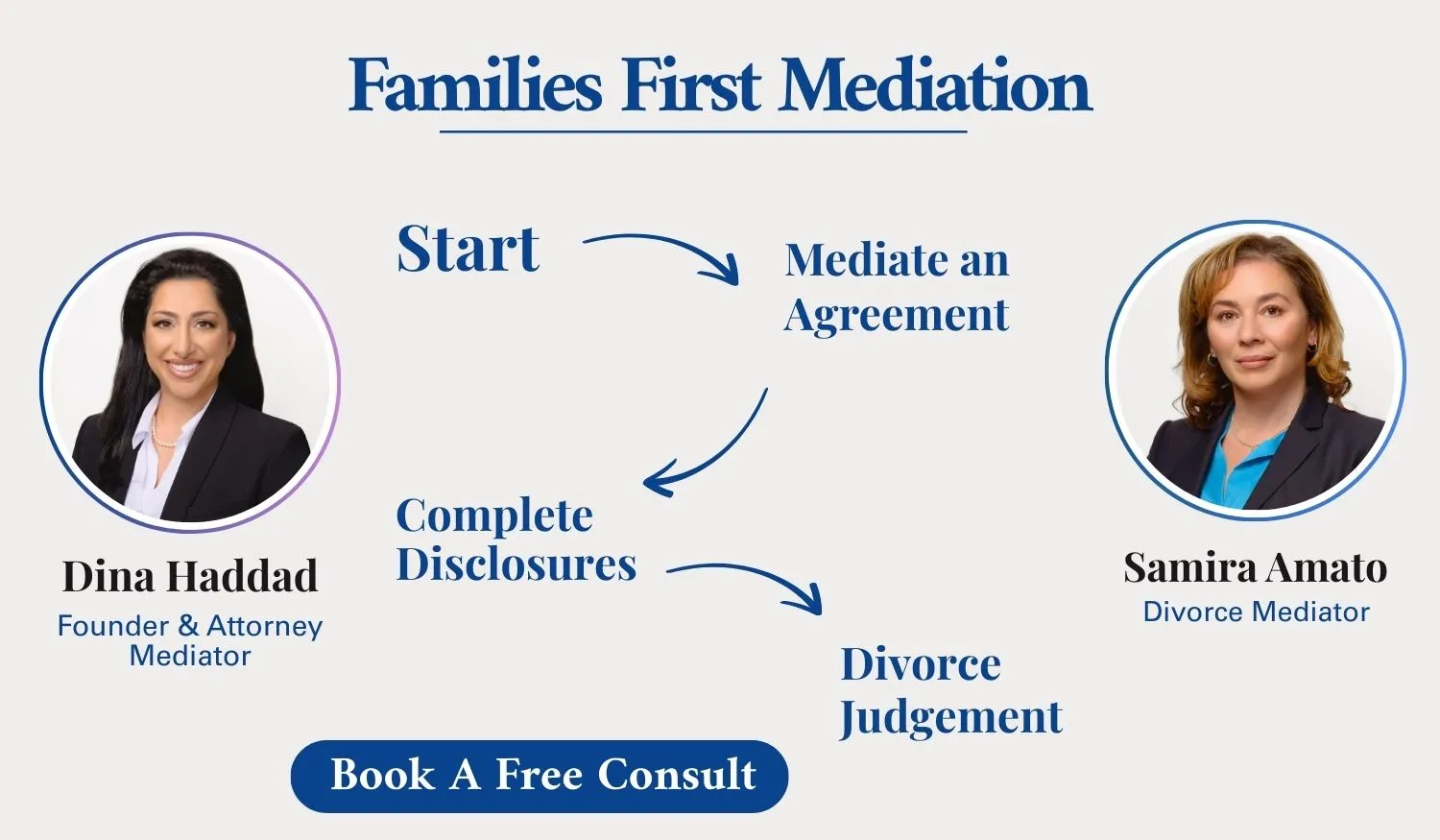
Find an attorney-mediator who is an active member of the California State Bar, has completed formal mediation training, is experienced in mediating divorces that involve significant assets and/or wealth, and has professional connections (e.g., CDFAs, forensic accountants, business valuators, etc.) related to your financial situation.
High-net-worth divorce mediators usually charge by the hour ($400-$800). The average cost of a mediated California case involving complex assets ranges from $10,000 to $25,000. If additional factors are involved (e.g., expert witnesses), the price could be higher.
Yes. High-net-worth divorce mediators frequently coordinate the services of forensic accountants, business valuation experts, certified public accountants, and certified divorce financial analysts (CDFAs) to help both parties reach an informed agreement on all relevant assets.
Mediation often provides lower costs, greater privacy, and more control than litigation. However, litigation may become necessary if one spouse refuses to provide financial disclosure, hides assets, etc., or negotiations fail to produce a fair settlement agreement.
Typically, an attorney-mediator drafts the Marital Settlement Agreement (MSA) for the parties. A non-attorney mediator will usually create a Memorandum of Understanding (MOU), and an attorney or a Legal Document Assistant will convert this to the finalized MSA.