Reach out to find the best solution for your divorce with trusted professionals.
In litigation, parties are pitted against each other. One is the loser and the other is the winner. This happens in family court for divorce as well.
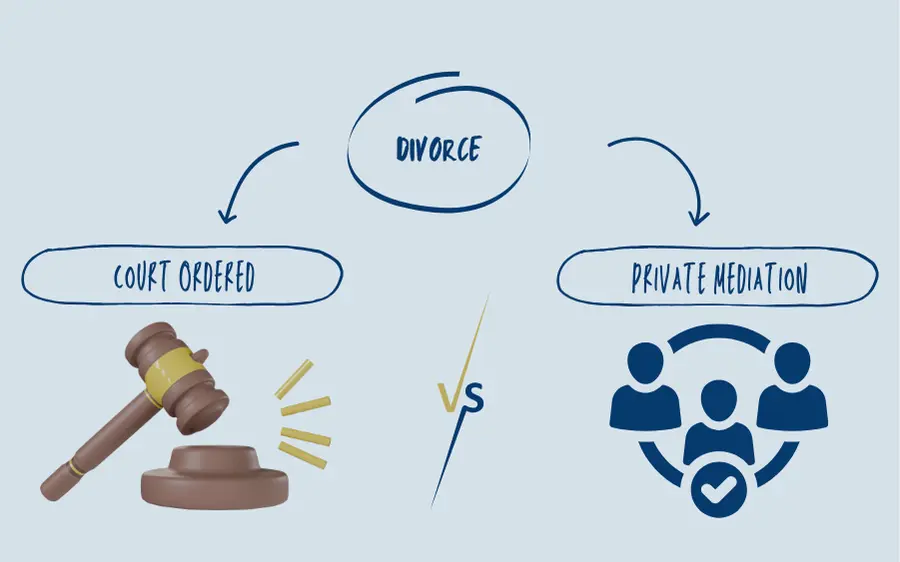
However, there are other better options to resolve family law matters than litigation. Such options include using private or court-ordered mediation. Both options can lead to an out of court settlement, but both are not necessarily amicable options.
Private family mediation grants the parties complete control of creating a detailed, long-lasting agreement. Meanwhile, court-ordered mediation is public service that is free, but parties have limited time and control over the process, especially if addressing complex issues. Don’t know what aligns best with your case? Book your FREE family mediation consult with California’s expert mediators – Dina Haddad and Samira Amato.
Court-ordered mediation, sometimes called court-mandated mediation, is a procedure required by a judge when parents disagree about child custody or visitation. The mediation is a public service at no cost to the parties. The time is often limited to one to two hours.
If there is no agreement, then the parties will proceed to their custody hearing. If an agreement is reached, then the parties no longer will need the custody hearing and the court-mediated agreement will be filed as a court order.However, low-income couples are covered by a fee waiver program.
A judge will not order mediation in cases where there is domestic violence, a current restraining order or strong power imbalance.
There is also an option for a Settlement Officer Conference (SOC) or Mandatory Settlement Conference (MSC) for non-custody issues. This is similar to court-ordered mediation but for asset division and support calculation.
Parties can request a SOC in the Family Court Settlement Office. Alternatively, a judge may order that the parties attend an MSC when a trial has been set. This is the parties and attorneys opportunity to reach an agreement prior to a court hearing or trial. Both of these court-ordered mediations are either in the courthouse or through remote court-service platforms.
Private family law mediation is far more flexible and expansive. Private mediation is not limited to single issues or constrained in time. It is a private professional service that can address the entire divorce process, including the divorce filings, or single issues or post-modification support and custody matters. The parties work with the mediator in the mediation to reach their agreements.
This method permits complete control of the timing and outcome, and avoids the cost and drama associated with litigation. You can pick your own private mediator who has the expertise to create a quality, lasting agreement and will minimize the resentment that often follows a court battle.
You can interview a few mediators to determine the right fit. The complexity of your case may further dictate the kind of mediator you need. For more simple matters, you may need someone affordable. For more complex cases, you will require a greater level of experience and management of your matter. Many like Families First Mediation offer a free consultation to see if the mediator would be the right fit for the parties.
While both private and court-ordered mediation aim for an amicable settlement without the cost of litigation, they have some noteworthy differences.
|
Aspects
|
Private Mediation
|
Court-Ordered Mediation
|
||
|---|---|---|---|---|
|
Cost
|
You pay the mediator's fee.
|
Public service (free)
|
||
|
Timeline
|
Your own pace, multiple sessions.
|
Rushed, often a single session.
|
||
|
Flexibility
|
Highly flexible process and location.
|
Rigid, court-directed process.
|
||
|
Focus
|
Global divorce settlement or single issues with enforceable agreement at conclusion
|
Primarily custody & visitation.
|
||
|
Success Rate
|
Higher, more time and control.
|
Lower, due to pressure and limits.
|
||
In a private mediation process, the parties choose their mediator and set their own time schedule. They can meet at any time and in any place, including online. This non-binding and creative environment produces agreements which endure, saving the parties costs and conflict after divorce.
The success rate of private mediation is more than 70%. The reason for this incredible success is that there is ample time for the parties to negotiate without feeling the pressure of getting immediate results. This leads to more reasonable and long-term agreements that will be respected by all interested parties.
Private mediation will remain entirely confidential in comparison to court-ordered processes. This protection of personal financial issues as well as your emotional issues is particularly important for high earners, business owners, public figures, and those going through a High Net Worth Divorce.
Court ordered mediation is ordered by the court and there usually is very limited options for setting the day and time for the mediation. Private-mediation starts with a free consultation, and is then followed with gathering information, negotiating, and finalizing your agreement in a simple, efficient manner. For most mediation, this includes filing the agreement with the family court.
A court-appointed mediator will act as a neutral third party to facilitate your dispute resolution process. The parties do not have choice in selecting their court-ordered mediator. The mediator is selected for them.
In private mediation, the parties select their mediator based on their decision-making process (such as interviews or referrals). The mediator acts as a neutral third party to provide the parties the strategies and solutions for their divorce . Private mediators may also be supported by a family law team, including paralegal, case manager and financial experts in reaching a fair settlement.
Your participation in private mediation is voluntary. You are free to proceed with mediation at your own pace and usually do so from the comfort of your home via online divorce mediation. This voluntary approach has proven to be a much more effective way of resolving complex issues such as property division and spousal support than a court-mandated process.
Where there are concerns regarding a power imbalance, fear of a partner, or an active restraining order due to “domestic violence,” private mediation is unlikely to be an appropriate method. In these scenarios, the parties may proceed to hearings or trial.

Mediation, whether it be through court ordered mediation or private mediation, both have the same end result – resolve your dispute with your former partner in a peaceful and inexpensive way, outside of a courtroom.
The correct choice for you will depend upon your individual circumstances and whether you are at the start of your case, or already in litigation.
Court-ordered mediation has several disadvantages, including being very structured and taking place in a formal setting. As a result of this structure, the process often feels forced and difficult to navigate, resulting in the exclusion of a child’s voice and many complex financial issues.
Private divorce mediation is not recommended for those who are experiencing domestic violence, a large power imbalance, or when there is no commitment from either party to fully disclose their assets, etc., to reach a mediated agreement.
While private and court ordered mediation have its advantages and disadvantages, research indicates that private mediation is significantly better at handling the complexity of disputes in an environment with no time constraints imposed by a same-day session.
At Families First Mediation, we offer virtual private divorce mediation for issues of child custody, divorce, spousal support, and legal separation. We take pride in creating thorough and secure agreements. Schedule a free consultation to decide what’s best suited for your case.
Court mediation and private mediation are different. Court mediation is mostly non-negotiable, short, and often focuses on child custody. On the other hand, private mediation is voluntary, addresses every complex issue presented, and reaches a settlement with a mediator of your choosing.
If parties are able to work together, mediation is better than going to court. Litigation is an adversarial process which is expensive and has no guarantee of success. The judge can opt for a decision that neither party desires. However, mediation is generally less expensive, faster, and allows the parties to arrive at a solution that works for them individually and the family as a whole.
A court order or formal letter from the court would specify this requirement. Court-ordered mediation is used almost exclusively for child custody and visitation disputes.
Mediation can have a downside if the parties are unable to work together during mediation and participate in good faith negotiations. When one spouse has a history of intimidating the other spouse, mediation may not be a viable option.
Yes, in most cases, mediation results in a full agreement between the parties. Given mediation is highly successful, those that mediate are able to resolve their divorce in a shorter-time period than a traditionally litigated case that goes to trial.
The three key principles of mediation are: voluntary participation, confidentiality, and a willingness to negotiate in good faith. By providing these basic requirements, mediation creates a safe environment for reaching resolutions.