Home » Divorce and Family law Blog » What Does a Divorce Mediator Do? | Role & Benefits


Dina Haddad and her team provide expert mediation services for Californians. If you want help related to any family law issue, call us or book a consult.
A divorce mediator in California is a neutral facilitator who helps parties reach an agreement regarding their divorce. For many mediators, this includes preparing the agreement and divorce forms for the parties, and filing them with the court.
Research shows that couples who use a mediator report greater satisfaction and less conflict. It usually is a much faster process and costs considerably less than going the attorney route. The mediator assists with child custody, support, and division of property without having to go to court.
A skilled divorce mediator will provide the divorcing couple:
Want a calmer path for your divorce in California? Talk to your divorce mediator – Dina Haddad – California’s leading divorce mediator today. Book your free divorce mediation consult.
Divorce mediation is a voluntary process used in California where the parties receive professional assistance from a neutral third party in negotiating their own settlement incident to the divorce.
Divorce mediation is aimed at helping the parties resolve all issues incident to their divorce, including child custody and division of property.
Before mediation, the parties will prepare financial statements, and during the divorce mediation sessions will discuss issues and problem-solve. After mediation, the neutral will prepare a legally binding divorce mediation agreement that the parties will sign and file with the court. If you’re preparing for your divorce mediation in California, our free resources ( divorce mediation checklist and divorce consult guide ) can help you have a productive divorce mediation.
A divorce mediator is a neutral, trained professional who facilitates negotiations between you and your partner so that you can come to a fair divorce settlement.
They conduct the conversations to ensure that both sides have their voices heard and help you to explore solutions. Please note that a divorce mediator does not give legal assistance, but provides legal information and recommendations having a personal attorney for legal advice for your situation.
Regardless, the best way to resolve family law disputes is generally through mediation, which is usually cheaper, quicker, and less adversarial than litigation. Family law mediators are trained to assist in generating solutions regarding:
A divorce mediator is someone with no stake in a particular outcome who tries to help you and your spouse get from disagreement to a signed agreement. Their purpose is to inform you of the laws involved, be a communicator, and help you reach agreement on terms that work for both of you. Typically, divorce mediation takes place in important phases:
First, you need to select your mediator together. In California, it is critical that you select a professional who is trained in family law mediation. Your first meeting will generally consist of a joint session that serves to describe the process of mediation to you and answer any divorce mediation questions that you may have.
You will provide financial documents and other data that are helpful to the mediation process. The mediator will require full transparency in order to help you understand the total marital estate that is to be discussed.
In California, all spouses are required to complete and exchange their Declarations of Disclosures, itemizing their assets and debts, and disclosing their income and spending.
The mediator helps to develop a list of issues to be resolved in your divorce, including child custody, property division, etc. Each issue is then negotiated in an educated, structured, and respectful manner.
The mediator will draft a Marital Settlement Agreement that contains all of your decisions agreed upon during the mediation sessions.
The mediator will provide the final agreement and instructions for filing the papers with the court to legally finalize your divorce.
The cost of divorce mediation is normally a fraction of the cost of a litigated divorce. Most divorce mediators charge either by the hour or a flat fee for each meeting. Total costs for mediation generally range from $5,000 to $15,000 for a full agreement.
This is a better option than each spouse spending tens of thousands of dollars on adversarial litigation.
The time frame is, similarly, usually much shorter. Although California has a six-month waiting period, the amount of time that divorce mediation takes to come to an agreement is under 6 months, depending on the complexity of your case and how well you cooperate. However, the following factors could affect divorce mediation timeline:
Read More: Divorce Costs in California.
Examining the different functions of legal practitioners will allow you to make the right choice as to the path you should take with your divorce.
A divorce mediator is a neutral facilitator who cannot give legal advice. A divorce lawyer is your own legal advocate in an adversarial process. The mediator attempts to bring both parties together to find a consensus, while the attorney advocates for your position, through litigation if necessary.
In the case of divorce mediation, the mediator is a single, neutral facilitator. In a collaborative divorce, each spouse hires his or her own specially trained collaborative attorney, and the entire team of four people works together. Know more about divorce mediation and collaborative divorce in the detailed guide.
A mediator helps you negotiate your own agreement. An arbitrator, on the other hand, acts like a private judge who listens to both sides and hands down a binding decision. When you work with a mediator, you are in complete control of making your own decisions. Know the detailed difference between divorce mediator vs arbitrator in our detailed guide.
A court can order you to see a court-ordered mediator, usually for something like child custody, and you usually have no say in who you get. On the other hand, a private divorce mediator is jointly selected by you and your spouse for the entire divorce which gives you more flexibility and expertise and control.
A proper vetting process is necessary to find the right divorce mediator in California. Look for a full-time professional who is trained in family law mediation. You don’t want just any lawyer who mediates “on the side.” The best divorce mediator blends professionalism with genuine compassion. This creates a safe setting for difficult conversations to take place.
Key skills are neutral, patient, and good at communicating. Fortunately, Dina Haddad and Samira Amato, are expert family law mediators and have these qualities. Both concentrate on helping California families arrive at peaceful solutions. Let your search end here. Schedule your free consult to discuss your situation today!
If you and your spouse can communicate respectfully and want to have an amicable divorce, seek a divorce mediator. This approach requires teamwork to address child custody issues and property division issues.
On the other hand, if there is a tremendous power imbalance, if domestic violence has occurred or if one party is acting in a dishonest manner, mediation is not appropriate for such situations.
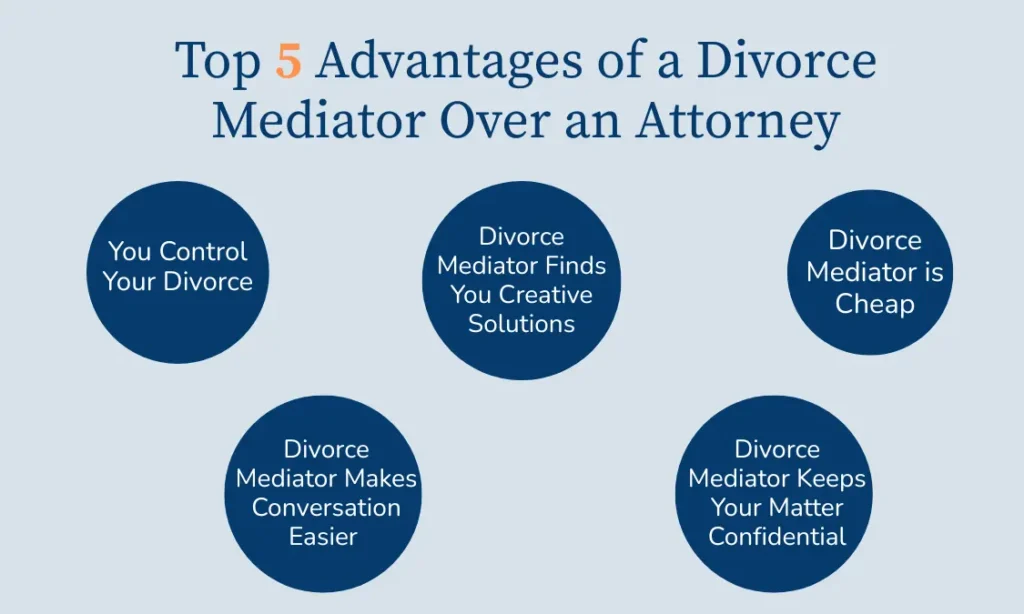
The divorce mediator brings you and your kids the peace of mind that you desire in your divorce or separation. The mediator and mediation allows you to share your divorce cost and reach agreements without the financial and emotional toll. Here a few benefits of choosing a divorce mediator:
In mediation, the couple is in control of their process, not the attorneys or the judge. The divorce mediator helps the couple make legal, binding decisions, which considers their unique interests. This helps parties reach quality and long-lasting agreements. That’s why mediation is good for the emotional health of both parents and kids navigating divorce.
Not every family is the same and neither is every divorce. With the guidance of a divorce mediator, you can come up with creative solutions to your divorce that you wouldn’t be able to in court. In fact, you can have creative solutions such as holding on to the family residence jointly until the real estate market rebounds.
In mediation, you only have the divorce mediator’s costs, unlike the costs of two attorneys in divorce litigation. Additionally, because the mediator is working with you and your spouse closely, you receive quality time with the sole purpose of reaching agreements.
You are not paying for senseless fighting or wasted court time. With the public courts backlogged, you often pay for your attorney to wait for hours in the court hallway for a twenty-minute hearing!
For many divorcing couples, communicating with one another is tough and often nearly impossible. And if you join divorce litigation, you know it’s about aggressive fights in the courts leaving behind little room for effective communication.
On the other hand, divorce mediators help create healthy conversation between parties- empowering divorcing couples to discuss the divorce issues and reach successful resolutions.
Divorce mediation occurs in the mediator’s office, rather than a dreary courtroom. Also, divorce and family law mediation are confidential processes unlike in a litigated process where your private and personal details can wind up in a public court file for your neighbors to see.
In short, mediation’s positive environment allows couples to discuss their personal and financial matters without the fear that their discussions would be a part of public records. This gives them confidence and encourages parties to discuss matters amicably and focus on reaching resolutions.
In the end, a divorce mediator in California provides a structured, neutral path to ending your divorce outside of court. Unlike litigators who advocate for one side or collaborative lawyers who operate in a team, the mediator is focused on reaching an agreement that benefits both parties.
It is crucial to find the right professional for your needs, a knowledgeable and sympathetic family law mediator. For a respectful and efficient resolution, choose Families First Mediation. Schedule a free consultation with Dina Haddad today!
There are times when mediation would not be helpful. These would include cases of domestic violence, extreme power imbalance, lack of good faith. Mediation does not furnish the parties with present legal counsel; therefore, it would be best for the parties to have independent legal counsel when appropriate.
A mediator is a neutral third party. He or she will help the parties communicate better, identify issues and work out solutions that are acceptable to all. The mediator facilitates the process, but does not make decisions for the parties.
Divorce mediators are a tremendous asset to couples who are seeking a civil, inexpensive divorce where the couple maintains control. They are exceptionally helpful to parents who will be co-parents after the divorce.
Qualified divorce attorney mediators are trained in family law and procedure so that they can give you helpful information regarding legal matters but cannot advise you specifically on the law.
A trained divorce mediator will work from a neutral and fair position and give both sides an opportunity to be heard. The mediator’s goal is to get you two to an equitable settlement and not take sides.
Have your financial papers assembled and consider what your priorities will be regarding custody, support and property. For a more complete list, see our Divorce Mediation Preparation Guide.
The parties wish to enter divorce mediation instead of litigation in order to save money, reduce difficulties, and finish their divorce as quickly as possible. Mediation also gives the parties the power and opportunity to create personalized solutions to their problems instead of one which the courtroom will give them.
Most divorce mediation is without the attorney present, however, it is strongly advisable that you have an attorney review your final agreement before signing it in order that your individual rights are adequately protected. If you have attorneys, you can also consider a settlement conference style mediation, which is also offered at Families First Mediation.