Home » Divorce and Family law Blog » Divorce Settlement Agreement California: Full Guide 2026

Founder Attorney-Mediator and California's Top-Rated Super Lawyer
Dina Haddad and her team provide expert mediation services for Californians. If you want help related to any family law issue, call us or book a consult.
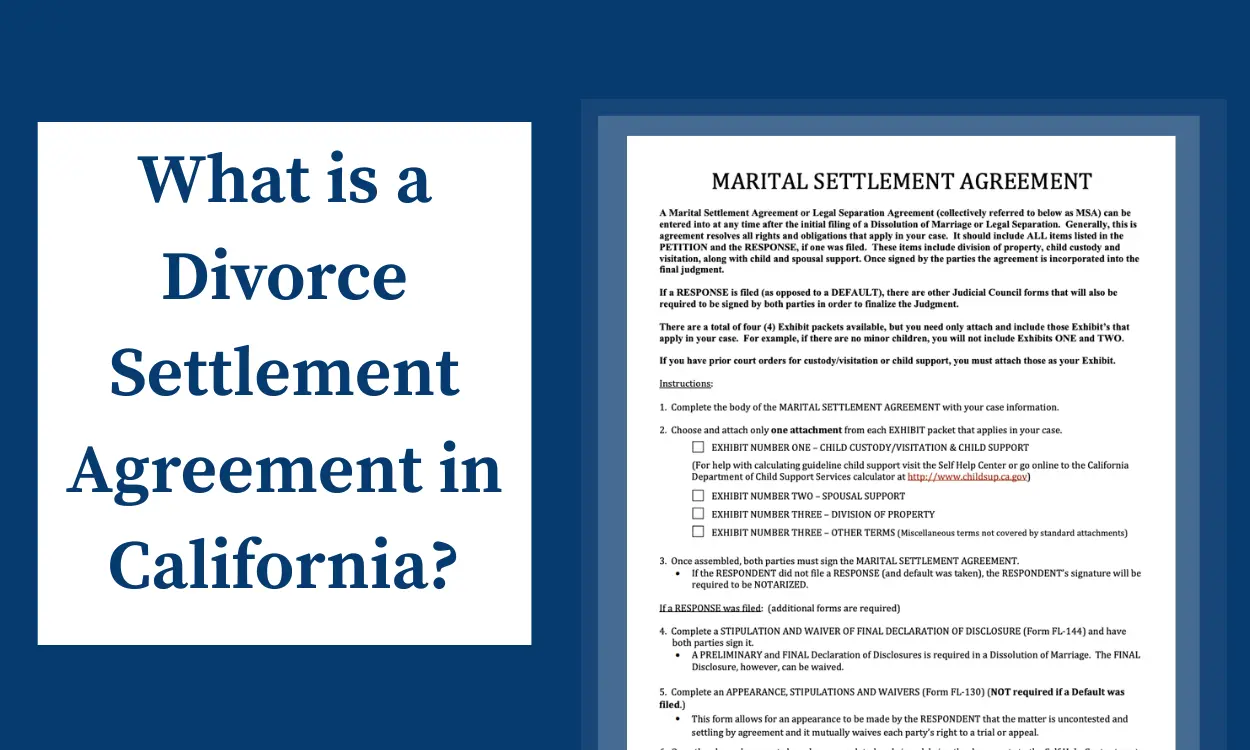
Divorce settlements can be difficult to navigate. However, in California, both spouses may draft their own marital settlement agreement (also known as an MSA) if it is an uncontested divorce.
Tools, templates, and even AI may be able to create a draft of an MSA, but Families First Mediation experienced mediators warn that you cannot rely solely upon those drafts without a thorough review of the document.
An MSA will determine how the most significant issues will be decided, including child custody, spousal support, how the couple’s assets are divided, and what financial obligations each spouse has when the marriage is concluded.
The best MSA not only resolves the current matter, but provides solutions for future modifications, changes in circumstances, and enforcement. For example, the MSA would cover:
Because these decisions could affect you for many years, it is recommended that the MSA be drafted with great care. At Families First Mediation, we have assisted in finalizing the divorce settlements of over 753 couples through mediation. Contact us to schedule a free consultation with one of our MSA professionals.

A divorce settlement agreement is a contract in writing between spouses regarding the major issues of a divorce, including but not limited to:
It may be referred to as a Marital Settlement Agreement (MSA), a Property Settlement Agreement, or a Separation Agreement in the U.S.
The agreement differs from a divorce decree, which is the final court order ending the marriage; the divorce decree formally authorizes and enforces the terms of the settlement agreement.
Divorce Settlement Agreements provide the divorcing couple with many benefits. One of the most significant advantages is the orderly transition of their marital assets. The second advantage is to provide both parties with the ability to agree on how children should be cared for after the divorce is finalized. Learn more about divorce decree and divorce certificate.
This is particularly important for families with minor children, as the best interest of the child is a primary concern for courts when determining how a family’s financial resources will be divided after a divorce.
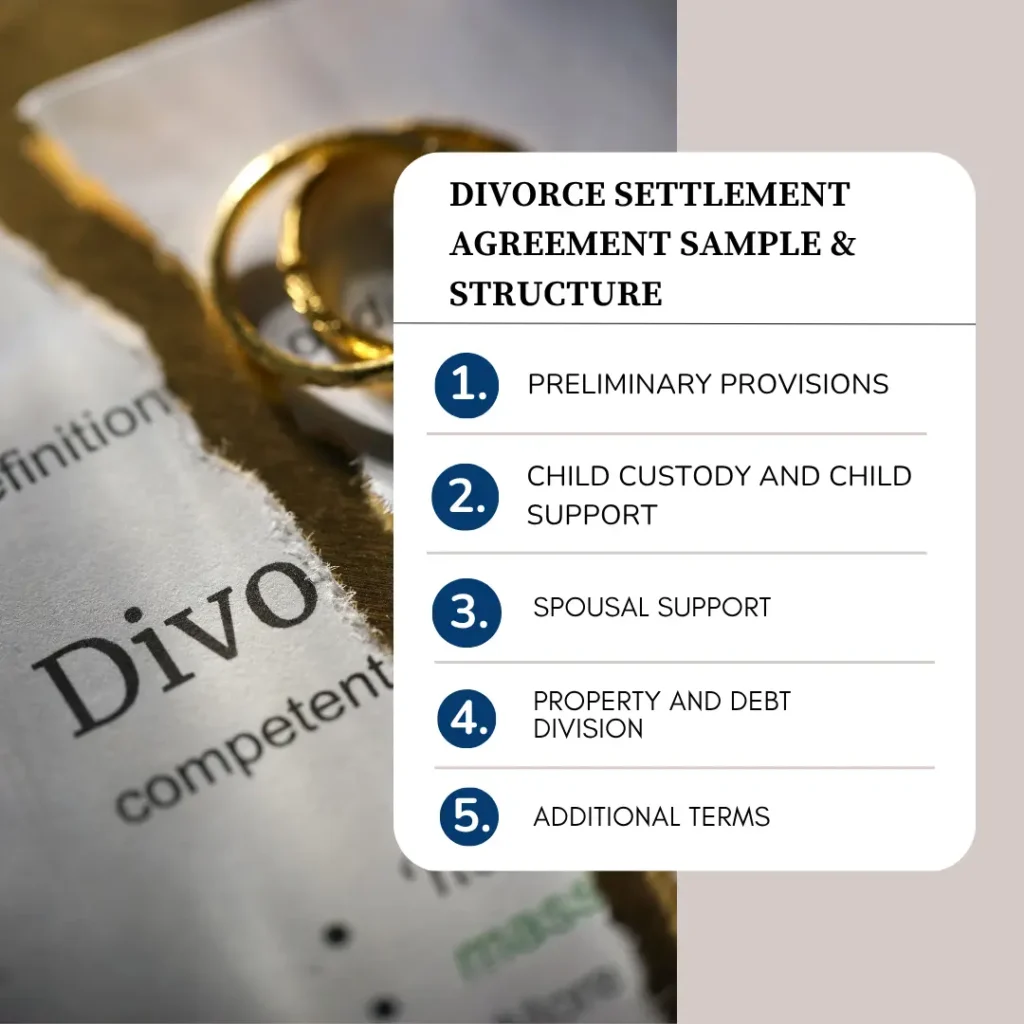
Divorce Settlement Agreements follow a typical structure for clearly outlining the agreed-upon terms of a divorce or legal separation by spouses.
In general, most agreements will begin with basic introductory information regarding the agreement itself, then detail the primary areas of divorce (i.e., property division, spousal support, custody, etc.), and conclude with signature sections to indicate that each spouse has voluntarily accepted all of the conditions in the agreement.
The agreement usually starts with the “who”, “when”, “what”, and “where” of the marital relationship:
The agreement will define the terms of parental involvement for children (including who has legal/physical custody of the child):
The spousal support portion of your agreement can either include spousal support (also referred to as alimony) or a waiver of spousal support. If you do agree to pay spousal support, then it is likely that the agreement would include:
This portion of your agreement outlines how you will divide the marital property and/or debts; this includes items such as:
Many of these contracts will include insurance, taxation, dispute resolutions, and enforcement provisions.
The document will end in General Provisions and Signature Blocks, which both parties are required to sign in order to approve the terms prior to presenting the agreement to the Court.
It is very important for you and your spouse to clearly define what happens to all of your marital property and debts, confirm separate property and debts to the separate owner, determine the custody of the children, and the terms of child and spousal support.
The terms of the MSA need to be clearly drafted. Terms should be specific and detailed to avoid confusion. It also makes it easier to enforce the terms of the MSA.
The MSA should include how modifiable provisions can be changed. MSA can also include provisions that parties must try mediation prior to filing an action with the court. Learn how private mediation is different from court’s mediation.
Property division provisions will typically be final; however, custody and support provisions may only be changed at a with a material change in circumstances, absent parties’ agreement.
An MSA must be in writing and signed by both parties to be enforceable. Notarization of signatures may be required under certain circumstances (e.g., a “default” case when one party did not respond). Upon approval by the Court and incorporation into the Final Judgment, the Agreement becomes a legally binding court order.
You should not sign an agreement that you do not understand or if you disagree with the terms. However, not being completely satisfied because of compromises and negotiated terms is part of the divorce process.
If you are unsure about how to resolve your matter or your spouse’s proposal, consider obtaining independent legal counsel or using private mediation to negotiate changes in the agreement terms.
If you do have conflict, mediation is likely to be less expensive than traditional options like litigation. It also offers a more cooperative way of resolving conflicts than through attorneys. Learn how divorce Mediation is distinct from Litigation.
Related: Divorce Mediation vs Arbitration
Only sign your agreement if everything in it reflects the agreements made between you. You should thoroughly read through each part of your agreement.
Even though you may have worked on the agreement together, it is still good to have someone else (a mediator, a lawyer) check over it before you file it. This way, you’ll know that your agreement has all the details, is written so that it will hold up in court, and is very clear about who is doing what.
Yes. Spouses in California are permitted to write their own divorce settlement agreement (usually called a marital settlement agreement or MSA), so long as the parties agree to all of the terms of the agreement.
The state courts also have self-help resources that confirm that individuals can create their own agreements without an attorney.
The agreement must meet certain criteria. It must be in writing, it must be signed by both parties, and it must address each issue that was contained in the divorce petition (e.g., the division of property, the division of debt, child custody, etc.).
In some cases, such as when one party has defaulted (i.e., failed to respond to the petition for divorce), a notary public’s signature may be required.
Oral agreements will almost always not be acceptable to a court of law since oral agreements cannot be incorporated into a final judgment as a written document.
AI tools can generate settlement agreement examples; however, relying on them as your final tool for a divorce agreement is highly risky.
Many times, when using AI-generated draft agreements, they will be generic, incomplete, or do not comply with the specific California law requirements that exist. Often, provisions will conflict with one another but are hard to catch unless you have a trained eye for such discrepancies.
In addition, an AI-generated draft may fail to include financial disclosure(s), parenting issues, or the required language that courts require. You can end up with an agreement that’s quickly rejected by the courts or leads to expensive divorce litigation in the future.
The safest option is to consult with a mediator or attorney to ensure your agreements are accurate, legally compliant, and enforceable.
After the divorce settlement agreement (MSA) is finalized, each party will need to carefully read through the MSA and sign the document.
Once that is done, the parties will need to fill out, sign, and exchange with one another the necessary financial disclosure forms. If there is no divorce case currently open, you will first need to file either a Form FL-100 (Petition) or a joint petition (if you and your spouse are filing together).
You should make at least two copies of the signed MSA and prepare the entire judgment packet. Once completed, take this packet to the courthouse and submit it to the Clerk.
The Judge will review the documents and sign the MSA. Once signed, the judgment clerk will process the papers solidifying that the MSA has become a Divorce Judgment (court order). The Divorce Judgment must be entered before or at the same time that the parties’ marital status dissolved.
Yes. In California, a couple can sign a Marital Settlement Agreement (MSA) without having a court hearing. Because many couples choose to use online divorce mediation to negotiate the terms of their divorce, they are able to submit their signed agreement along with their judgment papers, and without having to go to court.
Mediation involves a neutral third-party who assists both spouses in making decisions regarding how property will be divided, where children will reside, as well as the amount of spousal and child support that will be paid.
The mediator, like Dina Haddad, can also prepare the MSA in accordance with the terms that were agreed to by the couple. Divorce mediation is often less expensive than hiring separate attorneys and gives the couple more control over the mediation process.
Changes to a divorce settlement agreement can happen even after the couple has been divorced. The parties can modify child support, spousal support and child custody by agreement or by demonstrating a significant change of circumstances.
If one party does not agree with the other party’s proposed modification, that party will need to file a request for an order modifying those provisions using a Request for Order (FL-300).
The Court will determine whether or not to grant the requested modifications based upon the evidence submitted and the application of that evidence to the law. In general, property division is final and cannot be modified except under very limited conditions such as fraud, misrepresentation, duress, or clerical error.
The Court may modify child custody and visitation orders if there has been a material change in circumstances which affects the best interest of the children. Similarly, the Court may adjust the amount of child support and/or spousal support due from one spouse to the other when the financial situation of either spouse has changed substantially since their divorce.
Most couples with an uncontested divorce can usually settle the terms of their divorce or legal separation entirely out of court. This is done by preparing and signing a Marital Settlement Agreement (MSA), which is a divorce settlement agreement.
It is very important to draft the MSA correctly, as it will outline how your children will be cared for, how much child support will be paid, and who gets what assets and/or debts in the marriage. A poorly drafted agreement may result in rejection by the judge or create problems with enforcing the terms of the agreement down the road.
While there are many tools and templates available to aid in drafting a settlement agreement, consulting with professionals may provide assurance that the agreement meets all of the necessary requirements to be considered a legally enforceable contract, provisions do not conflict, and they are lawful and enforceable.
If you need assistance with drafting or modifying your divorce settlement agreement, our mediators at Families First Mediation is here to help. Book a free consultation for discussion.
A “divorce settlement” is an agreement by which both spouses determine how they will divide their marital property and decide on the other important issues (such as child support or spousal support) prior to the court’s approval of the divorce.
A “fair” divorce settlement will take into account how well a couple’s assets are divided as well as their child custody and support responsibilities in accordance with state law and each spouse’s individual financial situation. The fairness of a divorce settlement will typically be dependent upon the value of the couple’s assets, the income of each spouse, and the needs of their children.
The primary function of a settlement agreement is to give couples the opportunity to resolve their divorce issues without having them decided at trial. The couples also clearly understand how property will be divided, how the children will be cared for, how support will be provided, and more. Afterwards, the court will review this agreement, and if they are legally compliant, it will enforce it.
The amount of money each spouse receives is determined by many different factors, including the value of the marital assets, each spouse’s income, the specific rules for dividing marital property in your jurisdiction, the amounts of child support required, and/or if spousal support will be paid.