Home » Divorce and Family law Blog » Divorce Decree vs Divorce Certificate: Key Differences

Founder Attorney-Mediator and California's Top-Rated Super Lawyer
Dina Haddad and her team provide expert mediation services for Californians. If you want help related to any family law issue, call us or book a consult.
Your divorce decree, officially called the Judgment of Dissolution (Form FL-180), is the court’s final order. It explains your rights and responsibilities after the marriage ends.
A divorce certificate, on the other hand, is a shorter record issued by vital records confirming that your divorce was finalized. However, this document is only available for marriages between 1962 and 1984. This article will explain both documents, how to get them (if you qualify), their use cases, and more.
For further assistance or confusion regarding obtaining the divorce decree or divorce certificate, please book a free clarity consultation call with California divorce attorney and mediator Dina Haddad.
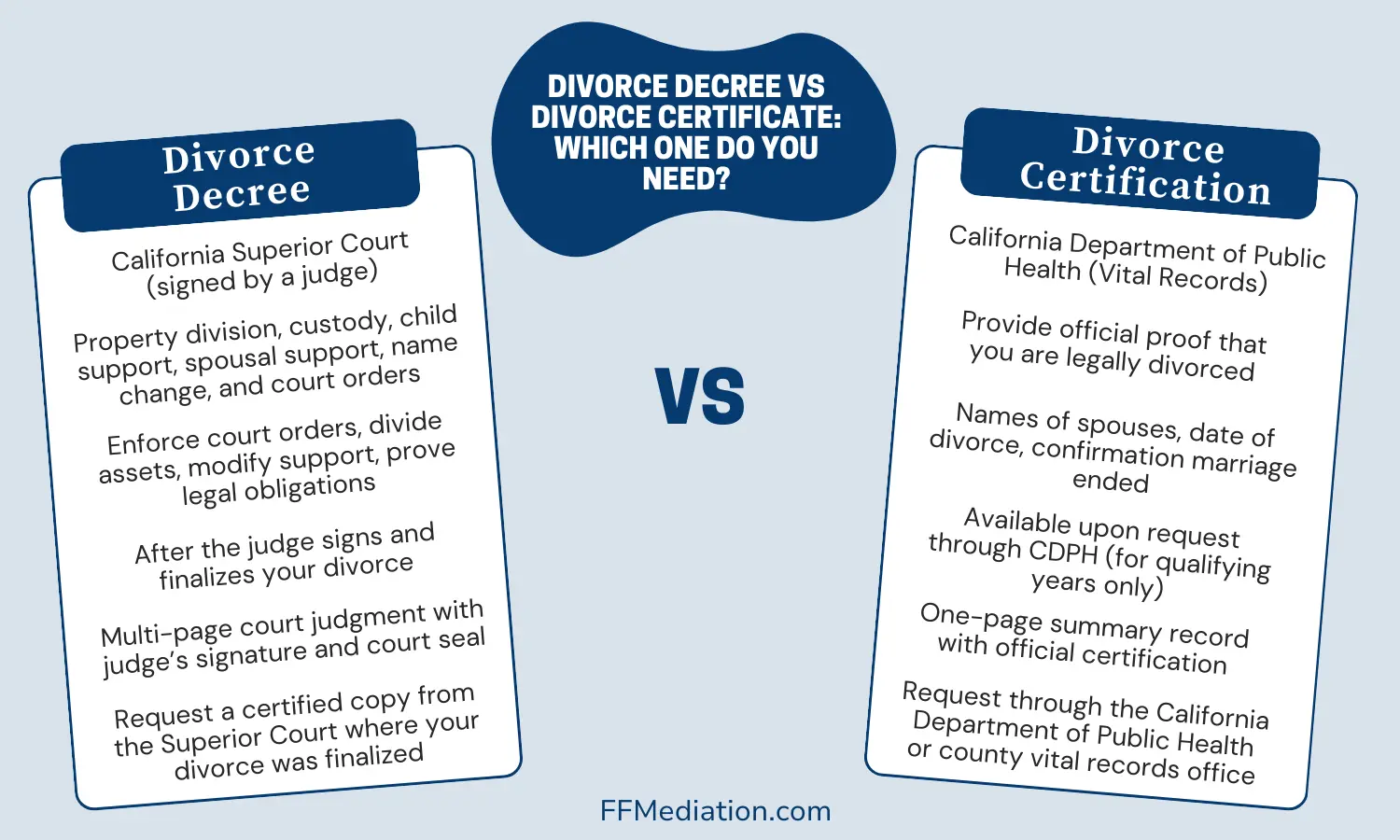
A divorce decree, also known as the Judgment of Dissolution (Form FL-180) indicates the end of your marriage as well as your obligations after the separation. As for a divorce certificate, this is merely a separate vital record confirming that your divorce actually happened. Here’s the difference:
|
Category
|
Divorce Decree
|
Divorce Certificate (Certificate of Record)
|
||||||
|---|---|---|---|---|---|---|---|---|
|
Issuing Authority
|
California Superior Court (signed by a judge)
|
California Department of Public Health (Vital Records)
|
||||||
|
Main Content
|
Property division, custody, child support, spousal support, name change, and court orders
|
Names of spouses, date of divorce, confirmation marriage ended
|
||||||
|
Purpose / Used To
|
Enforce court orders, divide assets, modify support, prove legal obligations
|
Provide official proof that you are legally divorced
|
||||||
|
When Issued
|
After the judge signs and finalizes your divorce
|
Available upon request through CDPH (for qualifying years only)
|
||||||
|
Format
|
Multi-page court judgment with judge’s signature and court seal
|
One-page summary record with official certification
|
||||||
|
How To Request
|
Request a certified copy from the Superior Court where your divorce was finalized
|
Request through the California Department of Public Health or county vital records office
|
The Divorce Decree is referred to as the Judgment of Dissolution (FL-180) and this is the Final Court Order that dissolves your marriage.
“Divorce decree”, “divorce judgement” or “Judgment of Dissolution” are all referring to the same document. As such you can use them in conjunction with one another; however, the official title is “Judgment of Dissolution”. Nevertheless, the divorce decree serves four important purposes:
It’s very important to recognize that a Divorce Decree is different from a Marital Settlement Agreement (MSA). A Marital Settlement Agreement (MSA), is an agreement on all material terms of your divorce with your spouse, that is then presented to the Judge for review and approval. Upon the approval by the judge, the MSA is changed to a Divorce Decree that may be enforceable by law.
The Divorce Decree contains all key terms of your divorce like how property and debt will be divided as well as child custody & visitation rights, child support, and spousal support orders.
It will also mention your full legal name and basic identifying details along with the date of your marriage.
Depending on your divorce case specifics the Judgment of Dissolution may include a name change as well as other obligations such as the parties’ respective insurance coverage responsibilities and/or tax obligations. In addition to these details you will see the Judge’s Signature and the Court Seal which makes this document legally binding.
To obtain a copy of the Judgment of Dissolution (FL-180), you can contact the Superior Court for the County in which your divorce was filed and make a request.
To be able to receive your divorce decree, you should:
If your divorce was finalized elsewhere, like Texas, California courts can’t help you. You’ll need to request the document from the state where your divorce was granted.
To get a certified copy of your divorce decree, contact the clerk’s office of the superior court that handled your divorce. They will request a fee, which is typically a set fee plus an additional amount per page.
A Divorce Decree is confirmation of your marital status by law that you are divorced; it also permits you to change your name, get remarried, have child and spousal support enforced as well as distribute assets in accordance with the terms of your divorce. Learn more about how I know if my divorce is finalized.
You may be subject to penalties for doing any of these things prior to obtaining your decree, which will likely delay, and possibly stop your divorce proceedings entirely.
There is no true document called “Divorce Certificate” issued by California courts. Most people usually refer to a Certificate of Record as the divorce certificate, which is issued by the California Department of Public Health or the county vital records office.
It’s important to note that California courts no longer issue these records, and this only applies to marriages between 1962 and 1984.
Regardless, Certificate of Record is a document only confirming that your divorce happened. It doesn’t contain any important details like property division, child custody or child support. All these are found in the Judgement of Dissolution (FL-180).
The divorce Certificate of Record can be used for the following purposes:
If your marriage was between 1962 and 1984, you qualify for a Certificate of Record. Marriages after this period can only get the Judgement of Dissolution (FL-180), which can be used for either proof of marriage or for updating government details.
Disclaimer: This section only applies to qualified parties whose marriage was between 1962 and 1984.
Before you ask for a copy of your divorce certificate, get as much information about the divorce as possible.
This will include both spouses’ complete names, the date of divorce, and in which county your divorce was finalized. Getting this information beforehand, makes it easier to find your divorce certificate.
Identify which county issued your divorce, and then obtain the certificate from that county/court using one of three methods: in-person, via mail, or online (the county’s method may vary).
You’ll need to fill out and send the VS-113B form , which is the official document used to request a Certificate of Record.
Submit your request to either the Superior Court Clerk or vital records office then pay the necessary fee, usually $18 per certificate copy you request.
So what is the difference between a divorce decree and a certificate? A Divorce Decree, also known as a Judgement of Dissolution, officially ends your marriage and dictates what both parties’ obligations regarding asset division, spousal support, child support, child custody, and more.
As for the Divorce Certificate, also known as the Certificate of Record, this only proves that your marriage ended, without any sensitive divorce terms. It can be received by divorced couples whose marriages were between 1962 and 1984.
Do you have questions for your unique situation? Schedule a free consultation with Families First Mediation today!
No. a Divorce Decree (FL-180) is signed by a judge and contains all legally enforceable terms of your divorce. On the other hand, the Divorce Certificate is merely a record that your divorce happened and doesn’t contain any enforceable information.
Your final document will be the Judgement of Dissolution indicating the end of your marriage. This document outlines the terms of your divorce (child support; division of marital assets) in addition to indicating the termination of your marriage.
The best evidence of whether or not your divorce is complete would be when a judge signs the Judgement of Dissolution. To determine if your divorce has been finalized contact the Superior Court where your divorce was heard.
No. A divorce decree does not expire. It remains a valid court order. However, certain terms, such as child support or custody, may be modified later by court order if circumstances change.