Home » Divorce and Family law Blog » CA High Net Worth Divorce: Keep It Off the Public Record

Founder Attorney-Mediator and California's Top-Rated Super Lawyer

Dina Haddad and her team provide expert mediation services for Californians. If you want help related to any family law issue, call us or book a consult.
A high-net-worth divorce in California is a complex proceeding that includes privacy issues, asset division, and reputational risk. It also often involves multiple types of assets, including businesses, investments, and real estate, and is generally public.
In a high-net-worth divorce, maintaining confidentiality is crucial. However, the California divorce process places sensitive financial information and personal data in the public record, exposing your personal matter to public scrutiny.
If privacy is what you want, this article will explore what high-net-worth divorces are, legal strategies for privacy, and ways to have control over the final outcome.
For further information regarding high net worth divorce or high net worth divorce mediation, book a free consultation with California’s expert mediation lawyers.

High net worth divorce California involves significant assets, complex financial arrangements, and an elevated level of concern regarding privacy.
There is no established minimum amount that defines a “high net worth” case; however, such cases are frequently associated with businesses or partnerships, two or more sources of income and/or one or more significant pieces of real estate.
High net worth divorce does not mean celebrity divorce. However, many celebrity divorces usually fall into this category due to the large amount of assets involved and media exposure.
Some common types of assets found in high net worth divorces include:
Due to the personal nature, high-net-worth divorce cases require complete confidentiality. In most cases, the parties in high net worth divorces are either publicly visible through their work, wealth and/or status (e.g., executives, entrepreneurs/celebrities) and are very concerned about financial, reputational, and professionally damaging publicity while going through the divorce process.
The High Net Worth Divorce Process in California focuses on privacy. Those who fall into this category include: Business Owners, Executives, Influencers, Celebrities, and other Public Figures.
Because these individuals have an increased level of publicity and exposure, there is a greater risk that their finances, assets, and personal information will be made public through the divorce process in California. Privacy protects wealth, the continuation of your career, family stability, and overall quality of life.
Confidential resolution methods like High Net Worth Divorce Mediation allow parties to resolve disputes without going to court, thereby greatly minimizing the potential of sensitive information becoming public. Mediation also results in lower costs to both parties when it comes to resolving issues related to the divorce, compared to litigating.
The following categories of people benefit from privacy due to the risks associated with having private matters exposed to the public:
While complete privacy cannot be guaranteed since most divorce documents are publicly available, there are evolving legal strategies and Alternative Dispute Resolution (ADR) processes, like high-net-worth divorce mediation, that are available and can significantly limit a party’s exposure while keeping negotiations confidential.
Read More: Asset Division Mistakes California Often Make.
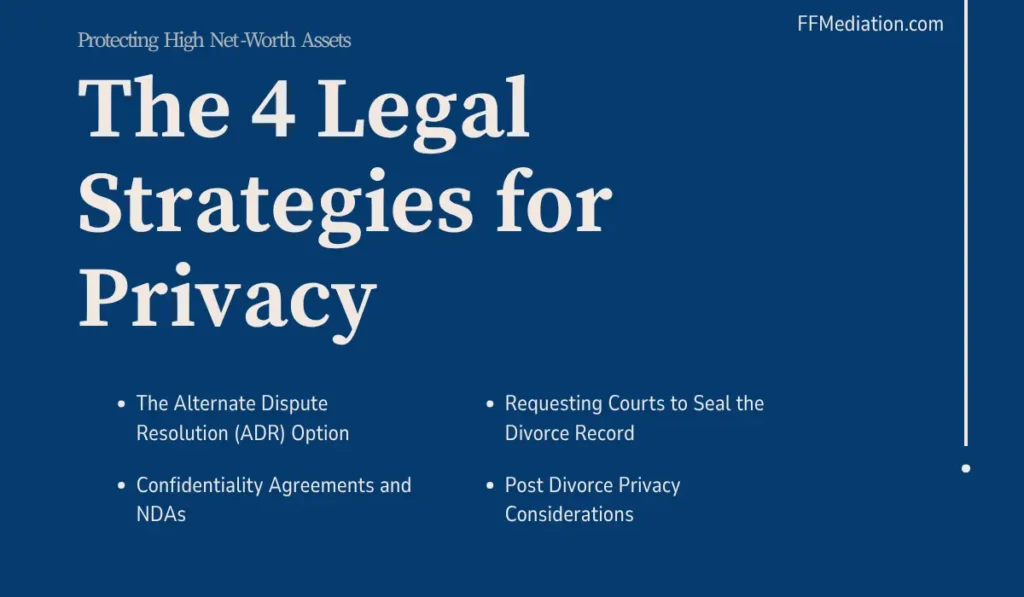
In a high net worth divorce litigation in California, you can’t be anonymous. California requires both spouses to use their legal name when filing with the Court and also all of the Court proceedings are typically public.
Your best option for privacy is to limit court involvement as much as possible. High-net-worth divorce mediation allows for privacy thanks to the California Evidence Code §1115 – §1129, which ensures confidentiality regarding communications made during mediation.
The most important way Alternative Dispute Resolution (ADR) helps keep your information private is that all discussions take place outside of a public record.
For example, California law permits full confidentiality of all communications made during divorce mediation, allowing parties to protect more sensitive information than in litigation.
Many California counties also allow parties to prepare a confidential Marital Settlement Agreement and not file it with the court. At Families First Mediation, when this is offered, we do provide this service for clients that are interested.
Some key alternatives for you to consider include:
You can request that the court seal sensitive parts of the divorce record. The court will have to approve the sealing request and there is no guarantee that they will grant it.
Even if they do grant the sealing, it may limit who has access to some of the financial or personal information contained in the record, however it is unlikely to provide complete anonymity.
Typically divorce judgments are still part of the public record and pursuing these types of actions can increase your litigation costs exponentially.
NDAs limit how much can be disclosed to spouses, attorneys, and experts. It limits what gets disclosed publicly.
However, there are no guarantees that it will be enforced. The obligation to disclose finances remains in place. Enforceability may also be challenged. However, Mediation works well with an NDA.
Protecting privacy does not end when the divorce case ends.
Protecting the identity of your children, maintaining confidentiality regarding your case (including by enforcing an NDA), and limiting access to you through the media or social media protects you from being victimized (e.g., through harassment) or from losing your reputation due to leaked confidential information.
Protecting your personal and financial information helps prevent the leakage of confidential information.
Privacy, confidentiality, and security are essential in a high net worth divorce California, especially for public figures, executives, and entrepreneurs.
Court proceedings expose sensitive details. ADR options, including high net worth divorce mediation, NDAs, and limited sealing requests, help reduce that risk.
Litigation does not guarantee privacy and often increases cost and exposure. For amicable cases, mediation provides a more controlled and confidential path.
Seek expert guidance (through our free consultation) to structure a private, efficient resolution aligned with your financial and reputational priorities.
California is a community property state. The court divides community property (property acquired together) equally. However, if you have separate property (assets that were yours prior to your marriage), the court would confirm those to you as your separate property, so long as those assets were not commingled (mixed with community funds).
There is no official California statistic that indicates who files for a divorce more based on gender. While most studies lean towards women filing for divorce more, the precise number or reason varies. Regardless, in California, both parties have the right to begin the divorce process.
High asset divorces typically involve large amounts of complicated assets (e.g. business interests, investments, real estate holdings & trusts). The definition does not include an actual dollar amount or threshold; it is simply defined by complexity of assets, the total value of the assets and the overall financial structures involved.
In California, the “10-10-10” rule has nothing to do with determining whether one qualifies to file for divorce. Instead, this rule applies specifically to military personnel regarding their retirement benefits. If both spouses were married for at least 10 years while either spouse served on active duty for at least 10 years, then that spouse will qualify to receive a portion of his/her direct retirement benefit.
One common error in high net worth divorces in California is to fail to accurately and completely disclose all of your assets before agreeing to a settlement. This can also occur when parties rush through the agreement process prior to understanding what the long-term effects of their decisions will be. Such asset division mistakes can result in potential sanctions, and possibly a less favorable outcome.
Assets which are defined as “separate property” (i.e., those that existed prior to marriage or acquired during marriage solely due to inheritance, gift or other means) are assets that cannot be touched in a California divorce. However, if the separate property is combined with community assets during marriage, then there exists the possibility that the entire property could be divisible in a California divorce.