Home » Divorce and Family law Blog » Best ADR Options for Family Law Disputes

Founder Attorney-Mediator and California's Top-Rated Super Lawyer

Dina Haddad and her team provide expert mediation services for Californians. If you want help related to any family law issue, call us or book a consult.
Alternative dispute resolution (ADR) offers California families a more efficient path. Compared to litigation or trial, ADR services are less formal, more cost effective, and still are legally enforceable.
Family law disputes can be resolved with ADR services, resulting in higher quality and fully enforceable agreements with less strain.
Common ADR options include mediation, arbitration, settlement conferences, and collaborative law. However, not every approach fits every situation, which is why choosing the right option matters.
Among these methods, family mediation is often preferred. This is because settlement rates are high, outcomes tend to last, and participants often leave satisfied.
While courts do offer ADR programs, these options can be limited. This is why many prefer private ADR. It is usually more flexible, and timelines are often faster.
To determine the best ADR approach for your case, you need guidance. Schedule a free consultation with Dina Haddad today!
Alternative dispute resolution refers to methods used to resolve disputes without a full court trial. In California family law, ADR is commonly used to address divorce matters, custody disputes, and support issues.
The setting is less adversarial than litigation, conflict is reduced, costs are more controlled, and families reach workable resolutions more efficiently.
Most ADR processes are voluntary and privately arranged, such as private mediation or arbitration. However, not all ADR takes place privately or outside the court system. Some are court-connected or court-mandated. California Superior Courts provide an ADR Information Package. This outlines available programs include:
ADR is different from online dispute resolution. ODR uses digital platforms where negotiation or mediation happens remotely. ODR can support ADR but it does not replace it.
ADR can address many family law issues, but some matters have limits. Some ADR services, like mediation, may not work for cases with safety concerns or a lack of financial disclosure.
At the same time, private judging or arbitration may be appropriate in these cases. In those instances, the outcomes are typically legally binding while others are not. Hybrid approaches may combine ADR with litigation for improved effectiveness. But overall, the goal remains preserving efficiency, stability, and keeping families in control of decisions and out of court.
The following are the common ADR methods in California family law:
|
ADR Type
|
What It Is
|
Who Decides?
|
Court Connected
|
Binding
|
|
|---|---|---|---|---|---|
|
Mediation
|
Facilitated negotiation led by a neutral mediator
|
The parties
|
Yes or Private
|
No (until agreement is signed and approved)
|
|
|
Arbitration
|
Private adjudication resembling a trial
|
Arbitrator
|
Sometimes
|
Yes
|
|
|
Settlement Conference
|
Structured negotiation to encourage settlement
|
The parties, with a neutral
|
Yes or Private
|
No
|
|
|
Collaborative Law
|
Negotiation with family law attorneys
|
The parties
|
No
|
Yes (if agreement reached)
|
|
One of the least common ADR methods is early or neutral case evaluation (ENE/EVE). A neutral professional reviews the case, then a nonbinding assessment is provided with outcomes likely outlined. While the process can be informative, it does not resolve disputes.
This section will explore the most common ADR methods, allowing you better understand what option is best for your case, plus what benefits it presents.
Family mediation uses a neutral third party who helps families reach voluntary agreements. However, mediation is not binding on its own. Agreements become binding only when written and approved by the court.
Compared to litigation, mediation is far less expensive and also more flexible. It addresses common issues like:
Research consistently shows that mediation works efficiently and disputes are resolved faster. As for court-mandated mediation, it is more limited. It often focuses only on custody and visitation, while private mediation covers broader issues and allows customization.
Arbitration is a binding dispute resolution process where an arbitrator decides the contested issues. It is faster than litigation, but costs are usually higher than mediation.
Nevertheless, Arbitration is sometimes used in high-net-worth cases because it prioritizes confidentiality. But unlike mediation, decision-making authority is surrendered to the arbitrator.
Settlement conferences bring parties together to explore resolution with a neutral facilitator guiding the discussion. However, the process is nonbinding and some conferences are court-mandated while others are privately arranged.
Regardless, costs are lower than trial but are higher than mediation, and outcomes depend on party readiness.
Collaborative law uses a team-based model where specially trained attorneys are involved. Agreements become binding if reached, but costs are higher than mediation. One reason for the increased cost is attorney participation. But at the end of the day, it costs less than litigation.
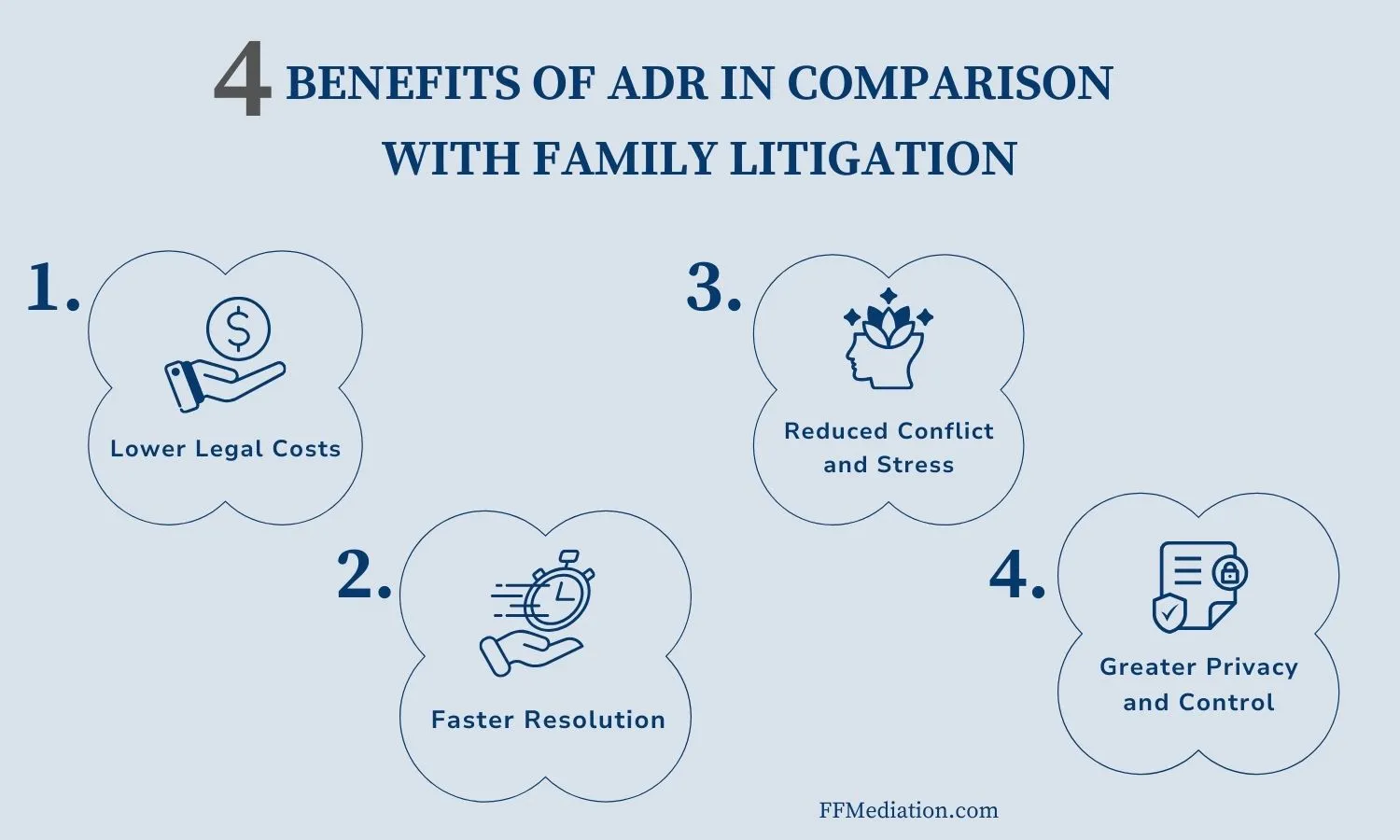
Alternative dispute resolution works well for many families. It allows disputes to be resolved efficiently, avoids full-scale litigation, reduces financial strain, and lowers emotional stress.
In California, many couples choose ADR instead of court. This is because the process is more practical, control is retained by the parties, and the approach is less adversarial.
ADR significantly reduces legal expenses by reducing attorney hours, court filings, and procedural motions. For Litigation, it often requires ongoing representation and repeated court appearances, which increase divorce costs quickly.
Family litigation moves on court schedules, but continuances can cause delays and congested calendars slow progress. For ADR, it allows families to set their own timelines, which means disputes often resolve in months, even weeks.
Litigation is adversarial by nature, where conflict often escalates and emotional strain increases. ADR encourages cooperation, and problem-solving is prioritized, which leads to less emotional strain and better working relationships, especially when you have children.
Court proceedings are public, but ADR is generally confidential. Therefore, discussions remain private, and decision-making stays with the parties. Most importantly, control is not transferred to a judge, leading to outcomes that reflect family priorities.
ADR is not appropriate for every family law dispute, but it is often the right first option. Some key reasons to choose ADR include efficiency, privacy, and control. This section explains when ADR works best, when ADR supports litigation, and some of its limitations.
ADR works best with good-faith participation as both parties must be willing to engage. Information must also be shared openly, and the focus must be on resolution.
It is mostly used at the beginning of a divorce or custody case, often to avoid the conflict associated with litigation, but still have effective outcomes. It’s also worth mentioning that ADR is most suitable when there are no safety concerns and decision-making capacity is stable.
ADR can be used alongside court proceedings. For example, mediation may resolve custody issues or financial disputes, while the case may remain open in court. This hybrid approach narrows disputes, and trial time is reduced. Courts generally permit ADR during motions, settlement conferences, and pretrial stages.
If mediation or collaborative divorce does not resolve all issues, litigation remains an option. That doesn’t mean trying ADR first is wasteful because it often clarifies disputed issues. With this information, the scope of conflict is reduced, and overall legal costs also drop even when court involvement continues.
Divorce mediation is widely regarded as the most effective ADR option in California. It offers efficiency plus flexibility, and decision-making stays with the parties.
Unlike arbitration, mediation does not impose outcomes. Compared to collaborative divorce, fewer professionals are involved as well. The end result is lower costs and a cooperative approach to disputes.
California offers several ADR options, including mediation, arbitration, settlement conferences, and collaborative law. All can reduce time and cost compared to litigation.
However, divorce mediation consistently offers the best balance of flexibility, control, and reduced stress. It also allows families to resolve more issues outside court with fewer professionals involved.
Effective mediation depends on the right support as mediators must be qualified with ADR training and equipped with family law knowledge.
Schedule a free consultation with Dina Haddad today to determine which ADR approach fits your situation.
ADR is used to resolve family law disputes without trial. It includes mediation, settlement conferences, and arbitration. The overall goal is to reduce conflict, cost, and court involvement.
ADR stands for alternative dispute resolution. In family law, it refers to non-trial methods to resolve divorce disputes, custody issues, and support matters.
Divorce mediation is generally the best option. It is flexible, costs are lower, and parties keep control over outcomes instead of a judge.
Yes. ADR is typically faster than litigation because it avoids court backlogs, formal procedures, and trial scheduling delays.