Home » Divorce and Family law Blog » High Net Worth Divorce California: Assets, Taxes & Strategy

Founder Attorney-Mediator and California's Top-Rated Super Lawyer

Dina Haddad and her team provide expert mediation services for Californians. If you want help related to any family law issue, call us or book a consult.
High net worth divorces are generally difficult for many reasons. Often, the asset structure is complicated including equity compensation, real estate (whether the family home or rental properties), family businesses, or even investments in privately held companies or AngelList holdings.
In some situations, those that have complex asset holdings are those in public-spheres of influence that require privacy and the exposure of their assets can result in direct harm to their family or profession.
Although it’s important that any divorcing party take care to understand their asset structure, there are more mistakes that can occur in high net worth or complex asset cases. These mistakes can result in significant financial problems, including tax consequences.
When you have complex assets, working creatively with your spouse results in the best outcome. Parties can reach creative agreements that take into consideration the reality of the complexity of their asset structure. This includes:
By using a professional mediation, specifically for high net worth divorce, you can protect your assets, keep your private information out of public record, and increase your chances of achieving long term financial stability. In essence, mediation shifts control from the courtroom to you.
Schedule a free consultation call with Families First Mediation. We specialize in high-quality agreements for complex-asset structures and high-income clients. This includes those working in tech and receiving equity compensation.
There isn’t one precise number that defines a high-net-worth divorce case. It’s mostly a combination of complex financial factors, such as estates exceeding $1 million, high incomes tied to bonuses or stock compensation, and multiple asset classes.
High-net worth cases also require attention when determining child and spousal support. The court would consider the parties’ marital standard of living as an important factor to calculate spousal support. The parties’ income will include income generated from closely held businesses, trusts, investment portfolios, multi-state real estate, or international holdings.
High net worth divorce cases often involve affluent individuals, which makes privacy and asset protection very important. Fortunately, private mediation with experts like Dina Haddad ensures your divorce is simplified, and settlements remain confidential, unlike litigation.
Standard divorce cases usually have simple assets to divide, such as the family home, basic savings, and the salary. As for high-net-worth cases, the asset structure and resulting tax implications can be complicated.
Assets cannot easily be divided equally, as some complicated assets are non-transferrable. Often high net worth individuals have a diversified portfolio with different risk assessments. Dividing the estate with equal risk can also be challenging.
Common assets in high-net-worth cases include closely held businesses, RSUs, stock options, hedge funds, retirement accounts, and multi-state real estate.
It’s not uncommon to have special strategies for child support and to determining spousal support, often based on an established standard of living. Here’s an overview of how high-net-worth divorce cases differ from standard California divorce cases:
|
Features
|
Standard California Divorce
|
High-Net-Worth California Divorce
|
|---|---|---|
|
Primary Assets
|
Family home, bank accounts, standard IRAs
|
Closely-held businesses, RSUs, stock options, hedge funds, 401ks, pensions, and multi-state real estate.
|
|
Property division
|
Straightforward 50/50 split of the community estate
|
High-stakes tracing of commingled funds to separate pre-marital or inherited wealth.
Complicated risk portfolio or non-transferrable assets.
|
|
Determined by the Statewide Uniform Guideline formula.
|
Courts may deviate from guidelines if the formula exceeds the child's "reasonable needs" (High-Earner Exception)
|
|
|
Based on regular consistent income, W-2 wages
|
Irregular income received in the form of equities, commissions or bonuses.
Or, heavily influenced by the marital standard of living often requiring lifestyle analysts to reconstruct spending, cash or tech money (e.g. payment in equities).
|
|
|
Experts involved
|
Often just the parties and possibly a
mediator
or attorneys.
|
Complex-asset mediator or attorney; forensic accountants, business valuation experts, and tax advisors
|
|
Tax impact
|
Minimal transfers are usually non-taxable events
|
Major risks for capital gains tax on appreciated assets and complex income tax issues on business transfers
|
|
Privacy Needs
|
Public court records are typically sufficient
|
Frequent use of private judges or mediation to keep financial disclosures confidential
|
To make fair and effective decisions, courts rely on the input of forensic accountants, business valuation experts, and tax advisors, mostly to understand each asset’s tax exposure and future income.
These analyses are often available in public records, which might not align with personal privacy needs. This is where high-net-worth divorce mediation becomes effective, helping both parties assess their finances and reach mutually beneficial divorce agreement terms with complete confidentiality.
If you’re in a high-net-worth divorce, it’s important to know that your case is complex, and the mistakes can lead to financial loss and delays. On the other hand, the right action can save you money and speed up the divorce process.
This section will provide the do’s and don’ts in a high-net-worth divorce in three key areas in the divorce process. These include financial disclosure, legal positioning, and settlement structure.
Failing to fully disclose everything about your finances. List every asset, investment, business, retirement accounts, offshore holdings, and even digital assets.
By providing disclosures early, you are able to see the full financial picture as well as the professionals helping you. You can also be more creative with full knowledge of the financial landscape. Learn more about splitting 401k retirement accounts.
To ensure your assets are accurately assessed and valued, consider partnering with the right professionals.
For example, forensic accountants can effectively trace funds and uncover hidden or forgotten assets; business valuation experts can ensure all assessments reflect current market value; and lastly, a tax advisor can help you curb or prevent losses.
Take time to separate what belongs to you and what qualifies as community property. Doing this limits dispute and time spent in court or mediation. However, failing to separate your property can make personal items like assets acquired before the marriage or your inheritance community property.
Resist the temptation to hide financial details, especially about your assets. Courts take this seriously and it results in huge sanctions.
Always consider the tax implication of your assets, even if both have the same face value. Factors like capital gains taxes and income taxes can affect the overall value, which a tax advisor can help you spot and mitigate.
Rushing the divorce settlement process can mean less attention is allocated to certain matters, and this oversight can lead to long-term harm. Your focus should be on future stability, and this is impossible with short-term closure.
Where and how you file your divorce paperwork can affect property division and support results. Here’s how to navigate this part:
Not all states and counties approach property division the same way. For example, in California, community property rules require all marital assets to be divided 50/50, while other states may not offer an equal split.
Therefore, choosing the right jurisdiction can affect how much you keep at the end of the divorce process.
Your prenuptial agreement has to meet rigorous legal standards, especially full disclosure and fairness. The court will assess the validity of this agreement, and if it’s found to be defective, the entire contract will be void, leaving you with no protection. Learn more about how to check if a prenup is filed.
For complex financial cases, standard child support rules may not apply, leading the court to apply a custom order for your situation. This may include additional payments for education, childcare, and lifestyle-related expenses.
It’s worth mentioning that while an asset appears valuable on paper, real world liquidity may show differently. Some assets may not bring instant cash, which can be problematic when you need funds for living expenses, taxes, and to fulfil your support obligations.
Asset offsetting allows one spouse to keep the business while the other receives investments or real este. This helps you avoid liquidation and lets you maintain each asset’s long-term value.
If possible, offer a lump-sum settlement. While this can provide closure and allow each party to fully move on, ongoing support can provide a steady income. Weight each option and see which benefits you the most.
Your focus should not only be on asset value but other factors that retain your wealth. These include risk exposure, liquidity, and long-term sustainability.
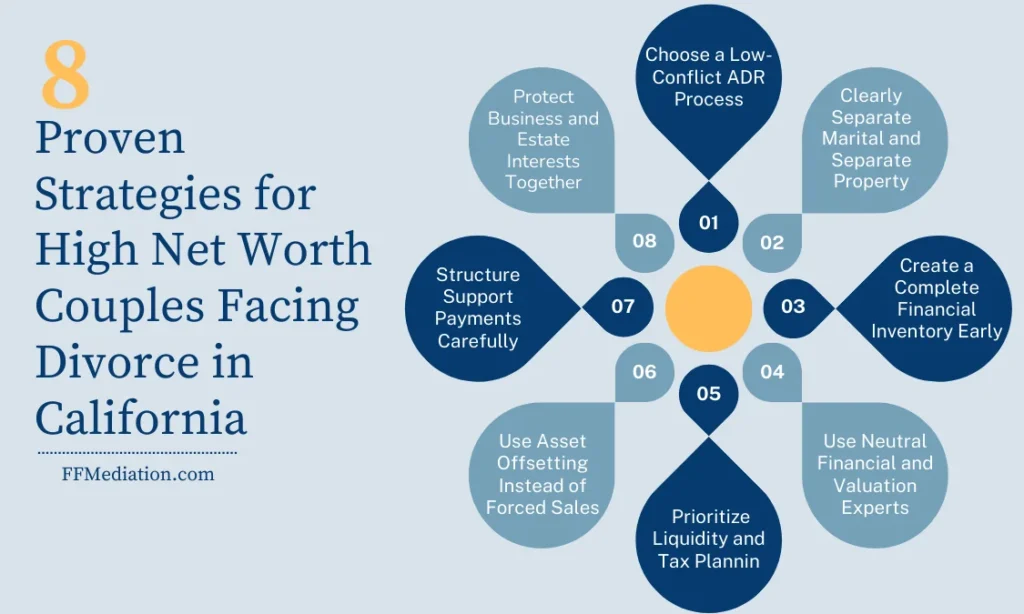
High-net-worth divorces can be incredibly stressful when the asset structure is unclear, emotions are high, and parties are litigating. Your best solution in this high-profile case is structure and confidentiality.
The strategies below are developed to provide focus, clarity, fairness, and long-term financial stability during your divorce, even when one spouse controls more assets or income.
The method you choose to handle your divorce will affect the overall cost, your level of control, and privacy.
If you choose litigation, your case becomes public, can get delayed by court backlogs, and can become expensive with attorney fees and expert involvement. It’s common for complex divorce cases to cost over $100,000.00 in attorney’s fees when litigated.
On the other hand, ADR services like mediation are a confidential and private approach. An experienced mediator will provide a structured process to manage difficult financial topics.
Additionally, experienced attorney-mediators will be well-versed in complex asset and income structures and able to provide higher-quality solutions for the family.
In addition to the benefits of mediation, the process can reduce conflict and boost future cooperation, especially when used early.
This cannot be overstated; during marriage, separate your separate property assets from community property.
During divorce, spend time to identify your separate property assets and credits. Doing this protects important financial items like inheritance or gifts.
If you are unable to agree or prove your separate property, the default will be that asset is community property.
Document and catalogue all assets correctly to speed up disclosure, build credibility, and prevent legal challenges. To do this, take note of all businesses partnership interests, RSUs, stock options, real estate in multiple states, digital assets, and all liabilities as well.
Doing this correctly speeds up resolution and reduces suspicion from the courts or your spouse, giving you a better chance to reach a negotiated agreement.
Divorce can be mentally and emotionally nerve-wracking, which is why compiling an asset inventory shouldn’t be done by you or only you.
Consider hiring experts; besides providing neutral perspective, they can assist with proper business valuation, income projection for each asset, tracing and separating commingled funds, and analysing tax impacts.
Even when two different assets have identical values, they can have different outcomes in terms of liquidity and taxes.
Have a financial expert analyze every asset, or at least, the complex ones, and provide an accurate overview of their potential in terms of liquidity and taxes.
Instead of selling every asset in the name of division, you can consider asset offsetting. In this case, one spouse can take the business, while the other keeps investment accounts of real estate of equal value. This way, you don’t have to liquidate unnecessarily; therefore, preserving asset value.
You can choose between offering a lump-sum or paying support monthly. The first option makes it much easier to move on since there’s rarely any reason to reconnect, while the second provides consistent income for the other partner.
Weigh both options, their benefits and disadvantages, and see which aligns best with your future goals.
Consider options that would increase your estate by holding assets jointly. If that’s not possible, consider whether agreed to delayed division might give you both a joint benefit.
For example, selling the family residence when the children are older or real estate values have recovered. Many of our high-asset clients will also reach agreements about inheritance for their children.
Consider if that will be a viable option for you. When you have reached a final settlement, update estate plans and use trusts where applicable. This planning keeps you financially stable while leaving assets for your child or future generation to inherit.
High-net-worth divorce cases can quickly overwhelm you, especially when litigation is involved. But the process doesn’t have to be combative.
With private mediation, you can have an organized and confidential setting to assess your assets and reach mutually beneficial terms.
Choosing mediation avoids stressful court battles, which significantly reduces the chaos, conflict, cost, and mistakes associated with high-net-worth divorce cases. Learn more choosing the right time for mediation.
Dina Haddad helps affluent couples resolve financially complex cases through confidential mediation, preventing unnecessary court battles. Schedule a free consultation call with Dina Haddad today.
High net worth divorces are more expensive because they involve complex asset structures that can take time to unwind, value, or take more time to arrive at a creative tax-effective solution.
The court usually needs help from accountants and business valuation experts and tax advisors to figure out the community division. It’s not uncommon for complex divorces to reach over $100,000.00 in attorney’s fees when litigated.
In high-income cases, the court does not just use a formula to figure out spousal support.
Instead, the court looks at how much money each person makes and how they lived during the marriage. This lifestyle and earning combination is then used as guidelines for calculations.
Yes, mediation can work well for high net worth divorces. Mediation is private, so people can keep their business and money matters confidential.
Families First Mediation helps couples work out their issues without having to go to court and make all their private matters public.
The biggest mistake people make in a high-net-worth divorce is rushing into a settlement without thinking about the taxes and how it will affect their money in the long run.