Home » Divorce and Family law Blog » When is the Right Time to Start Family Mediation? 5 Stages Explained!

Founder Attorney-Mediator and California's Top-Rated Super Lawyer

Dina Haddad and her team provide expert mediation services for Californians. If you want help related to any family law issue, call us or book a consult.
Family mediation can be used to describe mediation in family law matters. It would be the use of a mediator to work out family law issues like divorce, legal separation, child custody, child support and/or spousal support. When to start family mediation depends on the specific issues and the timing for those solutions.
Fortunately, you can mediate your family law matter virtually at any time. The timing may impact the success of the mediation. However, better at some point than never at all. In other words, mediation can be used for those in the thick of divorce litigation just as it is available for those at the start of the divorce.
If you are unsure about the right timing, this guide provides clarity. It explains when mediation is helpful. It also outlines when it may not be appropriate. For guidance specific to your situation, a free consultation is available.
Contrary to common misconceptions, family mediation remains effective whether used before filing, during litigation, or even after the divorce. Starting a court case does not preclude mediation. In fact, an active litigation can provide the clarity and motivation needed to reach a settlement.
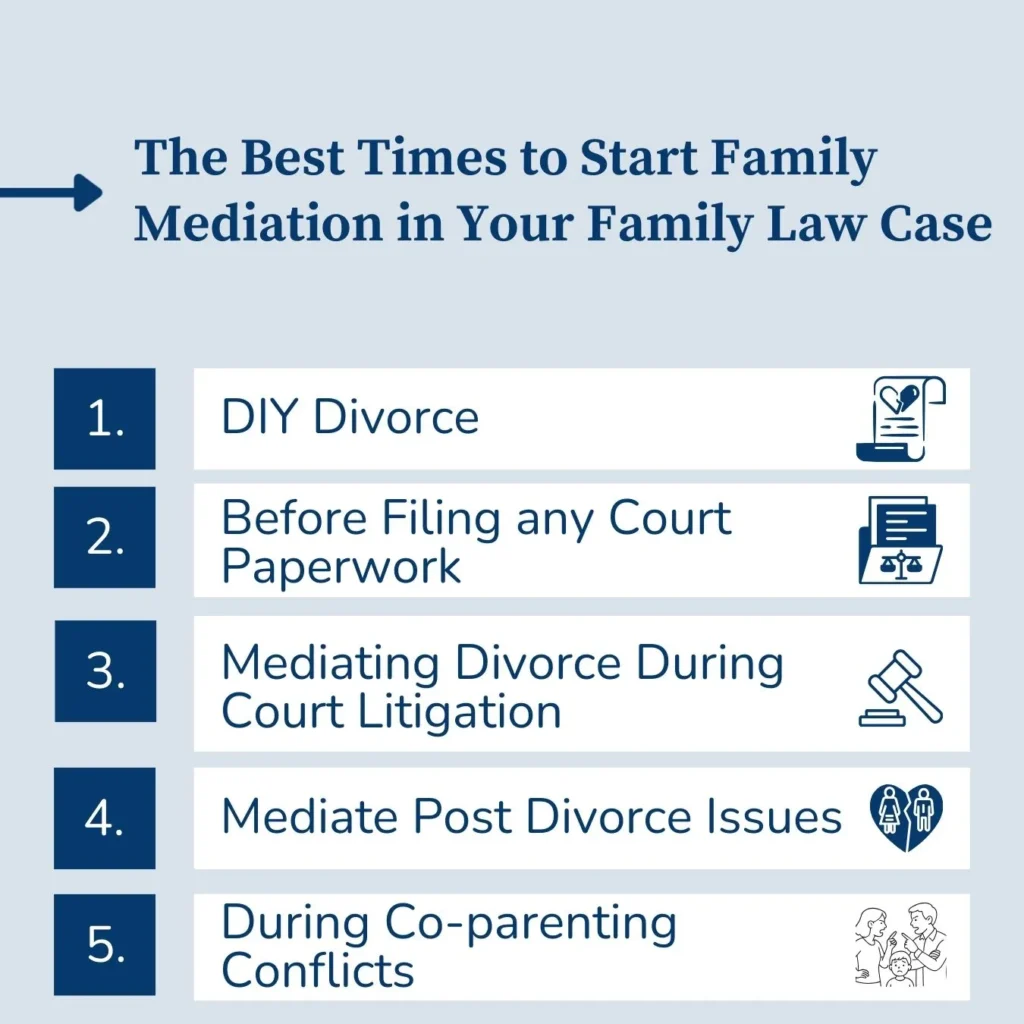
In California, family mediation can support a DIY divorce strategy. It is often used before filing for an uncontested divorce. When both spouses are willing to cooperate, mediation helps clarify key issues such as parenting schedules, property division, and support arrangements.
For this process to be effective, a neutral third-party steps in to facilitate conversation without imposing a decision. In other words, you two choose the outcome, not the divorce mediator. This approach is usually faster and less expensive than litigation.
Some expert-led divorce services include mediation early into their programs. In these programs, mediation happens first before court forms are drafted. The goal is to help couples identify both shared agreements and remaining disputes.
Once all these issues are resolved, the DIY uncontested divorce can proceed smoothly. The costs are lower, stress is reduced, and remaining unresolved issues are documented to be addressed either through another mediation session or legal action.
Starting family mediation before filing court paperwork is common in California. It is often the most effective approach. At this stage, spouses are not yet legal adversaries. Communication is easier to maintain and defensiveness is reduced.
Without a filed divorce case, discussions stay collaborative. The focus remains on problem-solving. It does not shift to procedure. Early mediation also avoids immediate legal costs. Court filing fees are delayed and attorney retainers are avoided. This makes mediation more cost-effective.
Early mediation also allows key issues like child custody, support, and property division to be discussed in a flexible setting. No court orders are pending at this point. This increases the likelihood of agreement. Couples can craft tailored solutions that reflect family dynamics instead of being dictated by statutes or judicial discretion.
A common misconception is that mediation ends once litigation begins. In California, this is not true. Courts do not prohibit mediation during a pending case. Mediation can occur while motions are scheduled. It may happen during pretrial conferences. It can even take place close to trial.
Divorce litigation often increases pressure to settle because unresolved issues will otherwise be decided by a judge, not you. That reality can motivate cooperation. In many cases, it makes mediation more productive.
Mediating during litigation helps both sides zero in on the real issues. The ones that actually matter. Many cases settle before trial even becomes necessary, which means fewer court dates, less attorney time, and lower legal bills overall.
Even after a divorce petition is filed, mediation still works. Custody, support, and property division can all be sorted out. The process stays private. What’s said in the room stays there, until both parties agree and submit the final decisions to the court for approval.
At Families First Mediation, we offer settlement conferences to those parties in litigation but looking for a way to settle their family law disputes outside of court. This could look like the attorneys and parties meeting with the mediator together or in a caucus format, with the intention to settle the pending issues. It could also mean that the parties decide to pause the litigation and try to resolve their issues in private mediation. Learn how mediation is distinct from litigation.
Mediation is often used after a divorce. It addresses disputes caused by changing circumstances or compliance problems.
Post-divorce mediation usually involves related issues like child custody and visitation, child support, spousal support modification, as well as changes to current divorce or legal separation agreements.
Mediation is also used in contempt-related disputes. This includes repeated violations of court orders. For example, a parent may ignore a parenting schedule. Mediation helps clarify expectations and create a workable plan, avoiding prolonged enforcement litigation.
Mediation is really helpful when parents have a lot of arguments about taking care of their kids. This happens a lot when they cannot agree on things like which school the kids should go to, what the holiday schedule should be, what activities the kids should do and making decisions when the kids are teenagers.
The ideal time to mediate is when patterns become apparent. It should happen before resentment sets in. Early intervention helps set expectations and supports healthier communication.
Mediation is especially useful after major life changes like having a new partner, relocating, or when the child reaches adolescence. These are times where parenting needs to shift and they need all the support they can get. Mediation can address these transitions and reduce long-term conflict, improving both party’s ability to coparent effectively.
Timing matters with mediation. So does judgment. There are situations where it simply isn’t appropriate; cases involving domestic violence, coercion, or a serious power imbalance usually require another path.
When those issues aren’t present, mediation can work at many stages of a family law matter. Families First Mediation serves clients across California with a focus on practical, settlement-driven outcomes. Court-mandated mediation is available, but private mediation often offers more flexibility and moves at a faster pace.
If you’re unsure whether mediation is right for your situation, an evaluation can bring clarity. You can schedule a free call with our mediator, Dina, to get guidance specific to your case.
Mediation is appropriate when direct discussions have failed. Both parties must still be willing to negotiate in good faith. Mediation works best once issues are clearly defined and emotions are under control.
Mediation can occur before filing. It can take place during litigation. It is also effective after divorce. California allows mediation at nearly every stage.
No. Mediation should not be used in cases involving domestic violence, coercion, or severe power imbalance.
Cases involving abuse, manipulation, active substance misuse, or refusal to provide financial disclosure are generally unsuitable.
Yes. Many cases fully or partially settle after mediation, reducing court involvement even when complete agreement is not reached.