Home » Divorce and Family law Blog » 9 Research-Backed Reasons to Choose Family Mediation

Founder Attorney-Mediator and California's Top-Rated Super Lawyer

Dina Haddad and her team provide expert mediation services for Californians. If you want help related to any family law issue, call us or book a consult.
Mediation is globally recognized as the better family law resolution method. This view is supported by decades of empirical research.
These studies reveal mediation consistently shows stronger outcomes than court litigation, while other formal processes perform worse.
In California, litigation often creates obstacles. Court backlogs slow progress. Legal costs are high. Privacy is limited. Timelines are rigid. These factors complicate resolution through courts, arbitration, or mandated mediation.
On the other hand, family mediation focuses on flexibility, deliberate participation, confidentiality, and results in high compliance. Mediation can be used to resolve divorces, including custody, support, and property issues.
For case-specific guidance, a free consultation is available. You can schedule a call with Dina Haddad or Samira Amato today.
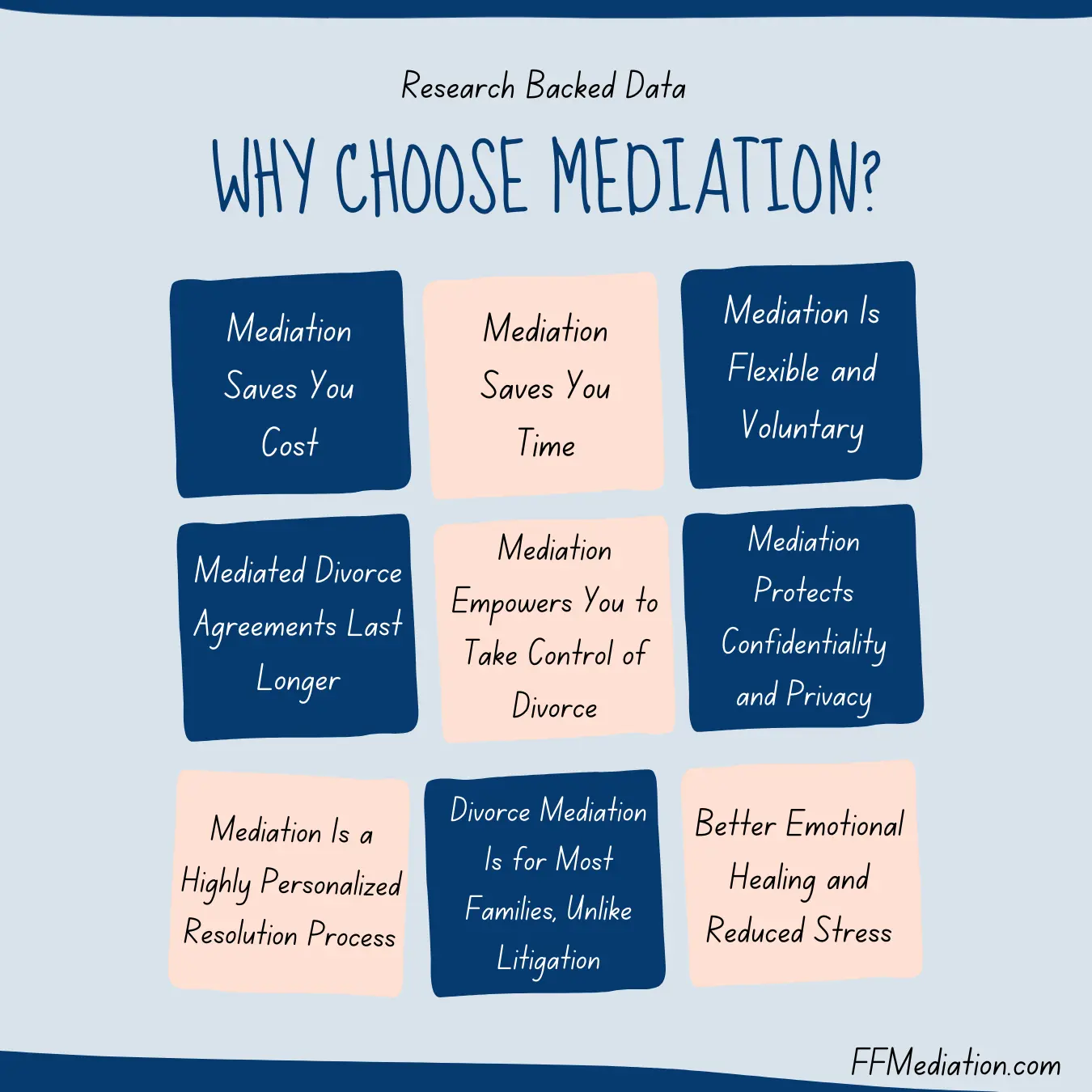
When choosing a process to obtain a divorce in California, parties can do the divorce on their own, mediate, use collaborative practice, or litigate. In Sacramento and across California, research consistently shows mediation as a more efficient and sustainable option. Here’s how:
Mediation reduces many common divorce expenses. Attorney retainers are often avoided. Repeated court appearances are minimized. Motion filing fees are reduced. Expert witnesses are rarely needed.
Unlike litigation or collaborative divorce, mediation focuses on resolution. It does not center on procedure. Issues are addressed directly. Research shows mediated cases cost significantly less than litigated divorces since fewer professional hours are required.
So instead of paying for multiple legal teams, the family only pays for the mediator’s time. This leads to substantial savings in California, especially when looking to lower divorce costs in California.
Studies consistently show that mediation resolves family law disputes faster. It outperforms court litigation and is often faster than court-mandated mediation programs.
Litigation timelines depend on court calendars, continuances, procedural requirements. These can add delays to your case. Meanwhile, mediation moves on the parties’ schedule, and progress is not tied to court availability.
Many mediated divorces resolve in weeks. Some conclude within a few months unlike litigation that can take a year or more. Mediation allows parties to move directly to agreement without needing hearings or trials.
Timelines still vary by case. Even so, mediation typically shortens the divorce process substantially.
Research shows that meditation is growing rapidly in adoption as people continue to solve personal family issues with this peaceful method. This voluntary participation happens because mediation has consistently shown effectiveness and can adapt to one’s schedule unlike court dates.
In other words, sessions can be scheduled around work, and meetings may be conducted remotely. Discussions focus only on disputed issues and parties are not bound by courtroom procedures.
This flexibility allows issues to be addressed in stages. Parties can pause when needed and the process can resume without penalty.
Multiple studies show that mediated agreements last longer. Since both parties worked together to reach a consensus on the path forward, this path is more likely to be followed since it satisfies both party’s needs.
In return, this higher compliance reduces post-divorce litigation. Enforcement actions become less common. Research comparing mediated and adjudicated outcomes even show that mediated agreements lead to fewer modifications or future involvement of the court. This is especially true in custody and parenting cases.
Mediation shifts decision-making back to the family. Control moves away from the court and judge. Parties identify their priorities together, while options are evaluated collaboratively and agreements are reached mutually.
This control matters in family law because rigid legal solutions often miss real-world parenting or financial needs.
Deliberately participating in mediation is where the true power lies. Families can express their issues and work together to arrive at a solution that benefits everyone fairly. This is why mediation is so successful today compared to litigation.
Court proceedings are generally public but mediation is private. Discussions remain off the public record. Proposals are not disclosed. Compromises stay private. Basically, nothing said in mediation becomes public.
This privacy matters to families that want their financial life protected. Parenting conflicts remain confidential as well as sensitive personal information. This confidentiality also supports honesty since open communication improves problem-solving.
Mediation is tailored to each family’s circumstances. It is not based on standardized court rulings.
Parenting schedules can reflect work demands. Support arrangements can fit real financial needs. Property solutions can account for children’s routines. Even cultural considerations can be included.
This level of personalization is difficult in litigation. This is because court time is limited and outcomes are constrained by statutory formulas.
Research shows litigation is better suited for high-risk cases. These cases include extreme conflict, safety concerns, or refusal to disclose information.
Outside these extremes, divorce mediation offers a practical alternative. It accommodates different family structures. It works across varying dispute levels. It also reduces the adversarial escalation often found in litigation.
This accessibility explains why mediation is increasingly favored over traditional litigation.
Research also links mediation to better post-divorce relationships. This is because stress levels are generally lower. The mediation process also encourages respectful communication and stays focused on future planning instead of playing the blame game.
Such a stress-free environment is beneficial to children since the final agreement focuses on stability and cooperation, thereby shielding children from parental conflict.
Family mediation services help families resolve disputes outside of court. The process avoids formal litigation, and a neutral third party conducts the mediation.
This professional may be a lawyer-mediator with family law knowledge. They may also be a trained professional divorce mediator. Nevertheless, the focus is structured negotiation and legal advice is not provided.
Also, the mediator does not decide outcomes. Their role is to facilitate conversation with both parties being in control of decisions.
Family mediation can resolve many issues. These include:
Mediation works best with good-faith participation, where both parties must be willing to engage. Information must be exchanged openly.
However, mediation is not recommended for cases involving safety concerns or coercion. For such situations, other legal approaches like litigation may be better.
Principal & Founder Attorney-Mediator
Dina Haddad is a divorce mediator with over two decades of experience in family mediation. Her work focuses on complex divorce cases and is known for settlement-oriented mediation. She has also developed widely used online divorce mediation programs that serve families across California.

Of Counsel Divorce Mediator
Samira Amato is an experienced California divorce mediator who serves as Of Counsel at Families First Mediation. Her background includes extensive legal training, allowing her to bring deep mediation experience in negotiated family law resolutions.
Mediation offers clear advantages like lower costs, shorter timelines, and reduced conflict. With this method, children and family relationships are better protected.
Mediation works best for families seeking practical solutions where unnecessary trauma is avoided. Before choosing mediation, you need to assess whether all parties involved are ready, willing to be transparent, or can engage in a safe discussion.
The core purpose of mediation is control, where families make their own decisions. Outcomes are not deferred to courts and rigid legal processes are avoided. Everything is done according to your pace and desired outcome. How you divorce matters, if you’re in California. Schedule a free consultation with our expert mediators. Let’s help you reach an agreement peacefully.
Family mediation helps resolve disputes efficiently. Legal costs are reduced, conflict is limited, and long-term family relationships are better protected. This is especially important when children are involved.
Mediation offers flexibility, privacy, lower costs, and faster resolution than litigation. Families keep control and decisions are not imposed by a court.
The biggest benefits of mediation in family is reduced expenses, shorter timelines, and privacy in proceedings. Compliance with agreements is also higher thanks to deliberate collaboration designed to fit your family’s unique needs.
A family mediator guides structured discussions and manages any conflict productively. Parties are supported in reaching voluntary agreements. However, the mediator does not decide outcomes but helps you reach them.
The main purpose is empowerment. Families resolve disputes collaboratively and control stays with the parties. Therefore, decisions affecting finances, children, and the future remain in their hands.
Many cases settle fully through mediation or at least a partial settlement. Regardless, research shows higher resolution rates than litigation with compliance also being stronger over time.