Home » Divorce and Family law Blog » Top 6 Exceptions to Community Property in California

Founder Attorney-Mediator and California's Top-Rated Super Lawyer

Dina Haddad and her team provide expert mediation services for Californians. If you want help related to any family law issue, call us or book a consult.
In California, you can keep inheritances, premarital savings, and gifts—even in divorce. The state has community property laws that require 50/50 division of marital property, but there is still separate property that allows you to keep 100% of the asset and is not subject to division.
However, if assets are not properly handled in California, by either mixing funds or lack of a clear agreement, separate property can become community property. Understanding these exceptions can help you protect your wealth in divorce and in planning your estate. Learn more about these exceptions and mediate your divorce and property disputes California’s Top-rated divorce mediation– Dina Haddad. Book your free Community Property Exceptions consult today.
In California, assets and debts can be classified in one of two ways: community property or separate property. The classification is important since it will determine how such property is divided in the divorce.
According to California Fam. Code § 760, assets and even debts acquired during the marriage are deemed community property. This means they will be divided in half during divorce, and at death, the community property will pass to the surviving spouse. Assets that can become community property include:
Property automatically qualifies as community property if acquired during the marriage. This also includes quasi-community property (i.e. property derived from prior non-CA residences).
Assets that were owned prior to marriage, or received as a gift or through inheritance, are deemed separate property (California Fam. Code § 770). In the event of divorce, you keep those properties – they are not divided.
In the event of the death of a spouse and without a will or trust, typically the default law is that one-half of the separate property will go to your spouse and the other half goes to your other heirs. Examples of separate property include:
If property was obtained before marriage, as a gift or as inheritance or after legal separation, then it is considered separate property. To retain the separate property qualification, the title and financial records associated with it must reflect your sole name to avoid commingling.
Here’s a clearer side-by-side comparison of Separate vs Community property in California:
|
Aspect
|
Community Property
|
Separate Property
|
|---|---|---|
|
Source
|
Acquired during marriage
|
Owned pre-marriage or via gift/inheritance (including during the marriage)
|
|
Division in Divorce
|
50/50 split
|
Retained by original owner
|
|
Documentation Needed
|
Default status (no proof required)
|
Proof of origin/title essential and “tracing” (proof to show the asset still exists)
|
In simple words, clear records determine which category your assets fall into during divorce. Therefore, ensure that you properly document each asset to avoid unwanted losses.
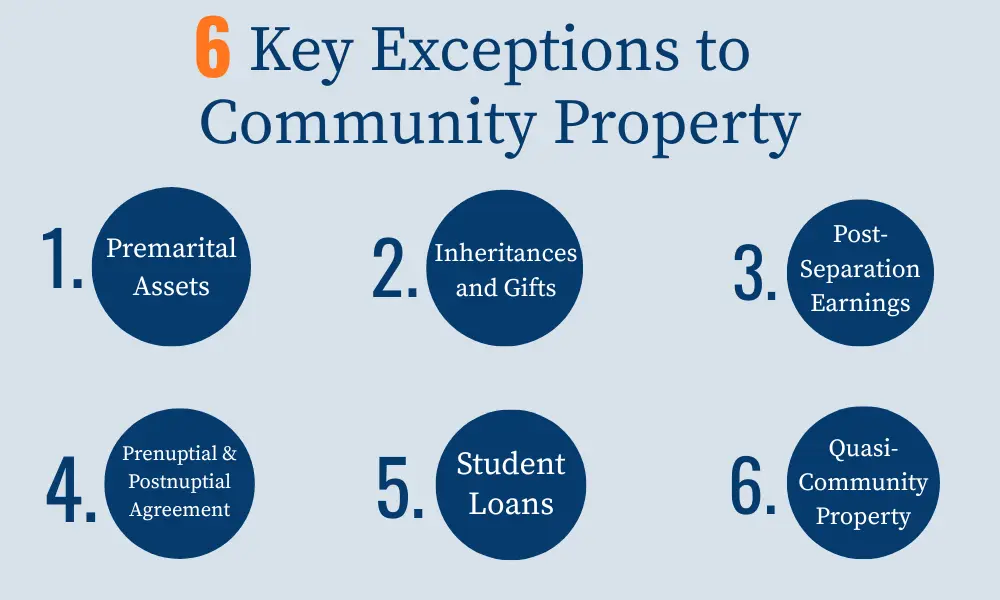
While California encourages a 50/50 division of assets acquired during marriage, there are exceptions with separate property.
If separate property is protected correctly, then the property can continue to be yours—for example, inherited property, premarital savings, and assets acquired after separation, to name a few.
Failing to do so can subject you to losing your property interests. Here are ways to take advantage of the legal protections California gives you to protect what is yours.
Assets you possessed before marriage (account savings, real property, investments) are separate property under California Family Code § 770. Examples of these assets are:
However, if commingled (for example, by depositing marital income into the premarital account) or transmuted, they may lose the separate property designation and be converted into community property. In other words, it is best to keep separate assets, separated, so that they can later be identified as such.
For transmuted assets, a written agreement is required under California Family Code § 852. To protect these assets, it is essential to adequately isolate titles and documents because commingling often results in the loss of any legal protection.
Property received by will or gift during marriage is considered separate property under California Family Code § 771 and is not subject to division in a divorce. But, what happens if you mix inherited money with marital or community savings?
If you combine anything (for example, depositing an inheritance into a joint account), you run the risk of converting it into community property.
If you use the inheritance for a community property home (for example, using it for renovating the family home), you very likely limit yourself to a reimbursement right (and not a separate interest in the property that gains appreciation).
For instance, if a party inherited $50,000 and used it to pay towards the community property mortgage, with proper tracing, a court would credit the party $50,000.00 as their separate property, but the party would not be entitled to an extra percentage of the community property home.
However, so long as your spouse needs proof, you would need to provide the evidence that the $50,000.00 came from your inheritance and paid down the mortgage. The best way to insulate yourself from this risk is to keep inheritances or gifts in a titled-only account and use tracing (bank records/forensic accounting) to prove origin.
Assets or income obtained after your date of separation are separate property (California Family Code § 771) and are all yours. This includes salary, investments, or any real property obtained after your date of separation.
However, a common mistake in the tech divorces is that the unvested employee stock will be considered separate property. Instead, the family courts approach unvested stock, like RSUs and stock options, as mixed property having both community and separate natures post date of separation. This is often referred to as the Nelson formula.
The date of separation is the day when either party intends the marriage to be over and acts accordingly first – such as moving out of the house or bedroom, ending marriage counseling to pursue separation, or actually filing a petition for divorce or legal separation.
It is not solely related to any paperwork filed in court; it is based on your intent + conduct. Proving the date of separation requires evidence like:
If you purchase a vehicle after separation with a loan, the debt will be your responsibility. However, if you used community funds to purchase it, the funds would still be owed back to the community.
Prenuptial agreements (before marriage) and postnuptial agreements (after marriage) can supersede the default community property rules, allowing you to divorce without splitting assets.
These documents legally protect:
This applies to divorce, legal separation, or estate planning (California Family Code § 1612).
Absolutely. A valid prenup can classify your business as separate property, which can also protect it from being divided after divorce. To make a prenup valid, you must disclose all income and assets, neither spouse can be pressured, and you must include particular clauses to identify the business, to list but a few things.
As an example, a clause could potentially read as this: “The Sweet Bakery owned by Spouse A shall be Spouse A’s sole and separate property. There shall be no community property resulting from Spouse A’s time, effort, and skill invested in Sweet Bakery.”
Related: Prenup Vs Postnup in California
Are student loans considered the separate property of a person in California? Not necessarily. The classification of student loans completely depends on the timing of the loan and what the money was used for.
Pre-marriage loans will be separate property (repaid solely by the borrower). On the other hand, they will become community property if the loans taken out during marriage were utilized for the joint benefit of the household, like rent, childcare, or sometimes groceries.
In simple words, student loans are often treated as separate property except used for the benefit of the marriage.
For example:
But can marital agreements override this? Yes. A couple may choose to assign who’s responsible for the loan through a prenup/postnup (California Family Code § 1612).
All property or debts acquired while living in a place that does not have community property laws (like New York) may turn into quasi-community property once brought into California. In the event of a divorce/death, quasi-community property is treated as community property (divided 50/50).
Example: a house bought in New York during marriage, once moved to California, is treated as quasi-community property. Except if it is a gift that was part of their inheritance; that gift would be a completely separate property.
a) Income from Separate Property:
b) Personal Injury Awards
Note, personal injury awards depend on the type. For example, compensation for pain and suffering is considered separate property, whereas lost wages are typically classified as community property.
Protect your premarital assets, inheritances, and gifts by keeping detailed records, tracing the funds and their uses, maintaining separate accounts, using a legal agreement, and utilizing professionals where appropriate. Do not commingle ownership to protect your award legally. Here are some asset division mistakes to avoid during a divorce:
Documenting the source of funds in detail and retaining as many records of any inheritance deposits, premarital balances, or gift letters will help you.
Maintaining a paper trail is crucial; all records must predate the marriage or otherwise demonstrate the origin of the asset. If you cannot prove the source of the funds, the court assumes it’s community property.
You can trace separate property using bank statements, cash receipts, and forensic accounting to track money. You can find deposits from rental agreements or when selling premarital personal property, as well as inherited funds. If you commingle funds, tracing can reestablish your “paper trail” to identify separate property.
If there are or were premarital funds or any inheritance funds, it is best to set these funds up in separate accounts.
You should never deposit marital income into these accounts or pay for anything jointly. Also, title all real estate, investments, or businesses you own solely in your name.
Mediation settles property issues without expensive court battles. Often in mediation, parties will agree to credit the separate party or a middle of the road approach when full tracing documents are not available.
If still possible, obtaining premarital and postmarital agreements will create the parties own property rules rather than California’s divorce property rules. Such agreements allow a party to clarify their separate property assets and limit the amount of tracing required in the situation of a divorce or legal separation.
Work with:
Any divorce will naturally divide assets, unless it involves premarital property, court-exempt property such as inheritances, earnings after separation, agreements where one party relinquishes an asset, or student loans used solely for a purpose unrelated to the couple.
Avoid commingling assets to keep them separate and use mediation to resolve property division in a timely and cost–effective manner while maintaining control over your estate and reaching creative agreements for complex assets and income. Still confused? Consult Dina Haddad, Divorce Attorney Mediator. It’s completely free and no-obligatory.
In California, the following items are not considered part of community property: inheritances, gifts, property owned prior to marriage, and property or earnings acquired after separation. If these assets are documented appropriately (California Family Code §§ 770-771), they will be considered separate property.
Yes, with legal agreements only. Nothing verbal or informal will hold up in court. Execute a pre-nuptial agreement, post-nuptial agreement, or a transmutation agreement (California Family Code § 852) to either change the classification of assets or waive community rights to them. Courts will enforce a contract that is properly drafted.
Cryptocurrency is treated like other assets: it would be classified as community property if acquired during marriage (by mining, trading, or purchasing). The first hurdle is to prove ownership of the cryptocurrency and/or trace its origins. However, prenups can override this rule.
Only if you and your spouse took that debt together while you were married (California Family Code § 910). For example, household bills, family vacations, or a shared item together. If your spouse incurred expenses that do not benefit the community (like gambling), then those are theirs alone. Debts incurred after separation are likewise separate.