Home » Divorce and Family law Blog » How to Refinance Your Mortgage After Divorce in California


Reach out to find the best solution for your divorce with trusted professionals.
In 2021, a California couple took out a $1.1 million, 30-year mortgage at 2.875%. They entered divorce mediation and agreed that one of them would retain the home.
However, the other spouse’s financial obligation (refinancing) would increase monthly payments to approximately $2,800. This means that divorce decrees and quitclaim deeds do not release the departing spouse from their mortgage obligations.
This guide goes deeper into refinancing options, buyout terms, and timing. For specific help with the best move for your divorce, schedule a free consultation call with our mediators at Families First Mediation.
When you divorce in California, your divorce agreement decides who keeps your house and how much of the monthly mortgage payment they must make. However, it does not remove either of you as a borrower on the mortgage. Family Code sections 760 and 2550 govern how a couple divides community property when they divorce.
Regardless of what the court decides in the divorce judgment, the bank has no obligation to honor anything other than what the borrower signed when he or she took out the loan.
So if one spouse pays the home’s bills after the divorce, the other spouse has a poor credit history, and the paying spouse misses two payments, the bank may pursue both spouses for the money owed and further damage both of their credit histories. The main solutions are refinancing, an approved mortgage assumption, or selling the property.
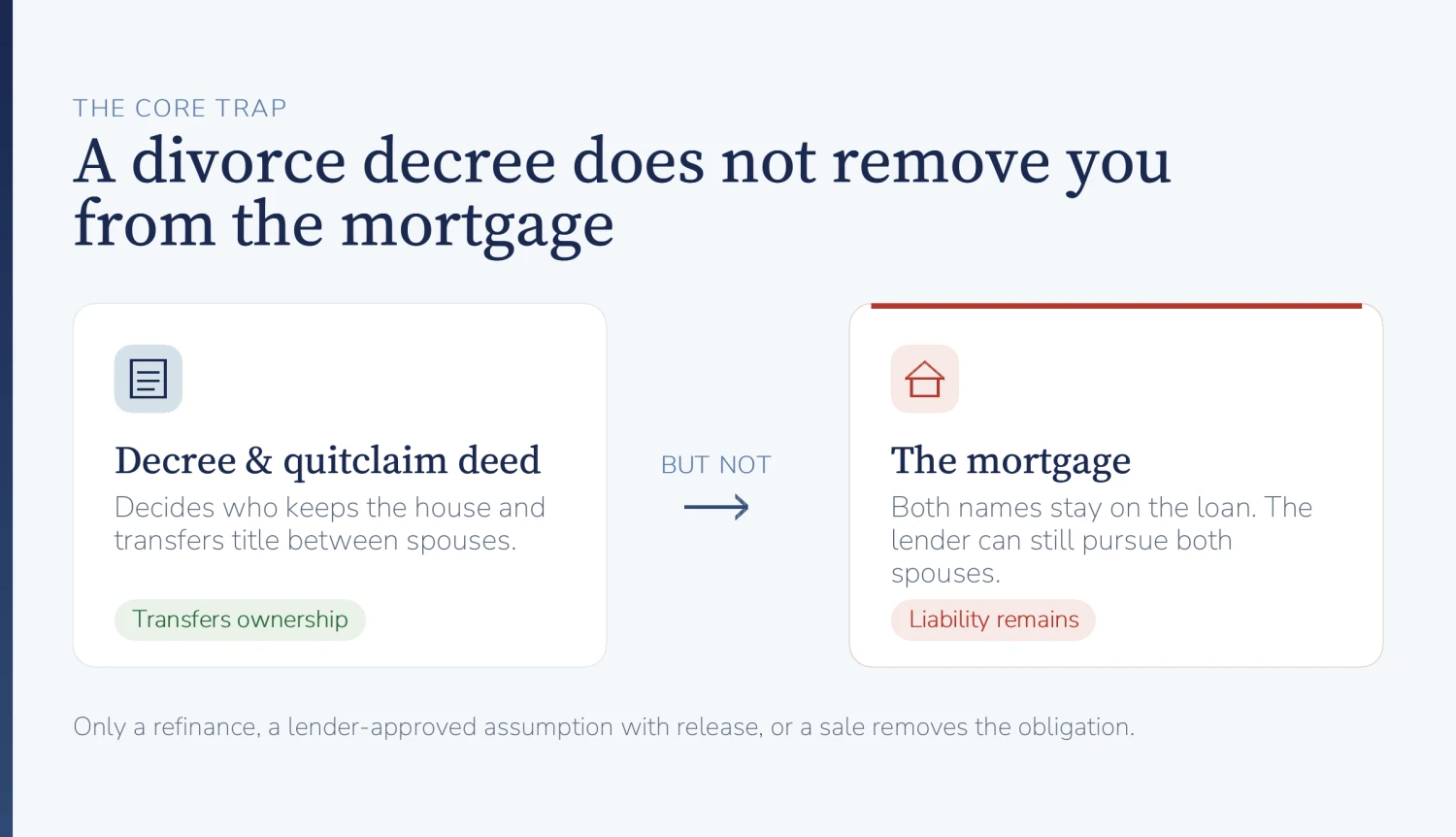
An interspousal transfer deed often conveys a California home between spouses during a divorce. Similarly, a quitclaim deed transfers an interest in the real estate, and either document may qualify for the California spouse exclusion if properly documented.
However, conveying the interest by deed alone does not eliminate one spouse’s liability on the mortgage. In addition, the Preliminary Change of Ownership Report (PCOR) must accurately document all aspects of the transaction and any applicable exclusions. Failing to report this information correctly can prompt an assessor inquiry and trigger additional action.
California Civil Code Section 2951 was created by AB 3100. It requires qualifying conventional home loans originated on or after January 1, 2027, to allow the spouse who retains the property to assume the mortgage (with lender approval) based on their income qualifications.
Section 2951 will not apply to older mortgages. Therefore, if a couple divorces in 2026 using a 2.875% pandemic-era loan, they cannot use Section 2951 to maintain this rate. Instead, they may need to consider existing assumption rights, refinancing, or selling the home.
California divorcing couples have four main options: refinance with a buyout, use limited cash-out refinancing, sell the home, or pursue a formal mortgage assumption. Each option has different costs, eligibility rules, and consequences for both spouses.
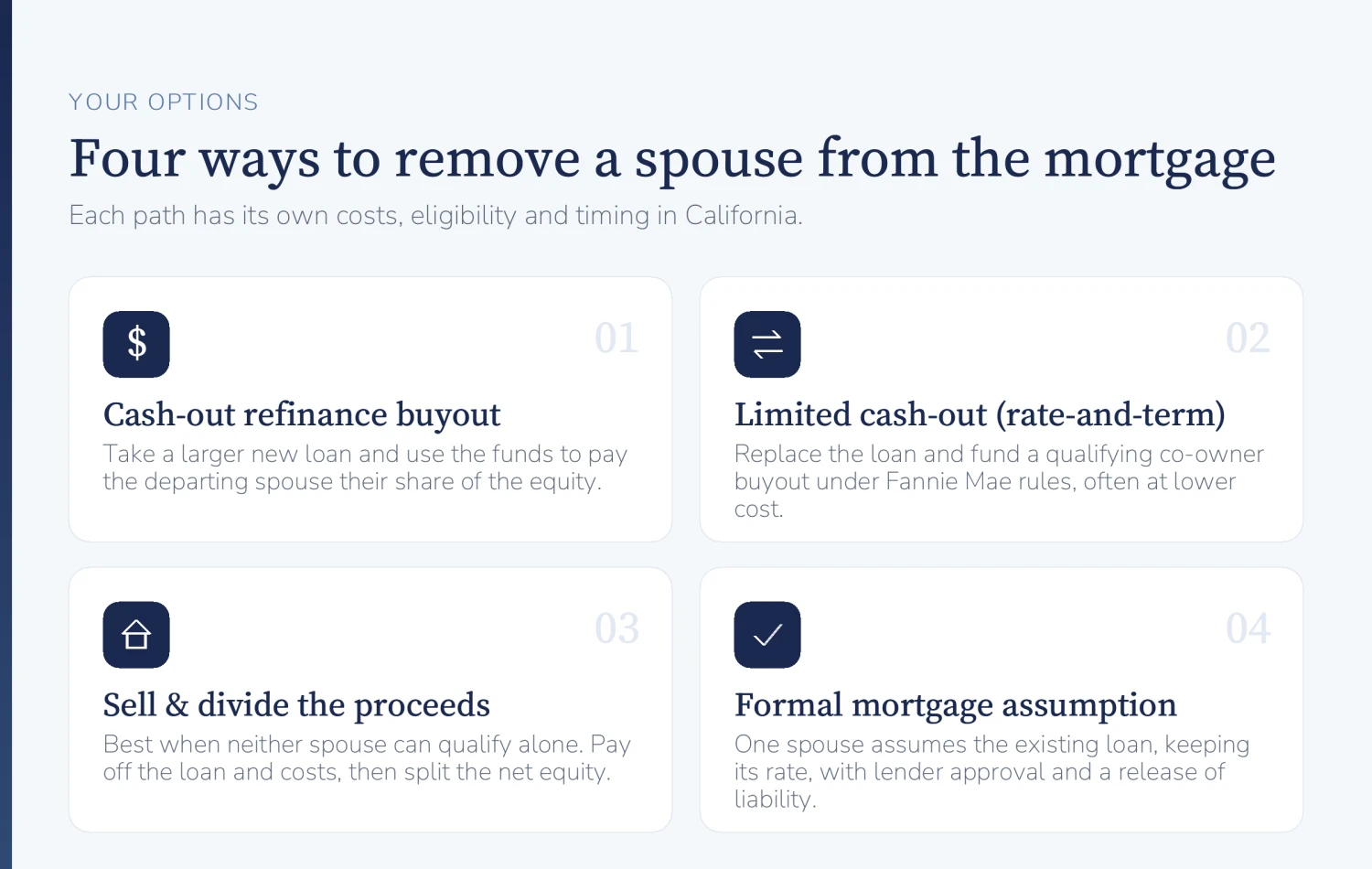
A cash-out refinance (also known as owner financing) creates a new loan for more than the original joint mortgage. The spouse who wants to stay in the property takes out this larger loan and uses the funds to pay out the departing spouse’s share of the property’s equity.
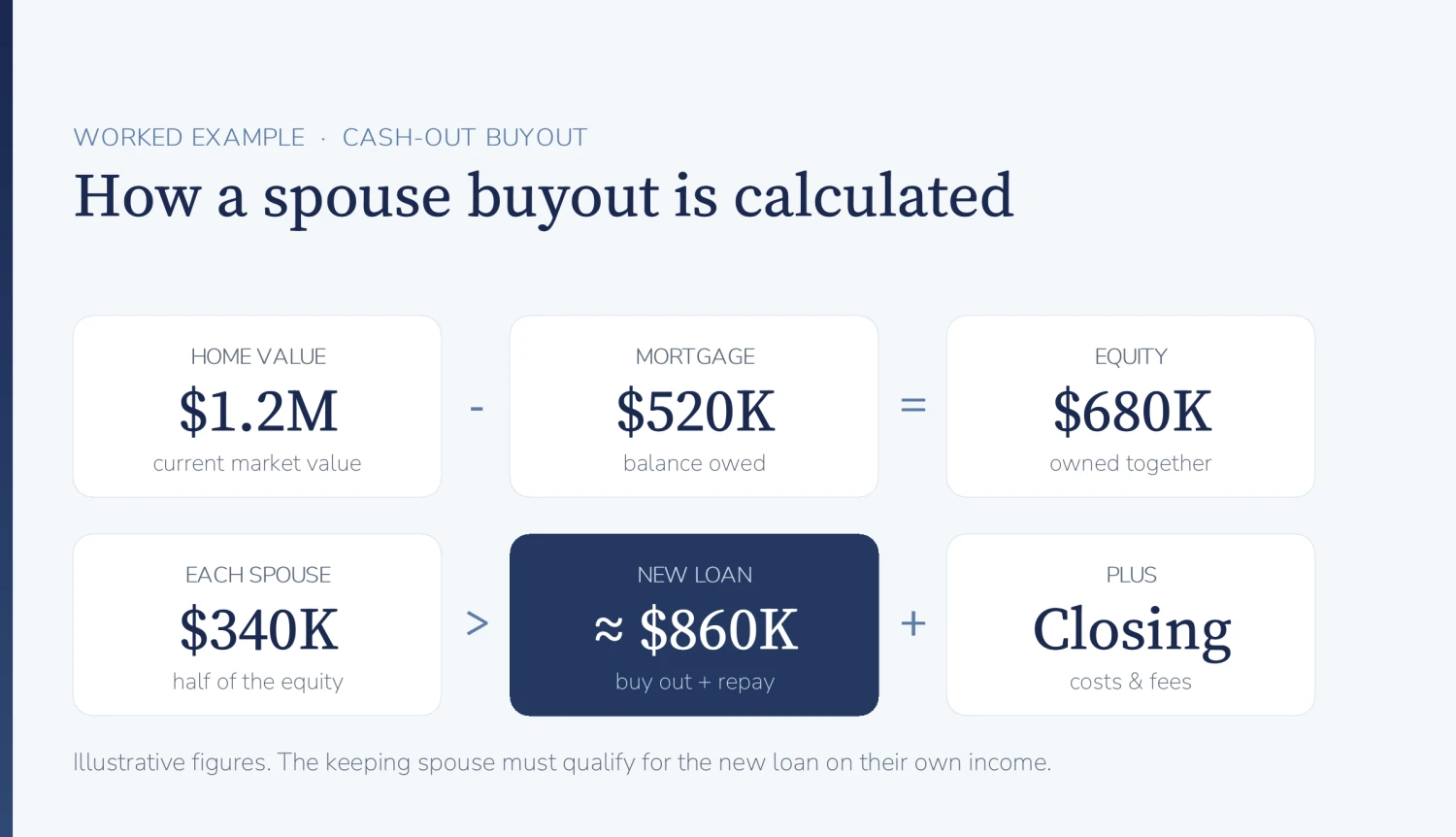
In the case of a $1.2 million home with a current mortgage of $520,000, there is $680,000 in available equity. Because both spouses own the home, they would split the $680,000 equally — $340,000 per spouse. To create this new loan for the spouse remaining in the house, you would need a new mortgage of about $860,000, plus closing costs.
A limited cash-out refinance replaces your old mortgage with a new one that lets you fund a qualifying co-owner buyout under Fannie Mae guidelines. Generally, the property has been jointly owned for at least 12 months, and the keeping owner qualifies on their own. The buyout proceeds are paid to the existing owners — the keeping spouse cannot receive them.
In addition to documenting the property transfer and distribution of the proceeds in the written agreement, it may provide lower interest rates or fees than a typical cash-out refi. However, 95% LTV on a limited cash-out refi is subject to additional eligibility requirements and does not include high-balance loans as part of Fannie Mae’s 97% option.
Selling the house is often the best choice when neither partner can qualify for a loan to keep the home or needs to use the equity to support two households. Use the proceeds to pay off the current mortgage (and interest), agent commissions, any necessary repairs or staging, and all local transfer taxes.
While the commission amount is determined by contract with the agents involved, the tax owed depends on where you live. After paying these expenses, the two of you can agree on how much net equity each will receive. During this period, you can also consider ways to divorce without splitting assets. If either party meets certain requirements, they may exclude the first $500,000 in profit (if married) or the first $250,000 (if single) from their gross income when filing federal taxes.
With a mortgage assumption in place, one of you may be able to assume the current loan, possibly keeping the original terms (interest rate and remaining term). The lender must agree to the assumption and officially discharge the spouse leaving the property from the loan.
All three federal programs — FHA, VA, and USDA — allow loan assumption but follow their own rules. Most conventional mortgages can be assumed with the lender’s approval and typically require refinancing. In certain FHA cases, a borrower may also have a streamlined option if they have made several months’ worth of documented payments on their own and meet all required qualifications. As of January 1, 2027, a qualifying new owner-occupant conventional mortgage will need to contain an assumption provision under California Civil Code § 2951.
Mediation works differently compared to litigation because it can include financing deadlines, settlement language, deed transfers, taxes, and backup plans in your mediation agreement. This gives you full knowledge and understanding before you make a final decision on how to divide marital assets based on what each spouse can afford.
A divorce takes at least six months to finalize after service of the summons and petition, or the respondent’s first appearance, whichever occurs first, under California Family Code § 2339(a). No court can shorten the statutory time frame.
This six-month waiting period allows time to address an appraisal, lender comparisons, rate locks, and drafting of the Marital Settlement Agreement (MSA), often through a divorce mediation process. It also gives spouses the opportunity to determine whether they need to support income to meet lender payment-history requirements before refinancing.
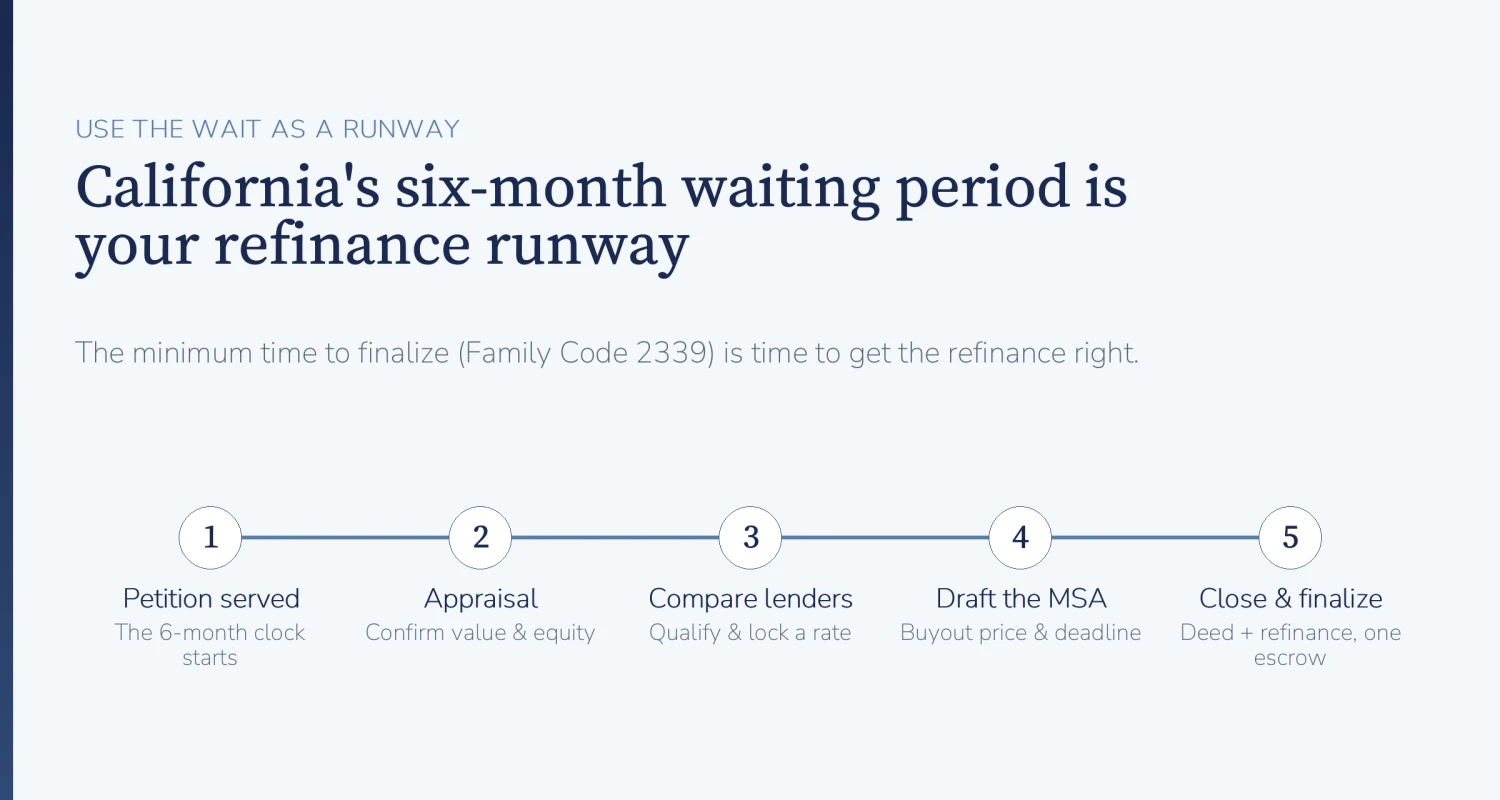
When drafting an MSA, it is best for each party to clearly outline when they will need to refinance (usually within 90–120 days of signing), and specifically identify which party is responsible for paying the loan until closing.
The parties should also decide how appraisals will be conducted, what the total buyout price will be, and what to do if refinancing does not occur. A divorce mediation checklist can clarify what to prepare. The parties may allow additional time if either party cannot qualify for financing; if so, they can use retirement funds to cover the difference in the buyout price. The agreement should also specify who will pay closing costs, rather than assuming both parties will share equally.
The Interspousal Transfer Deed (ITD) and refinance should typically close through a single escrow to ensure both parties are accurately reflected as owners of record and liable for the mortgage. Additionally, California’s Proposition 19 regulates which properties can transfer an eligible base year value from one spouse to another.
For example, eligibility depends on whether you were over 55 at the time of the sale, disabled, or experienced a qualifying natural disaster. If both former spouses meet these requirements, specific rules may determine who receives the benefit; therefore, we recommend discussing this in your separation agreement before filing for divorce.
Refinancing after your divorce involves more than deciding who keeps the home. The following seven common mistakes could make one spouse responsible for the other’s debts, increase your borrowing costs, or cause you to pay taxes on more property than necessary.
1. Signing a quitclaim deed before the refinancing has closed. This transfers title, but it does not release your mortgage obligation. Make sure the deed transfer and lender-approved refinancing occur simultaneously with the escrow closing so neither spouse is left with an unintended burden.
2. Assuming AB 3100 preserves an old mortgage rate. Civil Code Section 2951 does not apply to existing mortgages made prior to January 2027. If you were married and divorced in 2026, check into any assumption rights that still exist, as well as alternative financing opportunities available now.
3. Leaving limited cash-out buyout provisions out of the MSA. Fannie Mae requires adequate documentation of the awarded property and how equity was divided. If the MSA language is incomplete, the new owner may face different underwriting treatment and a higher cost of obtaining a loan.
4. Believing Fannie Mae and Freddie Mac treat all divorce buyouts equally. Although they share many similarities, their frameworks for treating divorce buyouts differ significantly. Ask your mortgage broker which framework best fits your circumstances, and get quotes from both entities on available funding amounts, loan limits, and rates.
5. Using the wrong deed or reporting the transfer incorrectly. Although an Interspousal Transfer Deed may be the best way to transfer a property as part of a divorce settlement, a quitclaim deed is not always considered void and may still be acceptable depending on the situation. To minimize the likelihood of a reassessment inquiry, complete the Preliminary Change of Ownership Report accurately.
6. Not considering Prop 19 planning. You need to discuss any possible base year value transfer before finalizing your agreement. Each spouse must meet unique eligibility and claim criteria to receive benefits, so you can’t rely solely on whoever filed first.
7. Assuming support income automatically qualifies. Lenders determine whether your spousal or child support payments meet their guidelines for length of time and payment history. Before agreeing on support terms within the MSA, confirm these requirements so you can plan ahead for qualifying for refinancing.
Refinancing a home after a divorce requires legal, financial, and tax considerations. Dina Haddad, principal mediator at Families First Mediation, and her California attorney-mediators work together to prepare Marital Settlement Agreements (MSAs), transfer the deed to the new owner, determine the escrow closing date, and assist with property tax strategies.
Refinancing is time-sensitive, and in most cases you will need a backup sale arrangement in case the refinancing fails. In many cases, California divorce mediation costs significantly less than litigation.
Want professional guidance on your assets during the divorce? Schedule a free consultation call with Families First Mediation today.
No, California law does not require you to refinance your mortgage solely because you are divorced. That said, your marital settlement agreement may require you to refinance so you can remove your ex-spouse from the mortgage.
No. A quitclaim deed transfers all rights to the property to whoever receives it, but it does not eliminate your personal liability for the mortgage. You must obtain an approved refinance, an approved assumption with a release of liability, or approval from a new lender before you can remove your name from the mortgage obligation.
There isn’t a specific statutory time limit. Typically, your marital settlement agreement or court orders specify when you must refinance. The common timeframe is 90–180 days, with contingency plans in place if you can’t refinance.
Yes. Depending on how you received the money, whether you have the required documentation, and whether you meet other lending criteria, some lenders will let you qualify using spousal support. Each lender has its own standards, including how long the payments will continue.
California Civil Code Section 2951 creates a qualified conventional mortgage presumption of a post-divorce assumption right for certain home mortgages originating on or after January 1, 2027. It does not apply to mortgages originated before January 1, 2027.