Home » Divorce and Family law Blog » Celebrity & High-Profile Divorce Mediation in California


Reach out to find the best solution for your divorce with trusted professionals.
The biggest problem with celebrity and high-profile divorces is that personal details are open to the public. This puts you in the spotlight, with multiple conversations surrounding this difficult moment in your life.
Fortunately, not all high-net-worth divorces in California have to be that way. For public figures, celebrities, and high-net-worth families, mediation offers one of the best options for privacy, asset protection, and a child-focused process.
In addition, at Families First Mediation, as long as allowable in your county, we can provide you the option to keep your Marital Settlement Agreement confidential and out of reach of the public court file.
For expert advice on how to navigate your high-net-worth divorce, schedule a free consultation with our high-net worth divorce mediators.
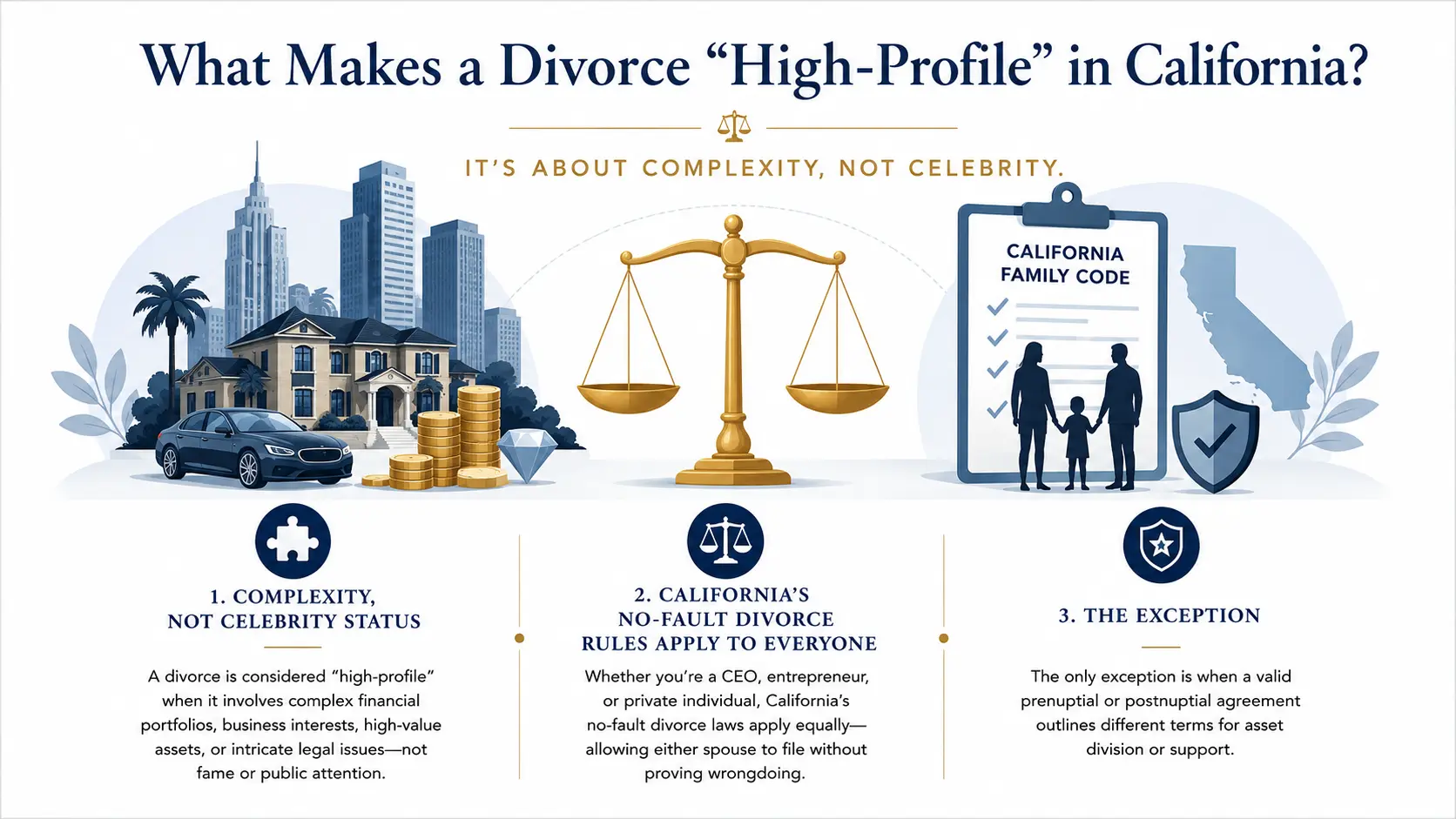
California law establishes no unique classification for celebrity divorces. All dissolutions in California will be governed by the same provisions of the California Family Code, regardless of whether either spouse is a celebrity, executive, entrepreneur, etc.
The California laws regarding the division of assets, child custody, and spousal support do not change simply because a spouse (or spouses) has achieved fame. It is not fame that defines a high-profile divorce but the complexities of the legal, financial, and privacy-related concerns.
High-net-worth celebrity divorces are often complicated and involve large sums of money and complex financial issues. Some common traits that define this type of divorce include:
Therefore, a tech founder in San Jose, a neurosurgeon in Los Angeles, or a pro athlete in San Francisco will likely face similar financial/legal challenges to those of an actor in Hollywood. Complexity of the case is the main differentiator, not social status. However, you cannot also ignore that the public is keenly interested in the private lives of these individuals.
Many high-profile clients incorrectly assume that their spouse’s misconduct will result in better financial outcomes than if their spouse had acted correctly. Generally, this is incorrect.
California is a “no-fault” divorce and community property state. Therefore, marital misconduct, which includes adultery, rarely affects the manner in which community property is divided or how spousal support is calculated.
In California, both spouses owe fiduciary obligations regarding the management of marital (community) property throughout the duration of their marriage, as well as in dividing that property.
As such, if one spouse willfully withholds information about his/her marital assets, willfully dissipates community funds for his/her own benefit, or fraudulently transfers community assets prior to or subsequent to the date of separation, the Court has the authority to order remedies beyond simply an equal distribution.
Potential remedies include allocating the unreported asset(s) to the “innocent” spouse, requiring the spouse who acted improperly to reimburse those amounts, and/or imposing other adverse financial consequences on that spouse.
Because forensic accounting expertise, expert business valuations, etc., are frequently needed to identify these types of problems in high-net-worth cases, using mediation at the earliest stages of a case is particularly advantageous.
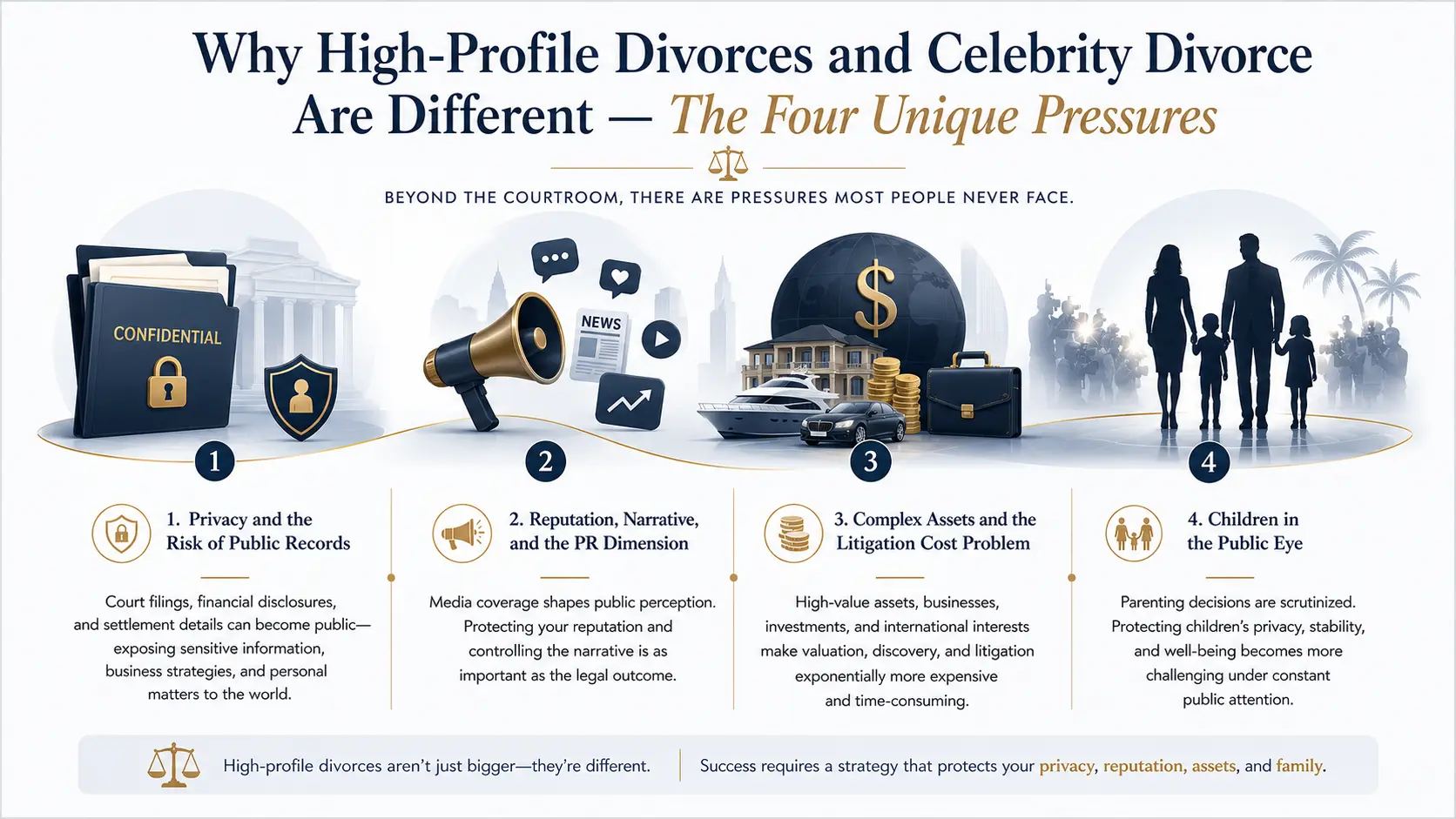
California divorce laws for celebrities are identical to those for private individuals; however, the consequences of a celebrity divorce differ dramatically.
The public has access to court documents and to the constant media attention, and there may be a large number of marital assets at issue. There are also child privacy concerns.
Mediation offers confidential high-net-worth divorce solutions such as mediation agreements (Marriage Settlement Agreement), which will limit public disclosure; redacted versions of the agreement that remove sensitive information from the public view; and, in rare instances, the ability to seal some or all of the records.
California divorce records are public and generally open to the public. Once your documents have been filed with the court, the public may be able to access (depending on the specific court) all financial disclosure statements, income and expense declarations, and all other court documentation related to your case, unless otherwise ordered sealed by the court.
It’s also possible to seal judicial records, but only under five very limited circumstances. The court must determine that there exists an overriding interest, that the sealing will support that interest, there is a reasonable likelihood of harm if the record is unsealed, the request for sealing is narrowly drawn, and that there exists no less restrictive way to seal the record. Simply wishing to avoid media coverage is typically not sufficient under NBC Subsidiary, Inc. v. Superior Court.
Therefore, for most high-profile divorcing parties, the best strategy is to keep as much private and personal information as possible out of the court file during their divorce.
This can be accomplished through private mediation, where you negotiate your settlement details privately outside of the courtroom, and through a well-written Marital Settlement Agreement, which reduces how much of the settlement details goes into the public record.
High-profile divorces are fought on two fronts: legal issues & public image. Mediation allows both parties space to negotiate joint press statements, social media conduct provisions, protocols for responding to the media, confidentiality clauses, and limiting disclosure.
This is unlike litigation, where all personal details (allegations, declarations, counterclaims) are open to the public and can not be undone.
Also note that confidentiality provisions have limits. An NDA or confidentiality clause included within a Marital Settlement Agreement (MSA) will not prevent either party from complying with a lawful subpoena, cooperating with law enforcement, participating in a criminal investigation, or making any other disclosures required by law.
These provisions primarily govern the actions of the parties, their households, and representatives.
High-profile divorces are most likely to involve closely-held companies, as well as other high-value items such as:
Determining whether an asset is classified as “community” or “separate” property, tracking commingled assets, assessing the value of a business entity, and locating undocumented income may require services from forensic accounting firms, business valuation consultants, and/or other financial professionals.
Separate from mediation, in which both spouses hire their own experts to produce conflicting opinions on the value of a marital estate, mediation can be implemented in which both spouses retain a single, impartial expert to produce a single report detailing the marital estate’s value. This approach allows for cost savings by eliminating duplicate work by multiple experts while minimizing costly expert-to-expert conflicts that contribute to many long and expensive celebrity divorces.Learn more about how to avoid costly mistakes in high net worth divorce?
Children of public figures face special privacy risks during divorces. California Family Code § 3170 generally requires mediation between parents before the court hears contested custody or visitation issues. Mediation can happen through Family Court Services (FCS) or private mediators. Learn more about how to choose high net worth divorce mediator in California.
Some counties recommend mediation: mediators there can submit custody recommendations to judges if parents cannot reach an agreement. Other counties use non-recommending mediation, in which no recommendation is made. For high-profile families, it is better to resolve parenting issues first through private mediation to reduce public attention and unnecessary court filings.
With mediation, both parties can draft a parenting plan that addresses important realities of public life, such as media interviews and social media posts involving the child. This can also involve requiring confidentiality from household members and prohibiting discussion of the divorce in front of the children.
California uses the same family law for all divorces; however, high-profile divorces require a unique approach due to factors such as complex assets, privacy considerations, public scrutiny, and the best interests of children.
Dina Haddad has substantial expertise in mediating high-net-worth and high-profile divorces and provides her clients with the opportunity to resolve disputes privately without the need to go to court.
The benefits of private mediation include preserving your family’s privacy, reducing financial burden, protecting your reputation, and limiting or eliminating many long-term effects of public litigation. Schedule a free consultation today!
Yes, to some degree. In many cases, they have used private mediation, limited their filing requirements in court, and redacted sensitive documents. Generally, it is difficult to seal all aspects of a divorce proceeding entirely in California. In many California counties, couples are allowed to keep their Marital Settlement Agreement confidential so that it is not filed with the court by using a private judge.
Yes, to some degree. In many cases, they have used private mediation, limited their filing requirements in court, and redacted sensitive documents. Generally, it is difficult to seal all aspects of a divorce proceeding entirely in California.
Generally yes. Communications made during mediation in California are usually confidential; however, there is no protection against disclosing communications to comply with a court order or subpoena.
Community property laws treat royalties and IP that were generated during your marriage as Community Property. However, if you owned these items prior to your marriage, then they would be considered Separate Property. Allocation typically requires that each item be traced and valued.
Yes. Only if both spouses are willing to provide complete financial disclosure. With the help of forensic accountants, mediators can proceed with mediation based on full financial disclosure. If a party continues to withhold information, mediation is not recommended, and court action becomes the better option.
Cryptocurrencies and NFTs, which were obtained by you and/or your spouse during your marriage, are normally treated under California law as community assets. Therefore, prior to their distribution in a divorce action, each cryptocurrency/NFT must be identified, determined to have value, and its classification as community or separate property established.