Home » Divorce and Family law Blog » What Happens to the Family Home in a California Divorce?

Reach out to find the best solution for your divorce with trusted professionals.
Most California couples have a home that represents both their biggest asset and a source of stability; “What will happen to the house?” is usually one of the first issues each spouse considers when they start thinking about divorce.
What will happen to your home depends on when you bought it, who paid with their own money, how the property’s value increased (equity), and not simply who is named on the title (the deed).
This guide discusses characterization, calculation of rights using the Moore Marsden formula, claims for reimbursement, options for keeping, selling, deferring, tax implications, and mediation.
A neutral California divorce mediator like Dina Haddad can help you reach an agreement without handing the decision to a judge. Schedule a free consultation today!
Everything about a California family home starts with one question: Is this property Community Property, Separate Property, or some combination of both?
When a property was acquired, how it was funded, and who holds title will help answer this initial question.
Generally speaking in California, all property purchased during marriage is characterized as Community Property.
On the other hand, properties exempt from community property in California are mostly individually owned items prior to marriage or acquired through gift or inheritance is typically Separate Property.
Also, if the parties acquire additional property after their marital separation, it is typically characterized as Separate Property.
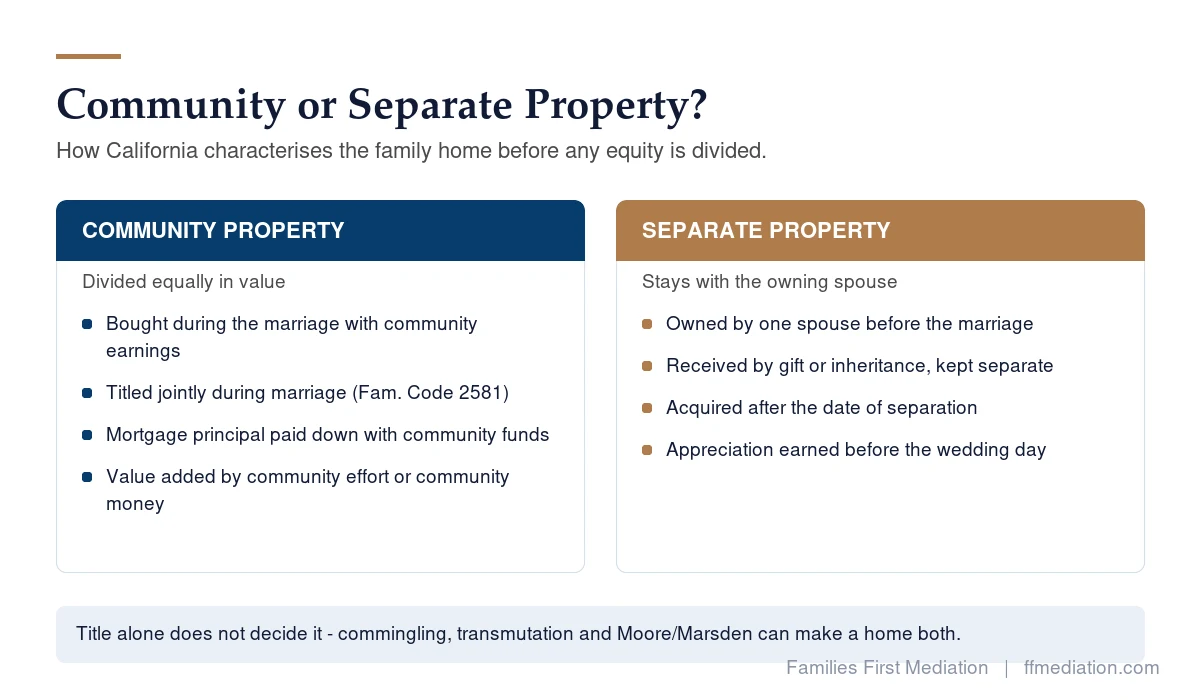
Timing sets the presumption for where you begin. Typically, a house bought with community funds during the marriage is considered community property, regardless of who earned the income to buy it or whose name is on the deed.
However, if a house is purchased before marriage, it is typically characterized as separate property.
However, once married, either spouse may pay toward the principal of their mortgage, creating a community interest in the house.
The three primary dates to focus on are your wedding day, the date you separated, and the date you value the assets at the time of divorce. Learn more about “when I should file for divorce in California.”
Title does not determine characterization. Family Code Section 2581 establishes a presumption of Community Property when property is titled as “Joint” during the marriage.
In In re Marriage of Brace (2020), the California Supreme Court also held that the Community Property rules take precedence over title-based presumptions.
Therefore, one party being off title does not necessarily negate a community claim, nor does one party being the Sole Title Holder automatically create Separate Ownership.
In marriages, it is common for the community and separate funds of both spouses to be commingled.
For example, if one spouse uses their own money (separate) as the down payment on a house but then makes the monthly mortgage payments with community funds, this creates a property interest with a dual nature that will require some degree of tracing and apportionment.
If a spouse cannot identify which portion of their community property came from separate property, they may lose the entire claim.
Unlike tracing, transmutation changes one type of marital property into another. Section 852 of the Family Code states that, typically, an express written statement must change the character of separate property to community property, or vice versa.
When one spouse owns a home before marriage and makes no other contributions from separate assets (except in cases of existing co-ownership), the parties create a pre-existing marital estate issue when they apply community income to pay down the mortgage.
In this instance, we use the Moore/Marsden method to calculate what portion of the reduced amount of equity is attributable to the community.
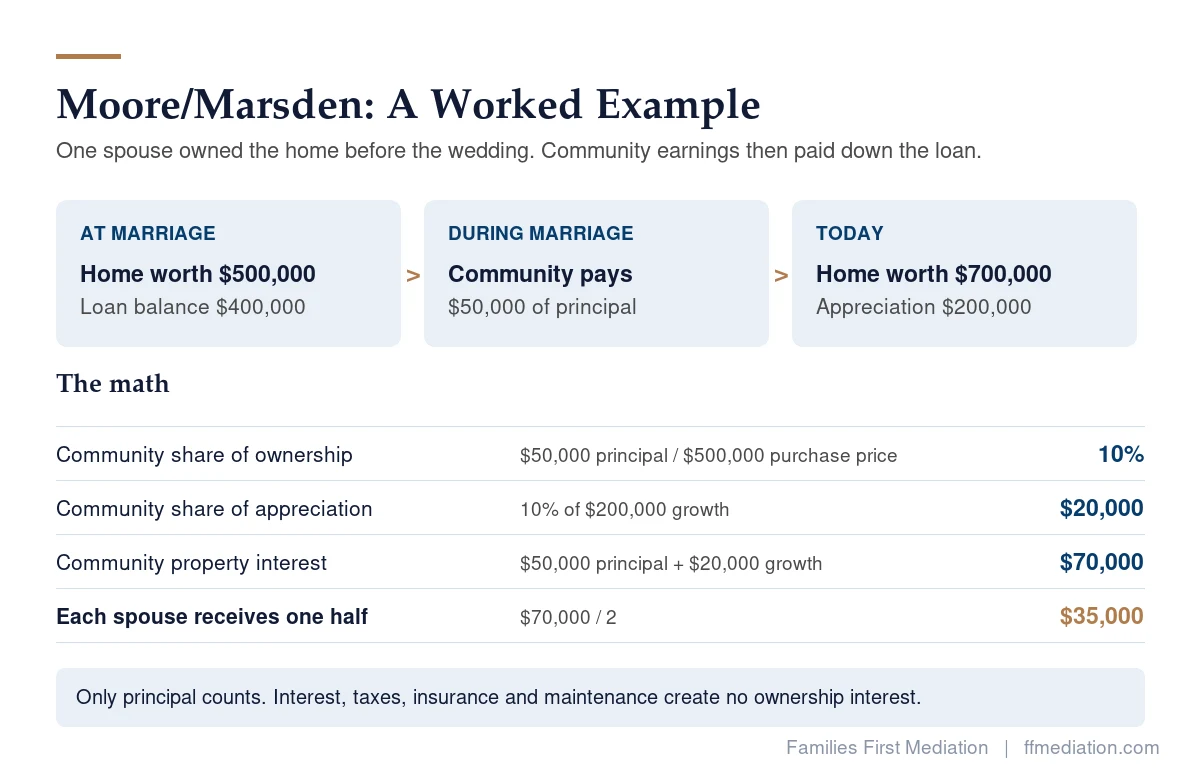
Suppose a spouse has an existing $500,000 home with a $400,000 mortgage when entering into a marriage.
During the marriage, community funds pay off $50,000 of the principal. After that, the home’s value increases from $500,000 to $700,000.
In this case, you need to determine how much the community contributed as principal toward the reduction of the amount owed ($50,000), and apply the appropriate pro-rata percentage (based upon the original acquisition price) to determine how much of the increase in value is community versus separate.
As the calculation will depend on the property’s purchase price/original loan balance/payment schedule/history, it is recommended to utilize the detailed Moore/Marsden calculator and instructions for your exact calculation.
A straightforward Moore/Marsden calculation becomes much harder with a refi, cash-out refi, title transfer, or separation.
Any time you refinance, you change your debt, which will likely require another characterization analysis. When an individual’s name is added to the deed, this creates separate property / transmutation concerns.
Separation can create other potential claims related to payment and exclusive use (e.g., Watts charge, Epstein credit, etc.), depending on the circumstances. Each of these issues must be addressed individually, not included in the initial formula.
Moore/Marsden addresses one situation: when community money reduces the equity in your spouse’s separately held house.
The Section 2640 of the Family Code addresses another: how to reimburse you for contributions you made to the community.
In general, if you document your contributions, you will get reimbursement under Section 2640 but no reimbursement or interest on the appreciation.
Even though it’s community property, spouses who invested their own money to buy or improve their home are entitled to reimbursement under California Family Code § 2640. To qualify for reimbursement, you’ll have to prove your contributions came from one of your separate properties.
Generally, you will only receive reimbursement for what you paid (i.e., no interest on top), and you won’t receive reimbursement for how much the home has increased in value.
If either spouse signs a waiver stating they don’t want reimbursement, neither party is eligible for reimbursement.
Section 2640 identifies several possible ways that spouses can contribute to marital assets.
In general, these contributions will be either a down payment from one spouse’s premarital savings (e.g., an inheritance or gift), or payments made to improve the home (or other asset) with money traced back to a “separate” source.
Payments made by one spouse using separate funds to lower their share of the debt on a loan to acquire or improve the home (i.e., payments toward the principal balance of the loan) would be eligible for reimbursement as well.
A § 2640 claim requires proof of where the separately-owned funds came from. Using several forms of evidence helps trace where these funds originated, such as bank statements, closing/escrow documents, inheritance/gift documents, and records showing how the money was spent.
Even if commingled, you can still file a § 2640 claim for your separate property; however, you must prove the funds used were traced correctly, which may require additional financial information.
Once you have identified the home’s character, as well as your own share, one spouse will purchase the property (buy-out), sell the home and divide the proceeds between the couple, or defer the sale of the home.
California law attempts to divide community property equally in dollar value; however, it does not require that all assets be divided equally.
Therefore, for example, a home could be considered “equal” to a retirement account or another piece of property. In either case, the spouses may reach their own settlement agreement or allow the court to decide.
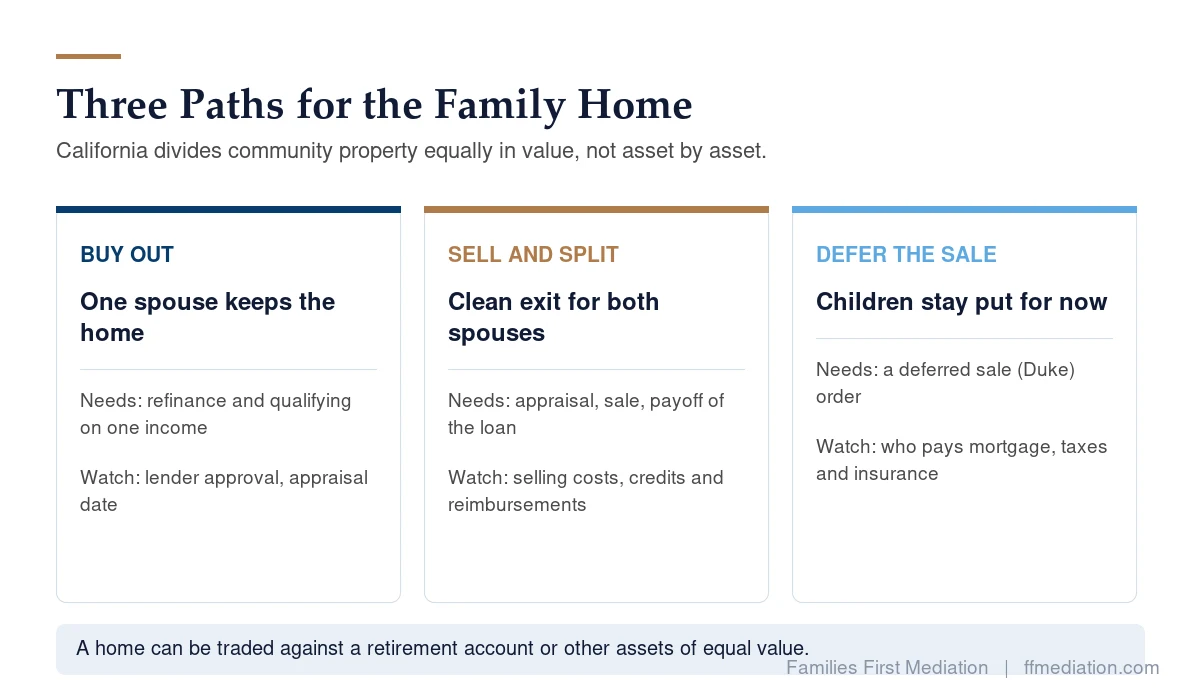
A buyout allows one spouse to keep the property and pay the other for his/her interest in it. The departing spouse then receives money from the refinance, while the remaining spouse keeps the house. If the owner cannot qualify for the new loan because of their income or financial situation, the buy-out may not be an option.
A sale may provide a clean exit for either party who cannot afford the property individually, especially if each party needs some of that equity.
First, determine the house’s current market value with an appraisal. Then sell the house. Pay the remaining mortgage balance plus any other selling costs.
Account for any agreed-upon reimbursements or credits before dividing the remaining money under the terms of the agreement or a court order.
California courts have a “Duke” or Deferred Sale of Home, an agreement that delays the sale of the home until after divorce proceedings are resolved.
This agreement gives the custodial parent sole use of the home during this time instead of moving out during a divorce.
The court will consider factors such as:
Lastly, the courts will also consider how each spouse will be affected by joint responsibility for the expenses associated with owning the house.
A spouse may be granted temporary exclusive use of the residence during the divorce through an agreement or court order.
Temporary exclusive use does not determine the permanent ownership of that residence. The spouse who is granted exclusive use of a community residence at the time of separation may have a claim for “Watts charges” based upon the reasonable rental value of that property.
In addition, if payments are made by one spouse for community expenditures prior to trial (for example, mortgage payments), these payments will likely be subject to some form of Epstein Credit.
Dividing the family home and determining how much equity each person gets in a divorce can be about more than which spouse wants to stay in the home.
Families First Mediation offers an impartial, economically informed method to help families resolve disputes over Moore/Marsden calculations, reimbursement under Section 2640, tracing, and buyouts.
Dina Haddad and the Families First Mediation (FFM) team will provide a legal and financial perspective on your decision-making processes and coordinate, if necessary, with financial mediators and certified divorce financial analysts (CDFAs).
Families First Mediation facilitates divorces across California using secure online mediation services coast to coast, particularly in the Bay Area, Los Angeles, and Sacramento.
Couples seeking an amicable divorce and control over what happens next are ideal candidates for mediation.
Schedule a free consultation call with Families First Mediation before you decide whether to allow one spouse to keep the home or whether selling is your best option.
Both spouses do not automatically have a claim to the residence. Ownership depends on the type of property (community, separate, or both). Spouses may agree to what percentage each will retain, or they may enter into mediation for the court to divide the property.
Generally no. Property acquired by either spouse before marriage begins as the individual purchaser’s separate property. However, if the husband and wife are married and pay down the mortgage together, this community contribution may be reflected through the Moore/Marsden formula, which could create a community interest in the real estate.
Not necessarily. Your spouse does not have an automatic right to take fifty percent of all of your property. As previously stated, community contributions toward paying down the mortgage balance may create a community interest, whereas the original interest acquired separately typically remains a separate interest.
The Moore/Marsden formula calculates community interest by accounting for both the amount contributed toward paying down the mortgage (the principal) and the proportionate increase in the home’s value over time due to inflation.