Home » Divorce and Family law Blog » Is There a Polite Way to End a Marriage in California?

Reach out to find the best solution for your divorce with trusted professionals.
Yes, there is a polite way to end a marriage in California, and it starts by picking the right process rather than just the right words.
Even nice couples can end up fighting if they take an adversarial approach. Options like mediation and collaborative divorce reduce unnecessary friction, but mediation tends to be the most cooperative.
Before deciding how to tell your spouse, you can schedule a free consultation with Dina Haddad for help with mediation and divorce related matters.
A polite way to end a marriage in California is all about choosing a method that reduces conflict while protecting the rights of all parties.
However, note that a polite divorce is different from an amicable divorce. The former defines how a spouse gets divorced (the process), and the latter defines the relationship of the divorcing spouses (amicable).
California’s new joint petition divorce can help create a less adversarial atmosphere because both spouses work together to file the divorce jointly rather than one spouse filing against the other.
In simpler words, a polite divorce basically means going through the divorce process with as little unnecessary conflict as possible. A polite divorce is not necessarily without emotion; however, it is typically associated with an amicable divorce because the proper divorce procedures allow for respectful communication between the divorcing spouses.
The divorce process you choose will greatly impact how emotionally difficult the experience will be for you.
Litigation is inherently adversarial since you’re pitting two separate lawyers against each other in front of a public audience, with a judge making decisions regarding issues where the parties could not come to agreement.
On the other hand, mediation is cooperative in design since it brings one third-party professional into a private room with two people who are trying to decide these issues.
Fortunately, California’s No Fault Divorce Law encourages a less confrontational process. According to Family Code §2310, a marriage can be terminated due to either irreconcilable differences or permanent legal disability.
Section 2311 states that typically, fault, blame, or evidence of conduct that contributed to the failure of the marriage need not be proven.
A legitimate statement that the difference has resulted in an irremediable breakdown of the marriage is typically all that needs to be made.
Therefore, couples can focus on dividing their property, determining custody arrangements, and support obligations without having to prove who caused the marriage to fail.
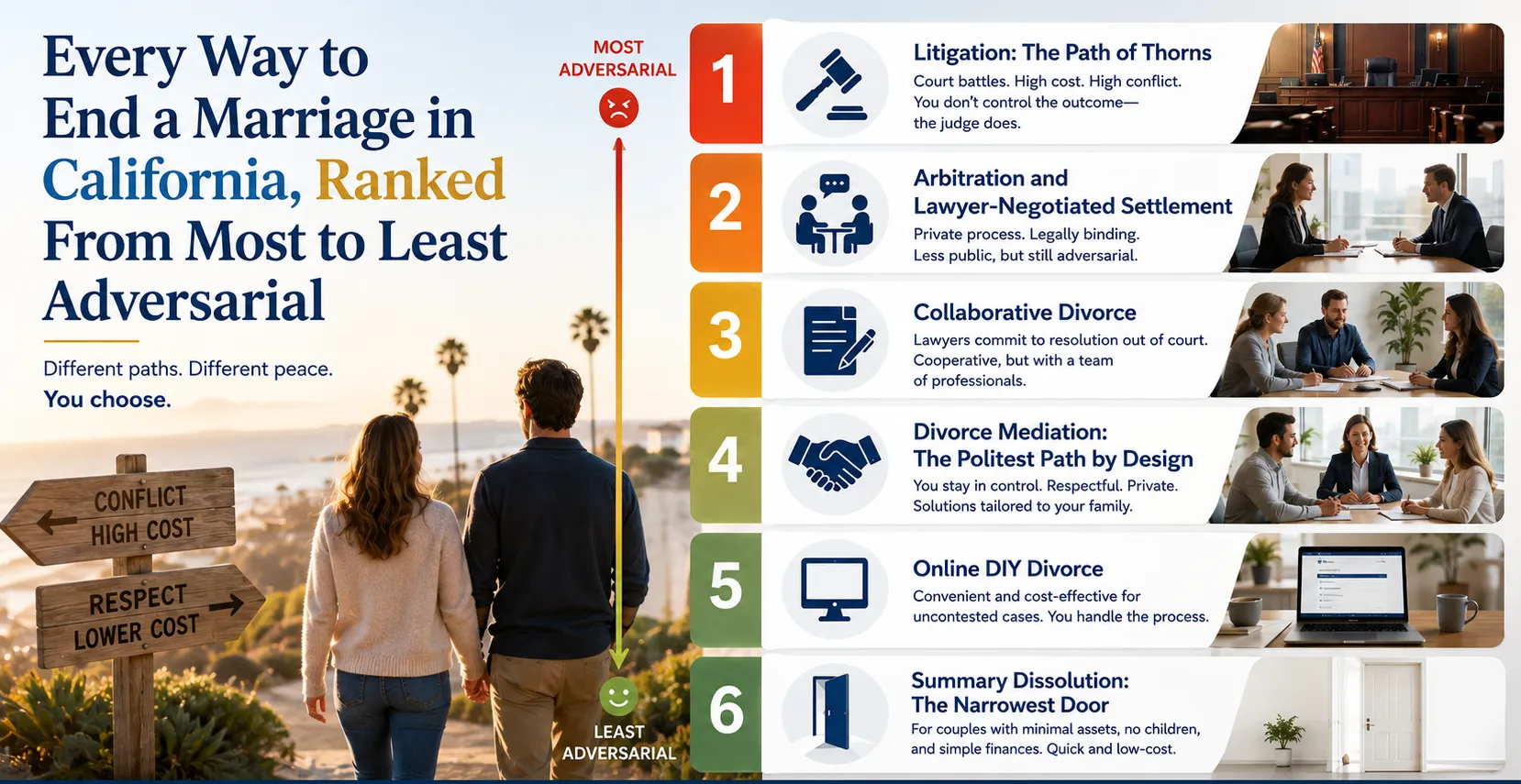
Your divorce method matters just as much as the divorce itself. Here are the six main ways to end a marriage in California, from the most adversarial to the least confrontational.
Litigation is typically the most aggressive method in divorce proceedings and is usually incompatible with a low-conflict divorce in California.
While both parties are attempting to resolve their issues, they hire attorneys to represent them in negotiations with the opposing party, and a judge makes decisions regarding all unresolved issues.
In general, court cases are open to the public and may be slower than a mediated case. Therefore, mediation will likely put less stress on co-parenting after the divorce and cost significantly less.
Although litigation is not inherently wrong, it could potentially be needed in situations such as if one spouse has abused another spouse or has been financially dishonest.
Additionally, if a spouse is unwilling to participate in the divorce negotiation process, then litigation may be necessary.
Arbitration and lawyer-negotiated settlements can resolve your divorce dispute, but the main difference is who makes the final decision.
In an arbitration process, each party presents their case to a private arbitrator. The private arbitrator’s decision on how the couple will divide up all of their property, etc., is usually binding on the couple.
Therefore, if you use this method, you give up some or all control regarding what happens during your divorce.
On the other hand, lawyer negotiations allow the couple to make the final decisions while the lawyers only negotiate a settlement on their behalf. This type of negotiation is well-suited for couples where:
Collaborative divorce was designed for couples that want to resolve a case without involving the courts, but still want to retain private legal counsel.
Each party agrees to enter into a participation agreement, which requires all parties to agree they will not litigate.
Additionally, financial specialists (neutral) or child specialists may be added to the collaborative team. The collaborative model promotes cooperative resolution of issues.
If you’re considering a collaborative divorce vs mediation, note that a collaborative divorce can also be significantly more costly than traditional mediation, as there are additional costs associated with retaining multiple experts. Learn more about private vs court-mandated mediation.
Divorce mediation is the least stressful way to end a marriage in California mainly because it uses cooperative means rather than competitive (conflict) methods.
A single, neutral third party, typically an attorney-mediator, will assist both parties in reaching an agreement on all items that need to be agreed upon prior to a divorce, including property division, child custody/parenting time, spousal or child support, etc.
In addition, there are usually no court hearings required as long as both parties agree on how they wish their marital status changed.
Unlike litigation, mediation eliminates the adversarial nature of two attorneys advocating against each other. You also have control over the decision-making process during mediation and do not have to rely on a judge’s interpretation of what is best for you.
In fact, California Evidence Code Section 1119 has made mediation communications confidential and generally inadmissible at any future proceeding(s).
In general, mediation may be a suitable option for couples who:
However, mediation is not recommended for every couple, especially ones where domestic violence or a heavy power imbalance is present.
DIY divorces are usually the cheapest option and work well when both spouses have already agreed on everything.
Spouses complete paperwork themselves or use online filing services, and they have maximum control and very little professional involvement.
The main tradeoff with DIY divorces is accuracy. Mistakes in filing, incomplete disclosures, or poorly drafted agreements can cause costly problems later down the road.
The Guided online divorce services supported by legal professionals can reduce some of those risks. This option works best generally for couples with few assets, no children, and full agreement on everything.
Summary dissolution is California’s simplest divorce process but only a small group qualifies. Eligibility rules are very strict, and both spouses must agree fully.
To qualify, generally spouses should:
Because both have to agree on everything, summary dissolution works best for couples whose divorce is already completely aligned.
The nicest way to tell your spouse you want a divorce is to combine a respectful conversation with an amicable legal process like divorce mediation or collaborative divorce.
Begin by making a respectful, sincere announcement rather than arguing. Before speaking about your decision to get divorced, make sure that once you’ve spoken, you will not change your mind.
Consider the tone and timing of the divorce announcement. Choose a private time for the discussion when children are not present.
Avoid discussing your desire to get divorced during heated times. For example, avoid having this type of conversation during a birthday celebration.
If there has been past abuse or if you feel threatened by how your spouse might react, do not worry about being polite. Prioritize your own safety first. Seek help from people who care about you. Find a safe place to have this difficult conversation.
You cannot force your spouse to cooperate, but you can still opt for low-conflict divorce in California and invite them to participate.
Mediation is voluntary, so both spouses must agree to participate. If they decline, you will need to use another process, but they cannot stop the divorce because California is no-fault.
If a spouse fails to respond after proper service, then the case can still proceed, and the court can enter a default judgment after completing required procedures.
Refusal to participate may slow things down, but it does not permanently block the divorce.
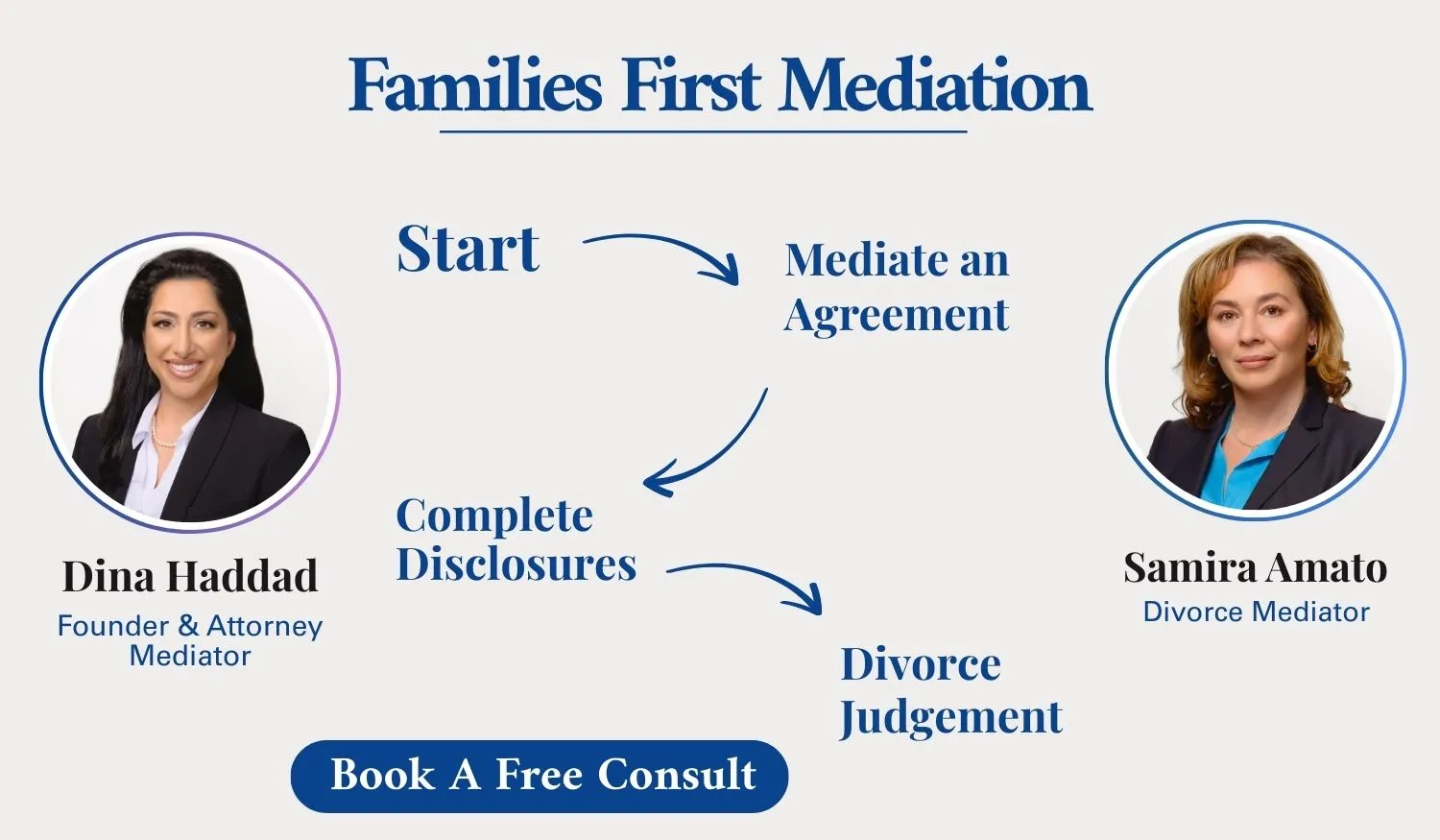
For California couples looking for a respectful way to end their marriage, Families First Mediation offers a process designed to reduce conflict while safeguarding your interests.
Led by Dina Haddad, a Super Lawyers honoree with 20 years of experience in family law, and Samira, both attorneys and mediators, the firm helps couples reach practical and lasting agreements.
Through our California Divorce Mediation Services, you stay in control rather than leaving decisions to a judge. Book a free consultation to explore your options and decide whether mediation is right for you.
Yes. Couples can use a polite method to finalize their divorces, like Divorce Mediation or Collaborative Divorce. These help to communicate with respect and work toward mutually beneficial resolutions rather than blaming each other.
Divorce Mediation is typically the best option because it allows two divorcing people to work out their own agreements with the help of a neutral third party. It does not involve the same adversarial atmosphere as litigation.
Yes, but only to an extent since you cannot force your spouse to be cooperative. But even if they reject mediation, the divorce process will continue through other legal avenues.
No. California is a no-fault divorce state. Therefore, one party cannot stop the divorce from being finalized by refusing to participate or agree to terms.