Home » Divorce and Family law Blog » New Child Support Laws 2026: Did Trump Change Them?


Reach out to find the best solution for your divorce with trusted professionals.
Child support provides basic clothing, food and stability for children, and there are legal changes potentially impacting child support in 2025 and onwards.
Some things will be an improvement (child support can begin during pregnancy), while other changes may have mixed opinions.
The only caveat is that the laws differ by state so making mistakes is costly, which is where a mediator comes in handy. A mediator can help parents overcome the confusion and negotiate fair terms for their family’s needs without a full-blown court battle.
If you’re navigating new changes in child support in California, resolve your matters outside the court with California child support mediation experts. Dina Haddad — California’s top-rated child support mediator, can help you seek guidance and make sense of these changes in the best interest of your child. Book your free consultation today.
In the United States of America, child support is evolving federally aiming at improving child support enforcement infrastructure, tightening passport based collection and extending support to pregnant mothers.
Three federal efforts including the Supporting America’s Children and Families Act (signed 2025, effective FY2026), H.R. 6903, Unborn Child Support Act are discussed in detail below.
The Supporting America’s Children and Families Act is a federal law meant to strengthen state and tribal child support enforcement. Its bill was introduced on July 22, 2024 and became the law when, then, President Biden signed it on January 4, 2025.
Since the bill was tied to fiscal year, therefore, its many provisions took effect on October 1, 2025 — the start of FY2026, which is the point families and tribal child support programs actually began feeling its effects rather than on its signing date (Jan 2025).
The law is about infrastructure repair, not a formula rewrite in child support. As it does not change state’s child support guidelines (whether that’s California’s K-factor or Washington’s income caps) or calculating anyone’s monthly support order.
Here’s what the law bring new things onto table for families:
The Ensuring Children Receive Support Act is a bill — introduced on December 18, 2025. The bill requires the State Department to revoke a passport from a non-custodial parent owing more than $2,500 in child support and is not paying it.
However, there is a real difference between revoking a passport vs denying the passport. Under current law, the State Department already denies issuing or renewing passports for anyone flagged with more than $2,500 in arrears.
But revocation goes further and pulls the passport a parent is already holding in their pocket, even if they never apply for anything new.
So, according to the current law if the parent owes payment of $2,500 in arrears and never asks for a new passport it is ok because the government is not going to take away the passport while the bill proposes to pay your arrears and your name will be removed from the system flagging you. This bipartisan bill is sitting in a Senate committee after being passed from Congress.
The Unborn Child Support Act is a federal bill that would let a pregnant woman ask a court to award child support before her baby is even born.
Under the bill, a judge would work directly with the mother to set a support amount and could apply it retroactively all the way back to the point of conception, as determined by a physician.
Here are a few important things about the Unborn Child Support Act:
Child support started as we know it now with the Child Support Enforcement Act of 1975 – this was essentially the first time the federal government stepped in to help ensure children received financial support from both parents.
The concept was primarily focused on recouping welfare payments back then.
Now, fast forward 50 years and a lot has changed. We have come nearly full cycle from pure enforcement, to truly working to stabilize family life, over the last 50 years.
The current changes are trying to implement much greater equity (e.g. suspending child support payments for parents that are imprisoned) as well as prevention (e.g. helping mothers stay healthy during pregnancy).
For context, when the 1975 law was enacted, there was no guidance on how to identify the amount to pay – it took about 20 years to develop. We are actually modifying a system that can hopefully become family centered.
There have been a lot of changes in individual states when it comes to child support guidelines from 2024 to 2026.
California updated how support is calculated and Massachusetts adopted new guidelines in 2025.
he state specific changes that have happened in 2024 and expected in 2027 are as under:

In California, Senate Bill 343 that was signed into law on Sep 22, 2023 and became effective from Sep 1, 2024 made an effort to make child support more equitable by balancing the financial responsibility of both parents fairly. It amended family codes such as 4055, 4057, 4058, 4061, 4062, and 4063 while bringing the following key changes:
The parent has to file a request for order to have the already existing child support order modified because it is not going to apply automatically to your order.
From the Year 2025 to 2027
On Jan 1, 2025, The Law AB 2397 made certain changes in the section of Family Code § 3910 – dealing with a parent’s duty to support an adult child who is incapacitated from earning a living and lacks sufficient means.
The law gives authority for a court to direct child support payments into a special needs trust instead of paying the child/dependent directly. The law does not bring formulaic changes or in other word changes in child support guidelines and touches how it can be paid in specific cases.
This law specially relates to families with a disabled child or an adult dependent who is incapacitated and unable to support themselves.
The Year 2026 and 2027
No bill is enacted or no law is made specifically for child support in 2026 and 2027 — touching how child support is calculated or administered. But there is a deadline date of Jan 1, 2027 for the Department of Child Support Services to adopt and implement SB 343.
No child support rules were changed in 2024 but the 2023’s rules (the ones started in July, 31, 2023) stayed in place until the end of November 2025.
In Massachusetts, every four years a group of experts have to review the child support guidelines. In 2024, Massachusetts Chief Justice Heidi E. Brieger put together the team of such experts to review the guidelines to make sure they make sense. The team led to the following developments
There is no new legislation for 2026 and/or any pending bill for 2027 or major changes regarding child support guidelines are expected because the next required four-year review is expected to begin until around the end of 2028. As of writing the piece the 2025 child support rules are into effect.
One thing is clear for Texas that no legislation could take place on even-numbered years for regular session as the legislature convenes regular session in odd-numbered years (2023, 2025, 2027, etc).
So no legislation regarding child support guidelines took place in 2024 and in 2026, there will also be no such legislation possible.
However, in 2025, in 89th Texas Legislature regular session The House Bill 2643 amended the Texas Family Code § 154.125 and effective from Sep 1, 2025.
The bill has been enacted into the law increasing the child support income cap from $9,200 to $11,700 — The largest increase of 27% since the cap was created.
The law will apply only to new child support orders or modified on or after its effective date. To modify the older orders, parents will need to file a motion to modify. The effects it will be:
Note: Texas has not reduced the interest rates on unpaid child support from 6% to 3% as the Bill SB 629 did not pass to become the law.
There has been no legislation regarding child support laws in 2024. However, Washington State enacted House Bill EHB 1014 on July 7, 2025 during its legislative session.
The changes for new and modified support orders introduced by EHB 1014 (July 7, 2025) have been in effect from the start of 2026 (January 1). This law brought the following changes:
As of writing this, there have been no additional statewide statutory changes beyond the 2026 reforms.
There are some administrative provisions of HB 104 planned for April 1, 2027 regarding temporary reductions for parents in qualifying behavioral health treatment or incapacitation but they would not impact how math of child support is applied.
Yes, Georgia made significant changes in child support guidelines through SB 454 effective from July 1, 2024 while no changes occurred in 2025. As per Georgia Support Commission the following are the key changes of 2024 legislation:
Similarly two changes also occurred effective from Jan 1 and Jan 2 of 2026 respectively. These are also changes related to SB 454: The following are the changes of SB 454 effective from Jan 1 and Jan 2 of 2026:
Note: No statewide statutory changes related to child support laws are scheduled to happen in 2027.
As of 2026, we have no new statute enacted in Mississippi beyond the equal-time offset that came with its custody bill. While there’s an important update regarding Louisiana regarding the child support law statute. Let’s see each of these and which bills died in Mississippi.
Louisiana enacted the child support law (House Bill 154) in 2026 and it took effect on August 1, 2026. This law is not a complete rewrite of how the child support will be calculated in the state. It edits the current support law in the following ways:
The parent is an unemancipated minor with limited earning capacity, whether the minor parent has family or other support available, and whether it’s desirable for the minor parent to stay in school. In short: if a parent is a teenager who can’t really earn yet, the court can factor that in.
A minor under sixteen cannot enter into an acknowledgment of paternity, and a sixteen- or seventeen-year-old needs a judge’s authorization.
A few changes that Louisian did in 2025 for support were the child-support dollar schedule under Act 86 (HB 773) and expansion of support for children with disabilities under Act 448.
Mississippi did not change its child-support formula in 2026 because the bill that suggested changes in formula (flat percentage of income mode on the paying parent’s adjusted gross income — 14% for one child, 20% for two, 22% for three, 24% for four, 26% for five or more) have died. Those bills were:
The old rules often trapped families in outdated formulas — like calculating payments based on income from years ago.
The updates finally adjust for today’s realities from equitable support to compassionate approach (Incarcerated parents won’t drown in debt they can’t pay, while pregnant moms get support earlier).
Here’s an overview of changes that will influence people across the United States:
More child support money will be sent directly to families instead of being retained by the state. This translates into more support for groceries, school supplies, bills, etc.
The issue is, many parents do not know they qualify for these changes, and in some states, it is still too difficult of a process for which to apply.
If a parent becomes incarcerated, their child support payments will now be paused rather than accruing—it gives some relief to the parent as he or she tries to rebuild his or her life. Some worry it is unfair when the other parent still needs support.
The biggest winners? Pregnant moms can now get support sooner, including prenatal vitamins and doctor visits.
The stronger enforcement gives some comfort that there will be fewer missed payments; however, some custodial parents are disappointed at how slow the system is for handling late payments, even with the new rights in place.
There is an estimated $34 billion in unpaid child support owed nationwide, with California families alone owed roughly $2.3 billion. These child support reforms would make it harder for a parent to conceal income, including from gig work or self-employment. Additionally, custodial parents who are owed money stand to benefit most from more effective collection.
The Supporting America’s Children and Families Act, though it did rewrite the entire formula, reauthorized the child welfare program and strengthened the state and tribal child support enforcement program.
The law also expanded access to federal tax data for child support and directed additional funding toward tribal programs.
The bill like H.R.6903 would make the child support enforcement stronger against the parents who fall behind by revoking a passport at over $2,500 in arrears. However, it preserves an exception allowing a limited, temporary passport for someone abroad who needs to return to the U.S. on an emergency basis.
Under the old system for families on TANF, the government paid itself and the federal government back for administrative costs before sending anything to families, so children received only a percentage, if any.
For example, DC’s Child Support Improvement Amendment Act of 2026 raised the monthly pass-through cap from $150 to $200 and, when fully implemented, removed it entirely so every collected dollar goes to the family.
Let’s address three common myths out there:
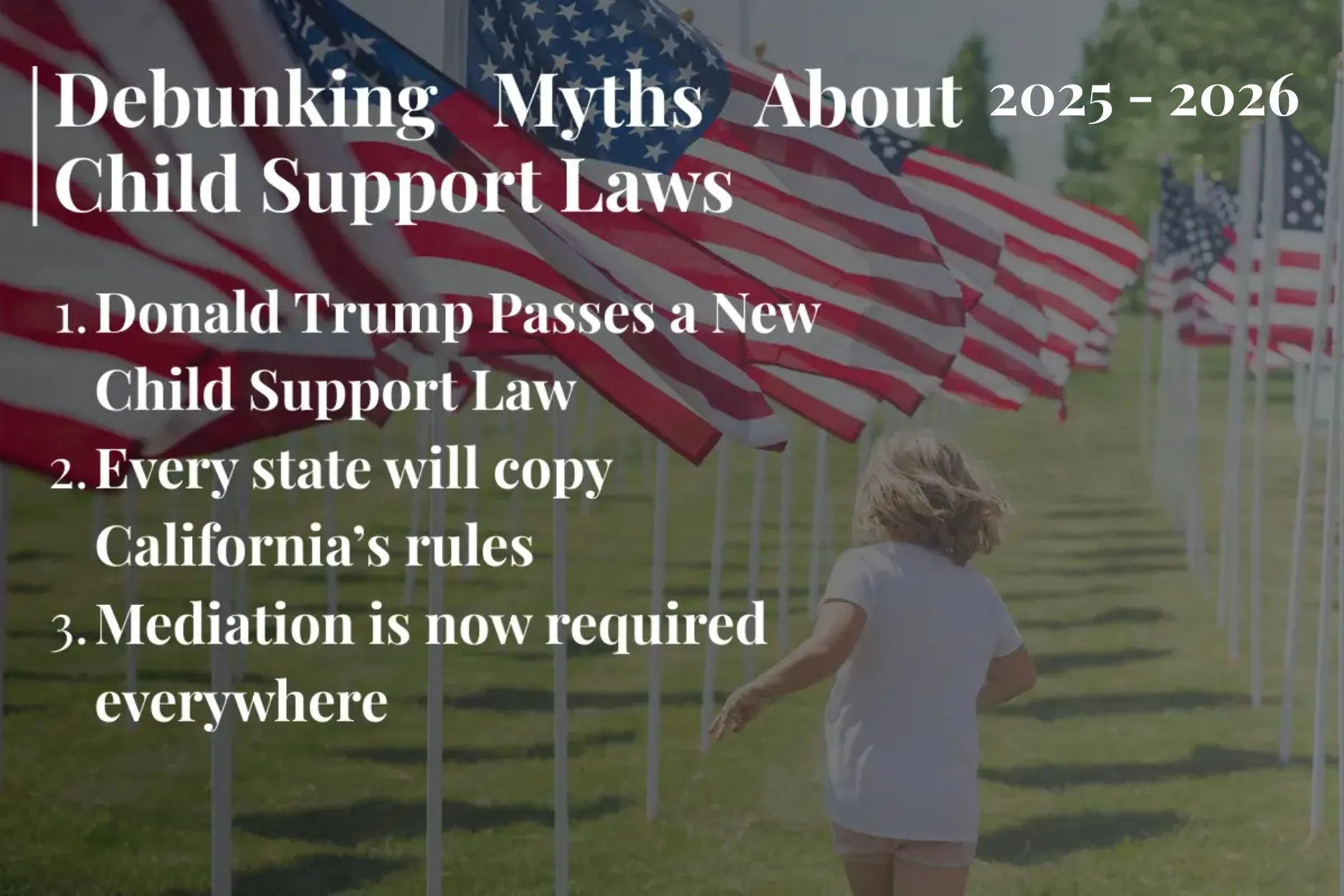
Nope. There have not been any presidential policies which have changed how child support payments are computed. Likewise, there is no executive order issued by President Trump on new child support in 2025. These myths seem to come from a misunderstanding of routine policy updates as complete political overhaul.
Nope. Texas and Florida routinely reject California reforms. While ideas may float around (e.g., prenatal parental support), each state has their own formulas, and timeframes.
Only a few states still actually require mediation for custody disputes (Oregon does); child support mediation is still voluntary in most cases – but judges are recommending that families mediate so that they can avoid having conflict in court.
So what’s the takeaway? Always check the official state site before believing something that has gone viral.
Continue to monitor the changes on the government site and our Families First Mediation Blog will be your best bet for California updates.
Any changes in income, employment status, or living arrangements? File to modify your order as quickly as possible using your state’s forms (each state has its own rules).
And if you attend mediation, the best way to win child custody is treat it like a job interview—gather paystubs, bills, and school schedules. The more organized you are, the easier mediation will go.
Need help understanding how child support changes apply to you and what you should do? Get personalized help by booking a free child support mediation consultation.

The changes over this calendar and legislative year – from Congress’ recognition of pregnant moms, to changes at the state level for child support formula – clearly show one thing: a system that is beginning to reflect the needs of real families.
That being said, speaking with a divorce mediator is much better than just googling. They will be able to explain how these changes will affect your situation, without the legal jargon.
Modify your existing support orders in California without the assistance of local child support agencies in a fast and personalized way by mediating the child support with California’s expert child support mediator, Dina Haddad. Get a free child support consultation today.
Child support agreements remain enforceable no matter which state you or your child movies to in the United States of America. Learn more about moving out during divorce and moving out of state with child no custody agreement.
How much child support you will pay depends upon your state in the U.S. If we assume you live in California, then child support calculation is a complex process depending upon multitude of factors such as number of children, taxes, cost of living, other child related expenses and local county guidelines. But roughly speaking an individual earning $1000, could expect to pay $250 per child. Here’s a detailed way and formula to calculate it:
CS = K (HN – (H%)(TN))
SB 343, titled as Child support, was chaptered by the Secretary of State and passed on 2023-09-22. It introduces the following provisions statewide:
The Section 228 of Title 18, United States Code, makes it illegal for an individual to willfully fail to pay child support in certain circumstances. According to the code, convicted offenders could face fines and imprisonment.
Individuals can face fines and up to 6 months of imprisonment if child support payment is overdue for longer than 1 year or exceeds the amount of $5000. Similarly, if the individuals willfully fail to pay payment for longer than 2 years or the amount exceeds $10,000, the offender faces fines and 2 years of imprisonment.
No, there has been no child support law enacted at the federal level nationwide in the US in 2025 that dictates how child support is calculated or enforced. Child support matters are handled at state level and each state can set its own guidelines regarding modification, calculations and enforcements.
Please note that the Supporting America’s Children and Families Act is just an update to existing federal child support law and Unborn Child Support Act is just a proposed bill, not law.
No, this proposed bill still has not been passed into law. This Senate Bill (S.230) was introduced by Senator Kevin Cramer on Jan 23, 2025. The bill is still (as of July 9, 2025) in the initial phase of legislative process and has not been enacted.
Child support payment is neither a tax deductible for the payor and nor taxable incomes for its recipients according to the current rules of IRS in the United States. It simply means that you cannot claim child support as tax-deductible and taxable income on your federal tax returns.