Home » Divorce and Family law Blog » Is Spousal Support Taxable in California in 2026?

Reach out to find the best solution for your divorce with trusted professionals.
Will spousal support be taxed in California in 2026? Your divorce or separation agreement determines whether spousal support is taxable.
As of January 1, 2026 (under SB 711, signed into law on October 1, 2025 by Governor Gavin Newsom), all newly entered spousal support agreements will no longer allow a California state income tax deduction.
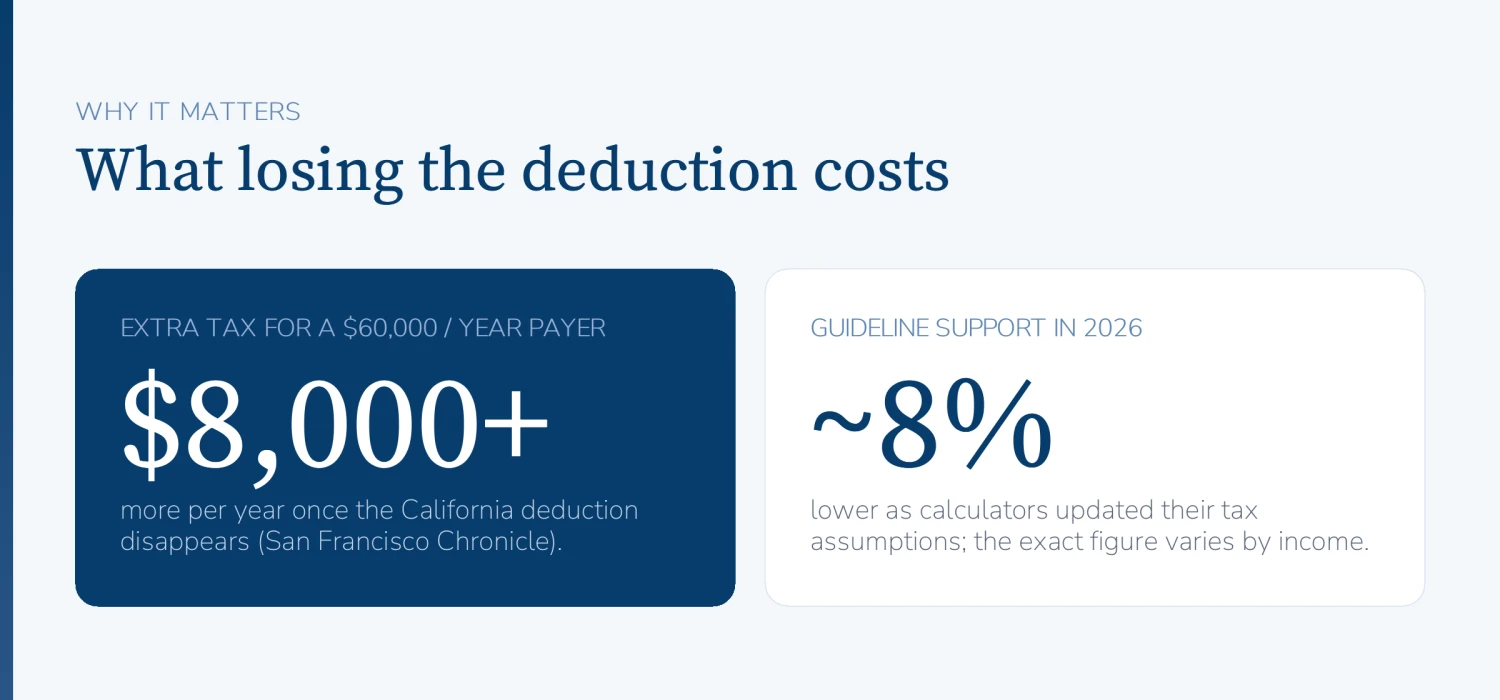
According to a San Francisco Chronicle report, losing this deduction may cost someone who pays $60,000 a year in support more than $8,000 per year.
This article covers the current spousal support guidelines, the reported roughly 8% drop in guideline support, and the options for those who already have orders in place.
Contact Families First Mediation to schedule a free consultation with mediator Dina Haddad for advice tailored to your situation.
Yes. After December 31, 2025, for agreements relating to divorce or separation, spousal support will be neither deductible by the person paying it nor taxable to the person receiving it under either federal or California law. Senate Bill 711 did not revise the statutory framework for spousal support; instead, it changed California’s Internal Revenue Code conformity date.
The Franchise Tax Board has confirmed this treatment and has added “Agreement Date” fields to Schedule CA (540 and 540NR).
This change relates to the taxation of spousal support — not whether a spouse is eligible for it, how long they may receive it, or an existing order, unless a modification specifically adopts SB 711.
California support-order treatment falls into three categories, determined mainly by the original effective date of the agreement (or any later “qualified” modification of it). This is also useful when thinking about how long you must be married for alimony in California.
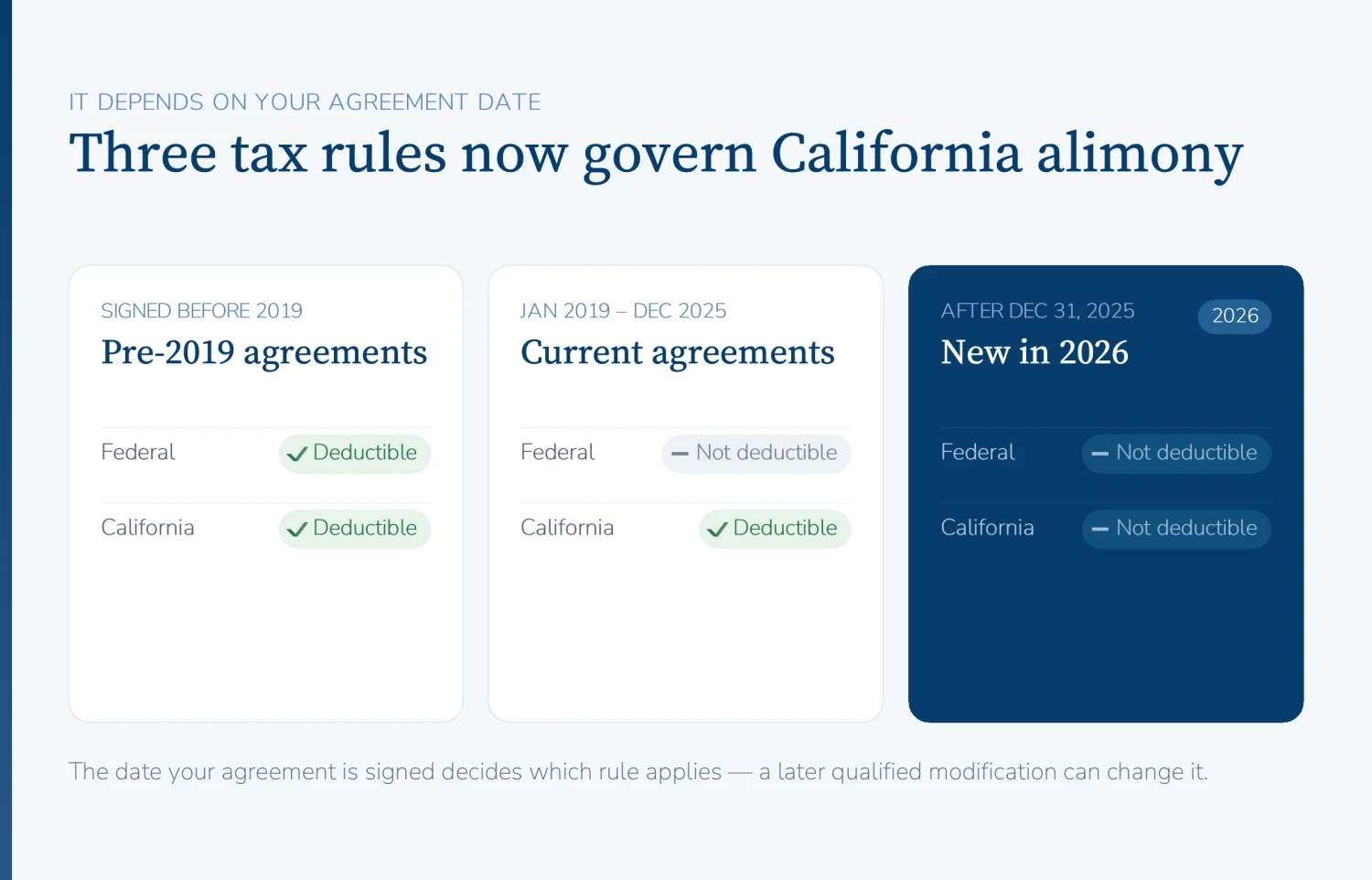
Agreements entered before December 31, 2018 keep the pre-2019 rules: the payer may deduct the amount paid, and the payee must include it in gross income, at both the state and federal levels.
Agreements entered between January 1, 2019 and December 31, 2025 are tax-neutral at the federal level but still allow a deduction and income inclusion at the California state level.
Agreements entered after December 31, 2025 are tax-neutral at both the state and federal levels. Any express language in a qualified modification can change the treatment of the original agreement.
SB 711, the 2025 Conformity Act, moved California’s IRC conformity date from January 1, 2015 to January 1, 2025 for taxable years beginning in 2025. This allowed California to conform to federal IRC Sections 71 and 215, which federal law had repealed. The bill’s stated purpose is easier administration.
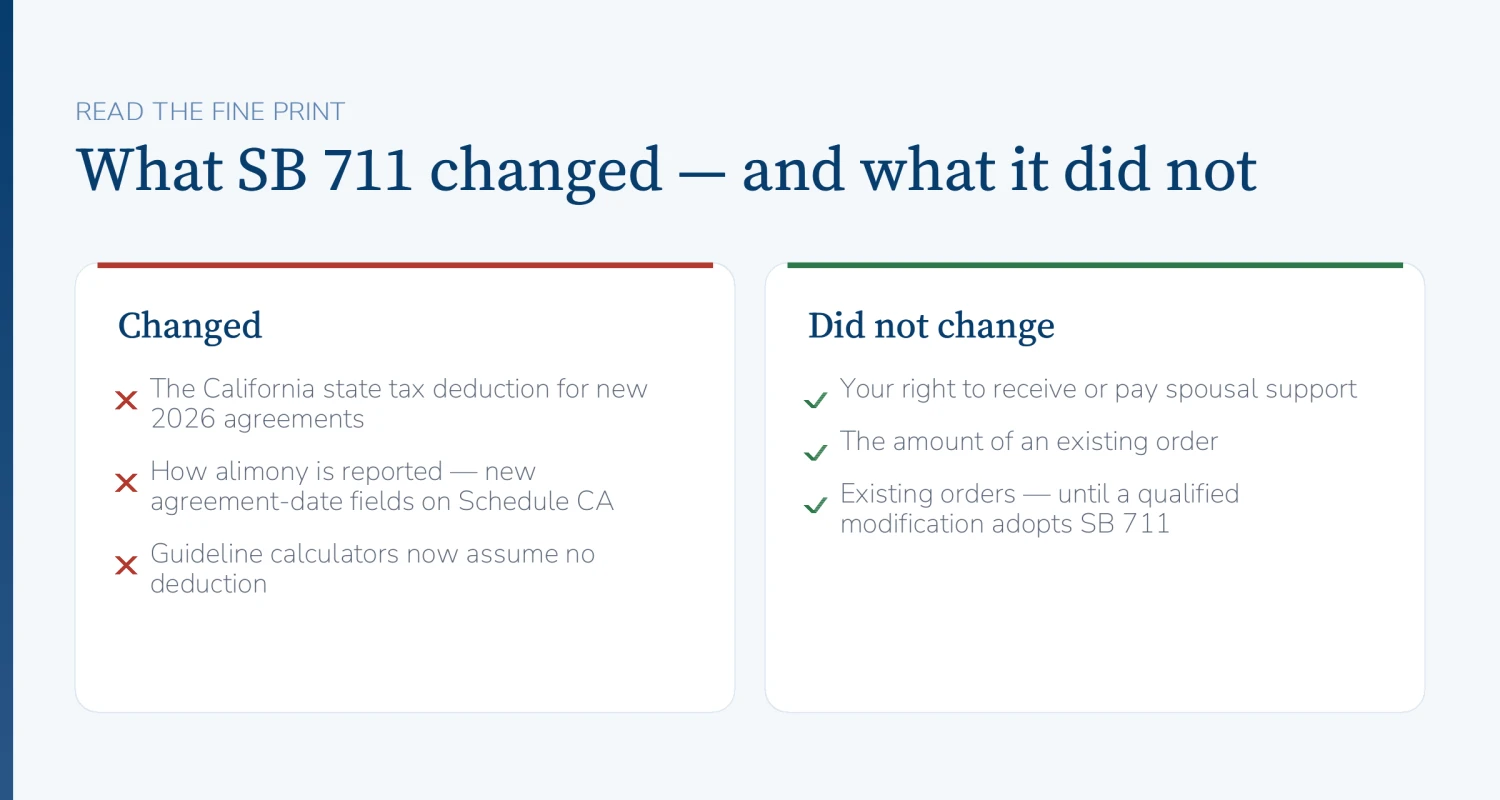
Before this change, California allowed a state deduction and included the income in the support computation, even though federal law no longer permitted it. SB 711 changed how you report taxes — it did not affect the court’s ability to decide whether you owe support or how much you must pay.
Since 2019, federal alimony tax law has been consistent. The Tax Cuts and Jobs Act ended the federal deductibility of qualifying post-2018 agreements; California, however, continued to allow a state deduction.
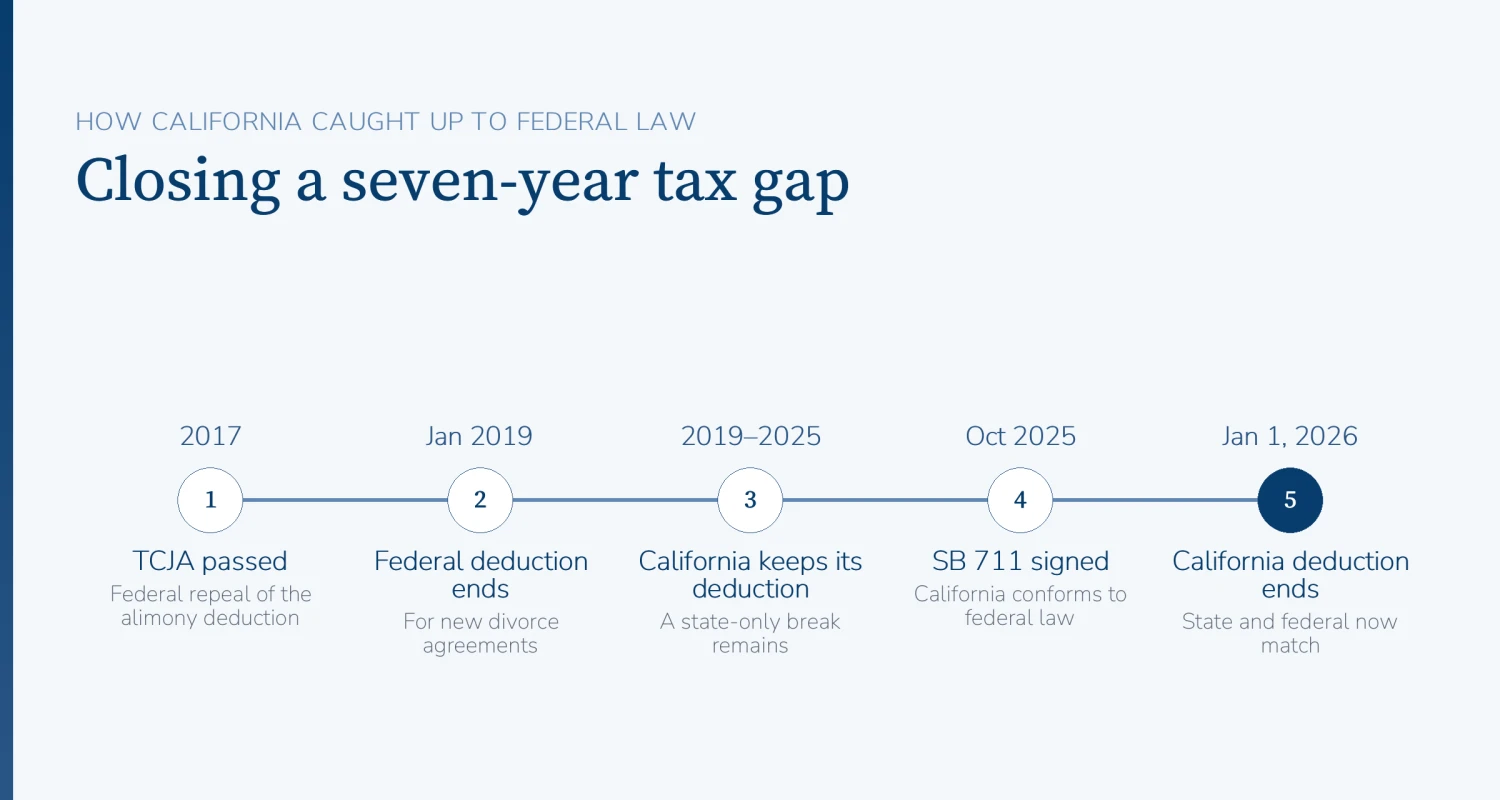
Senate Bill 711 closes this seven-year gap for agreements entered on or after January 1, 2026. Federal law governs federal treatment, and California’s new law will mirror U.S. Treasury regulations going forward. The key factor is the agreement date, which matters when preparing income tax returns (for example, Form 1040) or negotiating spousal support.
The Tax Cuts and Jobs Act (TCJA) of 2017 eliminated the federal deduction for alimony and the income-inclusion rule for all divorce or separation agreements entered on or after January 1, 2019. Before then, California maintained its own separate deduction and income-reporting provisions, so taxpayers could deduct alimony from taxable income in California while still including it in gross income elsewhere.
With SB 711, California will no longer have a separate deduction provision and will follow federal law for qualified post-January 1, 2026 agreements. Eliminating the remaining state deduction means there is no tax advantage to including alimony in such an agreement.
California taxpayers with an eligible 2019–2025 agreement will continue to make their Schedule CA adjustments. Payers deduct qualified alimony payments from federal AGI; recipients include all support they receive in their California AGI.
Because California follows federal treatment of qualifying agreements made after December 31, 2025, those agreements require no additional Schedule CA adjustments. To help identify when a new tax regime begins, the Franchise Tax Board added Line 2b in Section B of Schedule CA (540) and Line 19c in Section C of Schedule CA (540NR), each asking for the date the original agreement was signed.
Dina Haddad helps couples understand how SB 711 affects them from a tax perspective, coordinates a CPA or CDFA to review each couple’s circumstances, and drafts the necessary language for their marital agreement.
Unlike litigation — generally adversarial and often requiring multiple experts and high legal costs — mediation lets families work collaboratively. Private mediation often costs $5,000–$15,000 per family for a complete case and can address complex finances, such as high-net-worth divorce cases and equity compensation.
Whether you are working out spousal support or need to modify an existing arrangement, schedule a free consultation with Dina Haddad.
No. After December 31, 2025, spousal support is neither taxable income for recipients nor deductible for payers under either federal or California tax law.
Only if your agreement was executed before January 1, 2026. Agreements executed from 2019 through 2025 can still claim a California deduction; agreements entered before 2019 generally retain both federal and California deductions.
Governor Newsom signed California’s Conformity Act of 2025 (SB 711) into law on October 1, 2025 as an urgency measure. It aligned the state’s tax treatment of alimony with the revised federal rule, effective for agreements entered on or after January 1, 2026.
No. A previously ordered spousal support amount remains unaffected until a qualified modification specifically adopts SB 711. Simply modifying an existing order does not automatically change the amount paid or the parties’ obligations.
Calculation software used by family lawyers updated the tax assumptions behind the guideline because SB 711 eliminated the California deduction for new agreements. The exact percentage varies with each party’s income.