Home » Divorce and Family law Blog » How to Look Up Divorce Records in California: The Practical Guide for Non-Lawyers

Reach out to find the best solution for your divorce with trusted professionals.
Imagine someone divorced 12 years ago in Alameda County who has decided to get married again, this time in Nevada. The Courthouse is requesting a “Judgment of Dissolution“.
They search Google and find websites that offer access to divorce records. California divorce records are also public, yet they can’t find precisely what they want.
This article explains the difference between a Decree, a Certificate, and the Case File. It explains when to request each, what parts of your divorce stay confidential, and how Families First Mediation can help.
For more on looking up divorce records in California or finalizing your divorce, you can book a free consultation with our divorce mediation experts like Dina and Samira. They would be more than happy to assist you.
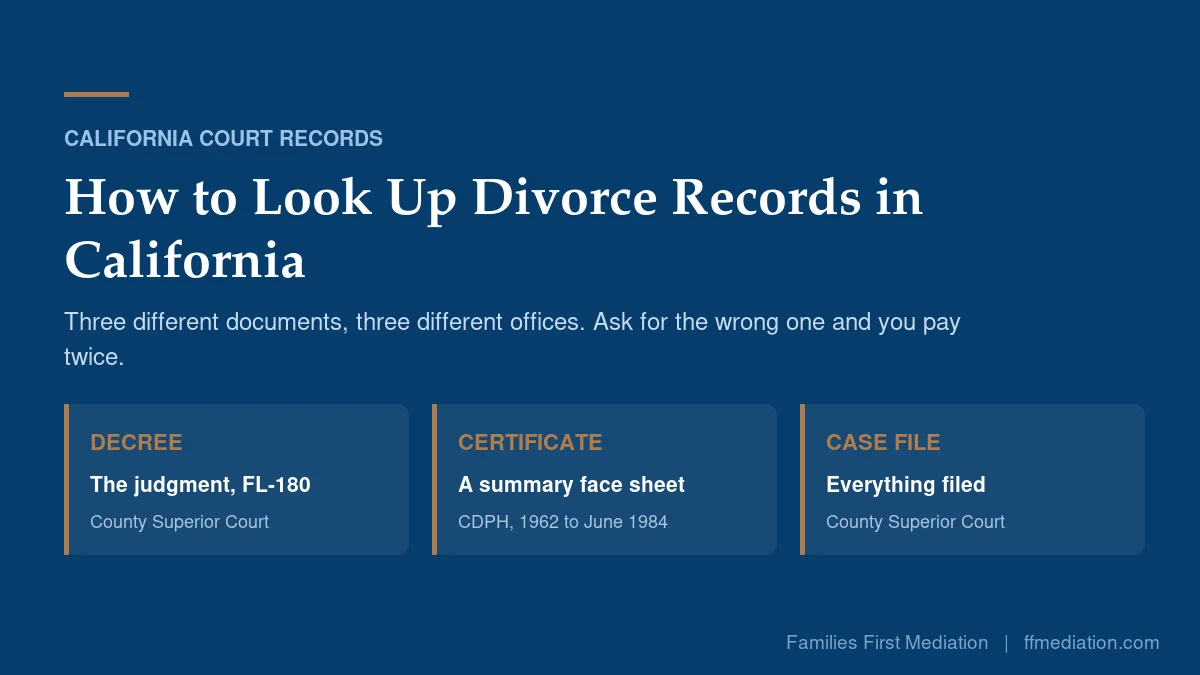
Many unsuccessful attempts to obtain a public record start with the wrong document. The three types of California divorce documents are: the Judgment of Dissolution, the Certificate of Record, and the entire case file. Each is issued for a unique reason and obtained from a different state agency.
California no longer provides new, statewide divorce certificates, as a divorce decree vs. a divorce certificate are very different today.
However, CDPH-VR maintains limited historical divorce data for California and issues Certificates of Record for all divorces that took place in California between January 1, 1962, and June 30, 1984.
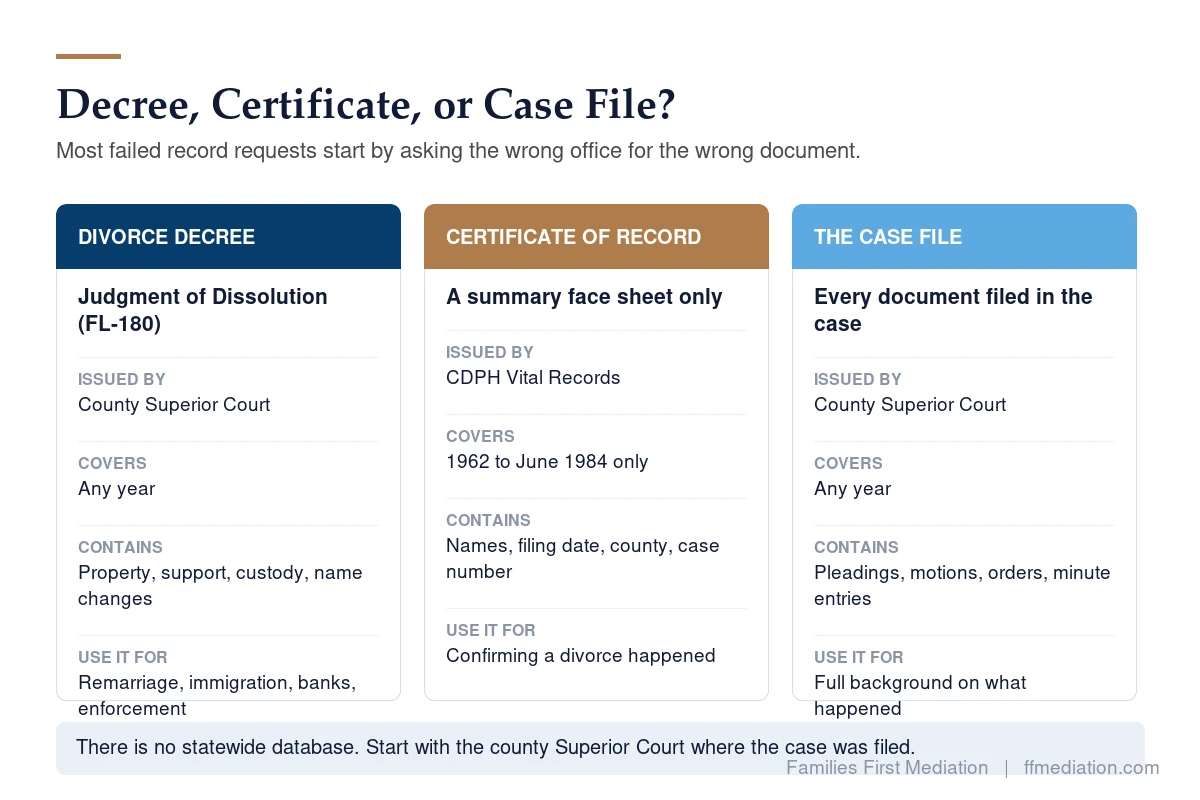
The Judgment of Dissolution (FL-180) is a final court order that terminates the parties’ marriage. A Judgment of Dissolution includes the Terms of the divorce, such as Property Division, Support, Custody, Name Changes, and other settlement agreements in your case.
The County Superior Court issues and maintains this document, not the State Vital Records Office.
You may be required to have this document to prove you are divorced prior to remarriage, immigration, benefits, refinancing, etc., or to enforce the provisions of your Judgment.
The related document, Notice of Entry of Judgment (FL-190), identifies the Judgment entered into the record and states when the Judge signed it.
The divorce case file contains all proceedings in the divorce case, including pleadings, motions, responses, orders, minute entries, and everything else filed in the case.
The Superior Court provides this information. If you want a general background on what happened in the divorce case, rather than just a copy of a single judgment, this is the place to look.
While it remains subject to the same courthouse access rules as family law cases, most family law case files are not available for general public remote electronic access.
However, many courts provide indexes and registers that help you find what you need within those large collections.
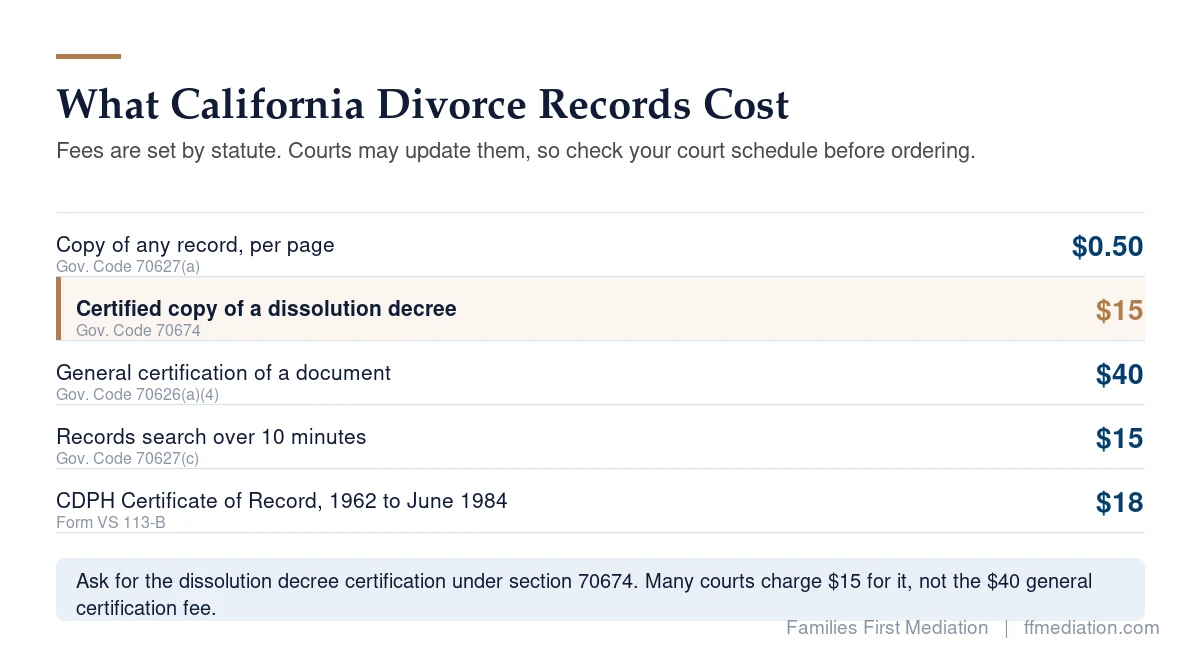
*Note: Copying a court record generally costs $0.50 per page under Government Code § 70627(a), so requesting an entire file can become expensive.
California has no single statewide centralized divorce records database. Typically, the county Superior Court is your best resource for obtaining a copy of the divorce judgment or file, as it keeps that court record; CDPH-VR and third-party websites provide only limited secondary information.
If the divorce was filed at the Superior Court level in a particular county, that county Superior Court maintains the original court record and can provide copies of judgments, decrees, etc. filed with it.
To file a divorce action in California, you must have been a resident of the State of California for six months and a resident of the county where you file for three months before filing.
For example, if you file in Sacramento County, even if you currently reside in San Diego County, you should still contact the Sacramento Superior Court to try to access those records.
You may access these records through an online case index, at a public terminal in the courthouse, or by submitting a written request by mail. Fees apply for copying and certifying records.
CDPH-VR maintains California divorce records for one window only: 1962 through June 1984. For those years it does not hold the actual divorce decree, but rather the original face sheet. The face sheet includes the parties’ names, filing date, county, and case number.
All mail requests need to be completed using Form VS 113-B. The fee is $18.00. Mail your request to: California Department of Public Health, Vital Records, MS 5103, P.O. Box 997410, Sacramento, CA 95899-7410.
Third-party record sites normally take data from public records and court index files and provide search capabilities for users.
Although a third-party site may provide you with a likely area or case number, the third party is not the original court that issued the document and therefore cannot be used in lieu of an official court document.
To obtain a certified copy of your divorce decree, contact the Superior Court where you originally filed.
In simple terms, mostly no. Some California counties allow free online access at an index level, but it is rare for all or most of the underlying divorce document files to be accessible online.
This matters because, most of the time, searching for a free online copy of a divorce judgment will lead you to a third-party website rather than the official courthouse record.
Typically, you can access the Register of Actions for free online, which includes the parties involved, case number, filing date, hearing dates, etc. With this amount of information, you should be able to verify if a case has been filed and determine the correct case record(s).
However, you likely won’t be able to access documents like the petition (FL-100), response (FL-120), judgment (FL-180), marital settlement agreement, etc., online. California Rules of Court Rule 2.503(c)(1) prohibits remote electronic access to family law records.
A few large county clerk offices also allow you to order certified copies online. But again, those copies come with the court fee, and the court office provides them rather than offering them for free online.
You can follow 6 simple steps to get your divorce records. However, each county will have different forms, fees, etc.
First, identify the court where the divorce was finalized, find the divorce case number, determine what document(s) you want, how you want to submit your request (in person, by mail), pay for the search/record costs, and then review your documents once they arrive.
Start by determining which California county the divorce was filed in. Then work back from each party’s location when they started their divorce proceedings in California.
If you can’t find the county, use the CDPH statewide divorce index for divorces filed between 1962 and June 1984, or identify the last known address of either spouse before filing and contact the County Superior Court.
Using the county where your divorce was filed, access the Superior Court online case index or “case-access” tool using your first and/or last names.
The case number is a unique alphanumeric identifier assigned to your specific divorce action and, as such, varies from one county to another; therefore, do not try to guess it.
When you have located your case using this method, verify it is a dissolution proceeding (i.e., a divorce), and that a Judgment (FL-180) has been issued.
First, decide which of the three documents will be required by USCIS, the DMV, a bank, or other agencies that will require a certified copy of the divorce judgment.
Only pay when the document matches your needs. For example, if you only need proof of certification (FL-180), you shouldn’t have to purchase an entire case file.
Select how you wish to submit your request based on the options provided in your county. The online option allows you to use the case number and your credit/debit card to complete the order.
You can also mail orders; however, they typically require the case name (caption), case number, contact information, payment, and a self-addressed return envelope.
If you need to review records before purchasing certified copies, or if you need older or non-digital case files, in person may be your best option. Check with the court’s current instructions.
Check the cost of a copy in the court’s current schedule before making an order. A standard copy in California courts costs $0.50 per page under Government Code § 70627(a). Certifying a dissolution decree costs $15 under Government Code § 70674 — ask for it that way, because the general certification fee under § 70626(a)(4) is $40. CDPH has a charge of $18 for each Certificate of Record. In some cases, a waived fee will apply to some (but not all) of these costs for court copies and certifications. Do not presume that the only fees that would be covered with a waived fee would be filing fees.
Court retrieval time frames vary by court and by how old the record is. Some online court documents can be retrieved quickly. Older court file records, however, may take several months to obtain.
Also, CDPH processing times vary. Once you receive your copy, verify that this is the exact document requested and that, when certification is needed, it has been certified by the Court. If there are other requirements for receipt by the receiving agency, ask them what those might be.
Divorce record research is simply a procedural activity. What’s different is understanding what that includes for a family, or what will be included as public court documents during their current divorce.
Families First Mediation can help in this area. Attorney-Mediator Dina Haddad offers comprehensive California divorce mediation services, including confidential exchange of all financial information, drafting a Private Marital Settlement Agreement, and filing only the agreed-upon judgment.
She provides these services to clients throughout the Bay Area, Los Angeles, Orange County, Sacramento, and across the state via video conferencing (Zoom).
If you want to protect your financial privacy during your divorce, schedule a free clarity consultation to learn how divorce mediation can keep your high-net-worth divorce case out of the public case file.
Yes. Generally, in a California divorce case, court records are public. However, family law case records that are located remotely (i.e., online) are restricted from public access. Additionally, certain types of data and/or court records may be sealed.
Use the county Superior Court’s online Case Index for the county where you filed for divorce. Most counties let you search by party name, case number, date of filing, and register-of-actions entry(s).
NO. California does not allow public access to remotely filed Family Law documents. The Public Access Portal lets you search for a Case Number; however, once you locate it, if you need specific filed documents like the FL-180, you must submit an additional Court Request.
Contact the court where you filed your divorce. Obtain your case number. Ask that they prepare a Certified Copy of your Judgment (the FL-180). Pay the appropriate filing fees. Follow the court’s instructions for completing the process online, by mail, or in person.