Home » Divorce and Family law Blog » How to File for Legal Separation in California (Step-by-Step Guide)

Dina Haddad and her team are here to help you find calm, fair solutions. Call us or book your consult today.
In California legal separation is a court-approved process allowing couples to part their ways while remaining legally married.
But unlike divorce that ends the marital status, requires residency (of California for at least 6 months and 3 months for county before filing petition) and cooling off period, legal separation is entirely different and explained in light observance of California laws:
Yes, you can file for legal separation online. Visit the online California Superior Court website to confirm before filing the petition as many courts don’t accept electronic filings.
Courts assist e-filing and self-representation parties through their approved e-filing portal that offers free self-help services — allowing parties to easily generate the necessary forms by answering interview questions and then submit them online. The following county courts accept e-filing for divorce or legal separation action
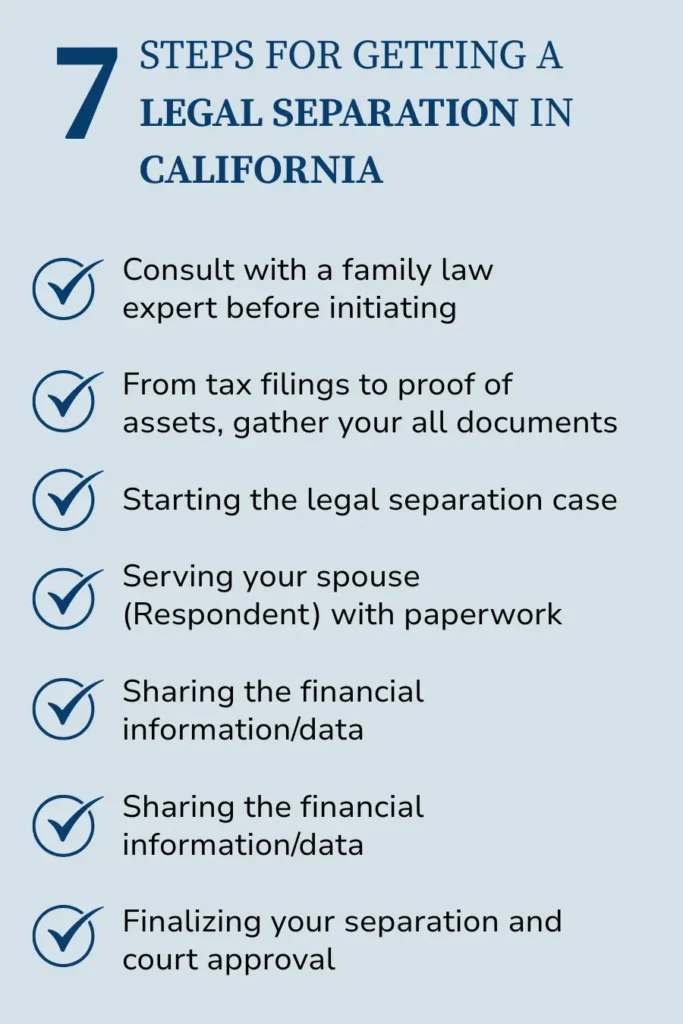
Following are the 7 “how to” steps in California for obtaining a legal separation judgment.
Before you initiate the legal process, take time to consult your family law expert as to whether a legal separation is the right legal action for your matter.
You can also find an online family law expert if you have a busy schedule. They can best guide you on different legal options while understanding your circumstances.
Gather documents that you may require from filing the petition to getting the final court order.
To begin your legal separation case in California, complete and file your petition with the court.
The Petition informs what action you want the family court to take regarding your marriage. A summons serves the purpose of informing your spouse that specific actions have been taken.
At this stage, you have to pay the court’s filing fee, which is currently between $435 and $450 as of the writing of this blog.
However, request a waiver if you cannot afford to pay the filing fee.
Following legal forms may be required to start the case,
After filing the Petition, the Petitioner serves their spouse, Respondent, with the necessary paperwork.
You can ask a server to deliver documents to the other spouse. You have to make sure that your spouse has received copies of your filed forms properly to complete service. Check out our other blogs and videos about serving documents. Respondent has 30 days to respond to Petitioner’s Petition once received.
The Respondent can agree or disagree with the terms stated in the Petition or suggest other arrangements accordingly. The following forms may be required at this stage:
To proceed with financial information sharing, you may require these forms.
You share financial disclosures with your spouse to settle financial issues and make decisions regarding child custody, child support, and parenting plans.
You also file the FL-141 (Declaration Regarding Service of Declaration of Disclosure) with the court at this step
At this stage, couples negotiate on essential terms of separation (including but not limited to marital property division and assets, spousal support, and child custody) and draft a legal separation agreement, which the court requires to finalize your separation. Some spouses may not agree on separation terms requiring a mediator.
If both parties agree on terms of separation, they will submit it to court for approval.
The court does not review the “fairness” of the agreement, but whether legal requirements were completed. If everything has been done properly, the court will grant separation judgment.
After a judge signs the final document, the clerk will file form FL-190 (Notice of Entry of Judgement) confirming that separation is final and mail that to you and your spouse.
You must provide these forms and the envelope for mailing with your legal separation judgment packet.
On the other hand, if both parties don’t agree on issues, both spouses may have to go to trial.
In California and nationally, in the United states the actual cost and timeline of legal separation depends upon how you do it. Whether you mediate or litigate or choose between contested or uncontested options.
Likewise, case complexity, court backlogs, attorney mediator’s expertise, and collaboration can impact the timelines and cost. That’s why high net worth cases costs more and take longer than average time. However, knowing their dos’s and dont’s could significantly reduce financial cost.
|
Route
|
Cost
|
Timeline
|
Best Suited To
|
||||||||
|---|---|---|---|---|---|---|---|---|---|---|---|
|
Collaborative Divorce
|
Simple Case
|
Simple Case
|
|
||||||||
|
Legal Separation Mediation
|
Simple Case
|
Simple Case
|
|
||||||||
|
Contested Legal Separation
|
Simple Case
|
Simple Case
|
|
California legal separation is similar to divorce dividing out the couple’s community property, awarding child and spousal support, and ordering child custody. However, the couple is still married.
Legal separation aims to divide the assets, debts, and other properties acquired during the marriage.
Sometimes a couple decides not to divorce. It could be for personal or religious reasons or even for other benefits.
Depending on the health insurance provider, you may be able to keep a legally separated spouse as a dependent of your health insurance. However, in a divorce, this is not the case. You cannot cover your divorced spouse as a dependent of your health insurance.
For social security benefits, you may qualify for spousal benefits even if you divorce.
You will want to discuss your specific case with your family law mediator, attorney or even the Social Security Office.
Couples who think that permanently dissolving marriage is against their religion or belief system can opt for a legal separation option that allows them to stay legally married but have court orders regarding the division of assets, and child custody and support orders.
This allows the couple to abide by their religious, cultural, or personal beliefs.
To file for a divorce in California, you or your spouse must have lived continuously in California for the past six months and at least the past three months in your current California county.
But legal separation neither requires you to meet six months California residency criteria nor three months county residency requirements, which means that you don’t need to be a resident of California before filing for legal separation.
You can start your legal separation filing sooner rather than waiting months. You can then later change it to a divorce, depending on the timing.
However, if you have children, the residential requirements for legal separation may be different. Get a free legal separation consult with ‘Our Family law Experts’ to figure out your next steps. They can help you navigate procedural challenges while optimizing your benefits.
No, California family law does not require individuals to file for legal separation before filing a divorce petition. Also, a legal separation has no residency requirement, unlike divorce.
No, in California, you cannot enter into a second marriage or domestic partnership after a legal separation. To end your first marriage or remarry, you must file for divorce.
Legal separation is not necessarily cheaper than divorce, as both involve the same paperwork, filing procedures, and filing fees.
Whether a legal separation ends up being cheaper or more expensive depends on how you are separating (e.g., contested or uncontested).
Yes, in California, you can convert a legal separation into a divorce at any time, as long as you meet the California residency requirements for divorce. You can even file for divorce while a legal separation judgment is pending or after it has been finalized.